
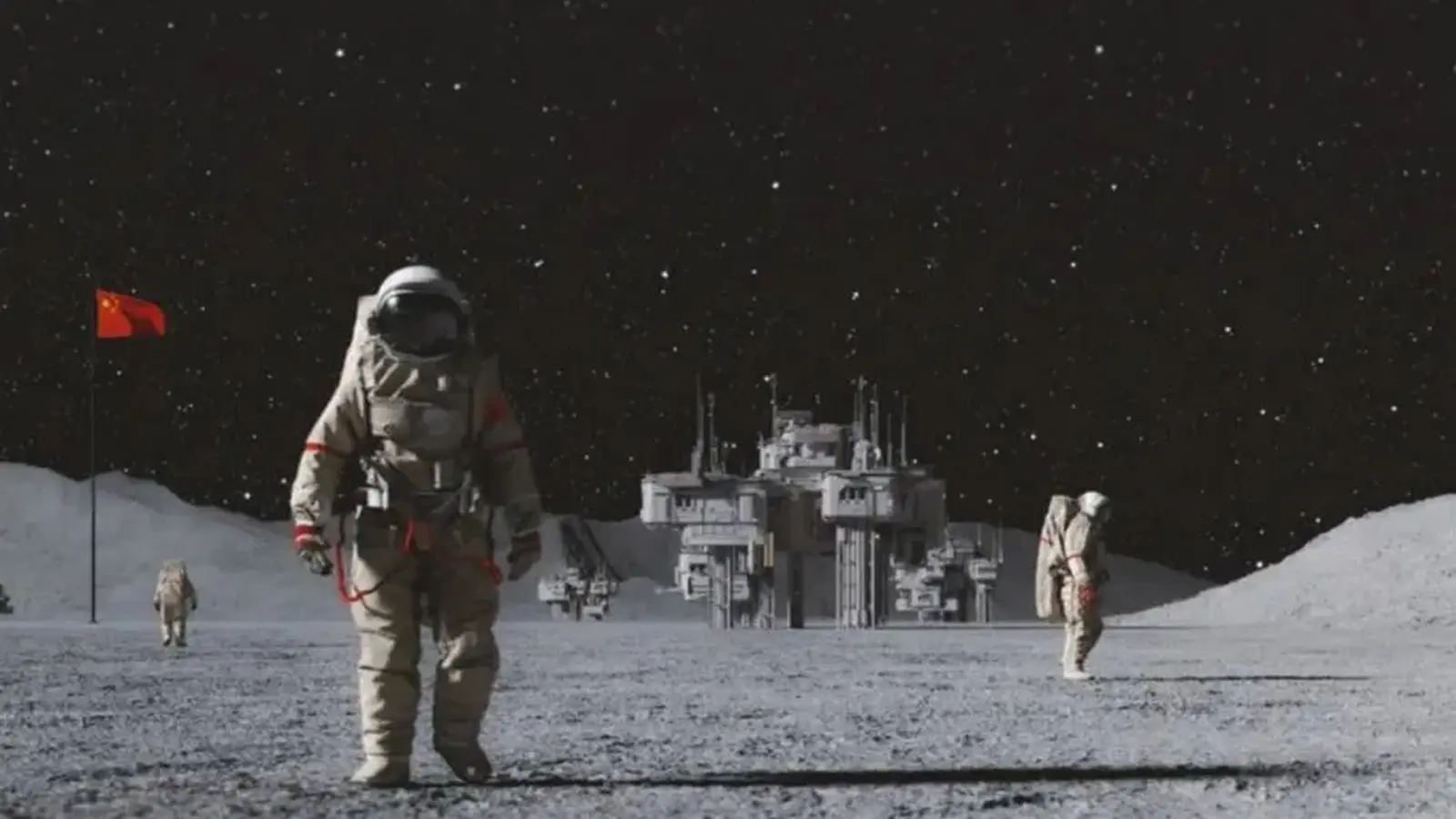
Imagine boots on lunar dust before the decade turns. That is now more than a headline; it is Beijing’s declared objective.
At this year’s conference on crewed spaceflight in Beijing, China’s lead lunar architect, Wang Xiang, laid out the most detailed sequence yet for a crewed Moon landing slated to occur before 2030. The method is deliberately conservative and, in a way, familiar: a lunar-orbit rendezvous. Ships first reach lunar orbit. They dock there. Then the lander drops down to the surface. The pattern echoes Apollo. The hardware and launch profile do not.
The reason is simple. China does not have a Saturn V analogue. So instead of one gargantuan launch, the plan hinges on paired missions and staged assembly in lunar orbit. Two separate Long March 10 flights will carry the pieces—crew capsule Mengzhou on one, the Lanyue lander on the other—so the surface team can descend and return via orbital rendezvous.
China aims to land astronauts on the Moon before 2030 using lunar-orbit rendezvous and dual Long March 10 launches.
The timeline Wang described reads like a mission-control checklist across three years. Early 2027: an uncrewed Long March 10A single-core flight carrying a Mengzhou test vehicle into low Earth orbit. 2028: an uncrewed Long March 10 heavy-lift flight delivering the Lanyue lander to demonstrate a full descent and ascent profile from a simulated lunar surface. 2029: the orbital choreography begins—two simultaneous Long March 10 launches, one with an uncrewed Mengzhou and the other with Lanyue, to execute the lunar-orbit docking. Finally, before 2030, a dual, crewed Long March 10 launch will send astronauts atop Mengzhou for the landing sequence.
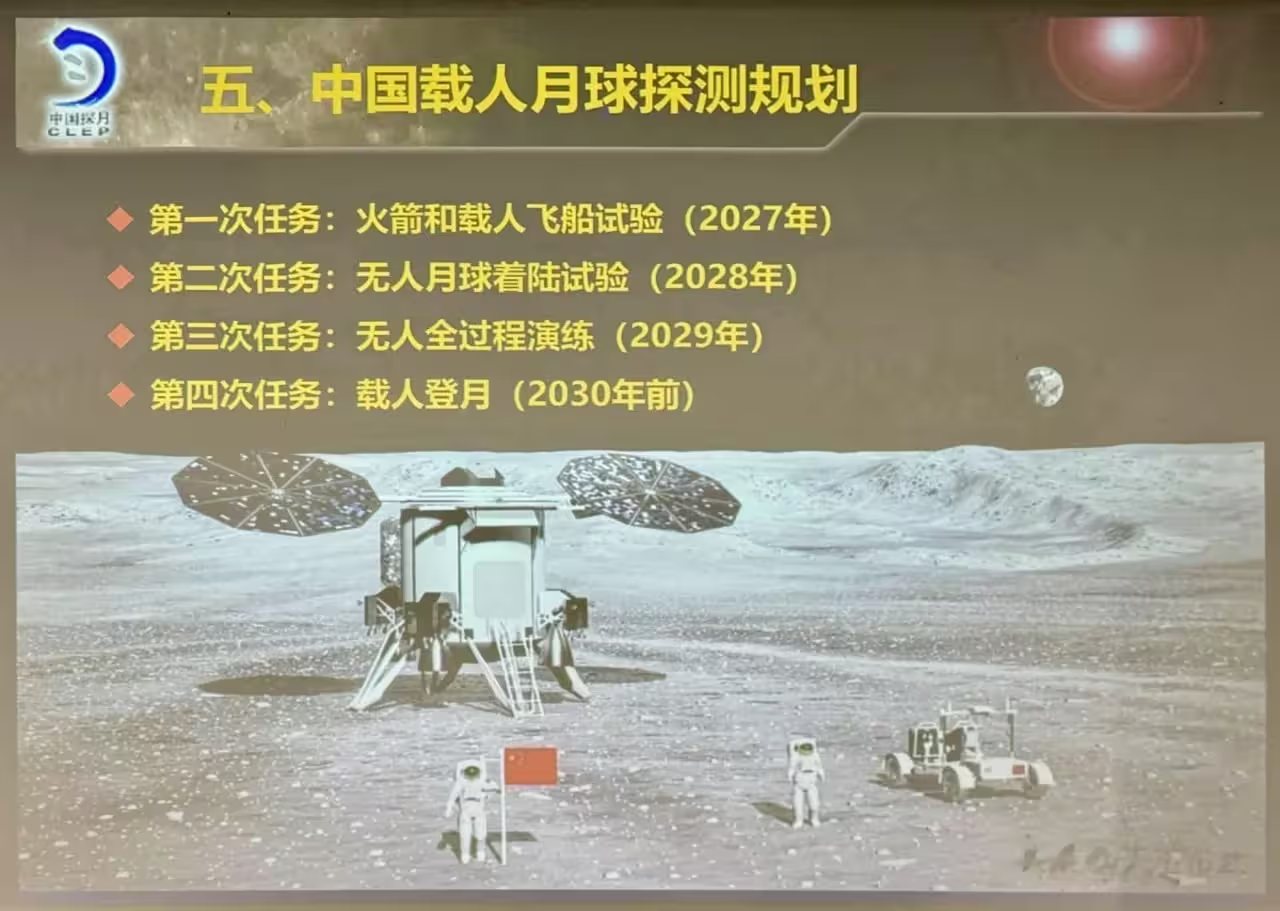
Details remain sparse—China’s program is not an open book—and yet the technical signals are unmistakable. In August 2025, Chinese engineers successfully tested a 26-ton Lanyue lander mock-up with a high-fidelity tether rig that simulated weak lunar gravity. The lander ignited its main engine and fine-control thrusters to touch down on a cratered testbed near Beijing and then lift off again. Meanwhile, the Mengzhou capsule intended for the 2027 flight has already been shipped to the Wenchang launch facility on Hainan Island.
How does this stack up against the American schedule? NASA is targeting a crewed lunar return in 2028 under the Artemis umbrella—roughly a year ahead on paper. Decades of development on the Space Launch System and the Orion capsule give the United States a mature backbone. But the lander side of the equation is less settled: multibillion-dollar contracts to private companies create schedule and technical risks that could push a crewed American landing toward 2030 or later.
That uncertainty in Washington has rippled through policy circles. U.S. legislators and the White House have pressed NASA’s leadership to speed Artemis, reshuffling priorities and canceling some previously planned elements to concentrate resources on a timely crewed landing. New collaborations with industry are being proposed to firm up lunar lander development and to bolster Orion’s capacity for sustained lunar-orbit operations.
So the race is not only about rockets. It’s a test of logistics, of industrial depth, and of political will. Will paired launches and orbital assembly prove a robust alternative to single-launch architectures? Can rapid prototyping and high-fidelity ground tests bridge the transparency gap? The answer will unfold over a handful of launches, some daring docking maneuvers, and the quiet moment when a human steps from a lander into shadow and light on the Moon’s surface.
Watch the launch manifests. Watch the orbit tracks. The next few years will tell whether these plans are bold ambition or the first steps of a new lunar era.


Leave a Comment
Comments
No comments yet. Be the first.