
3 Minutes
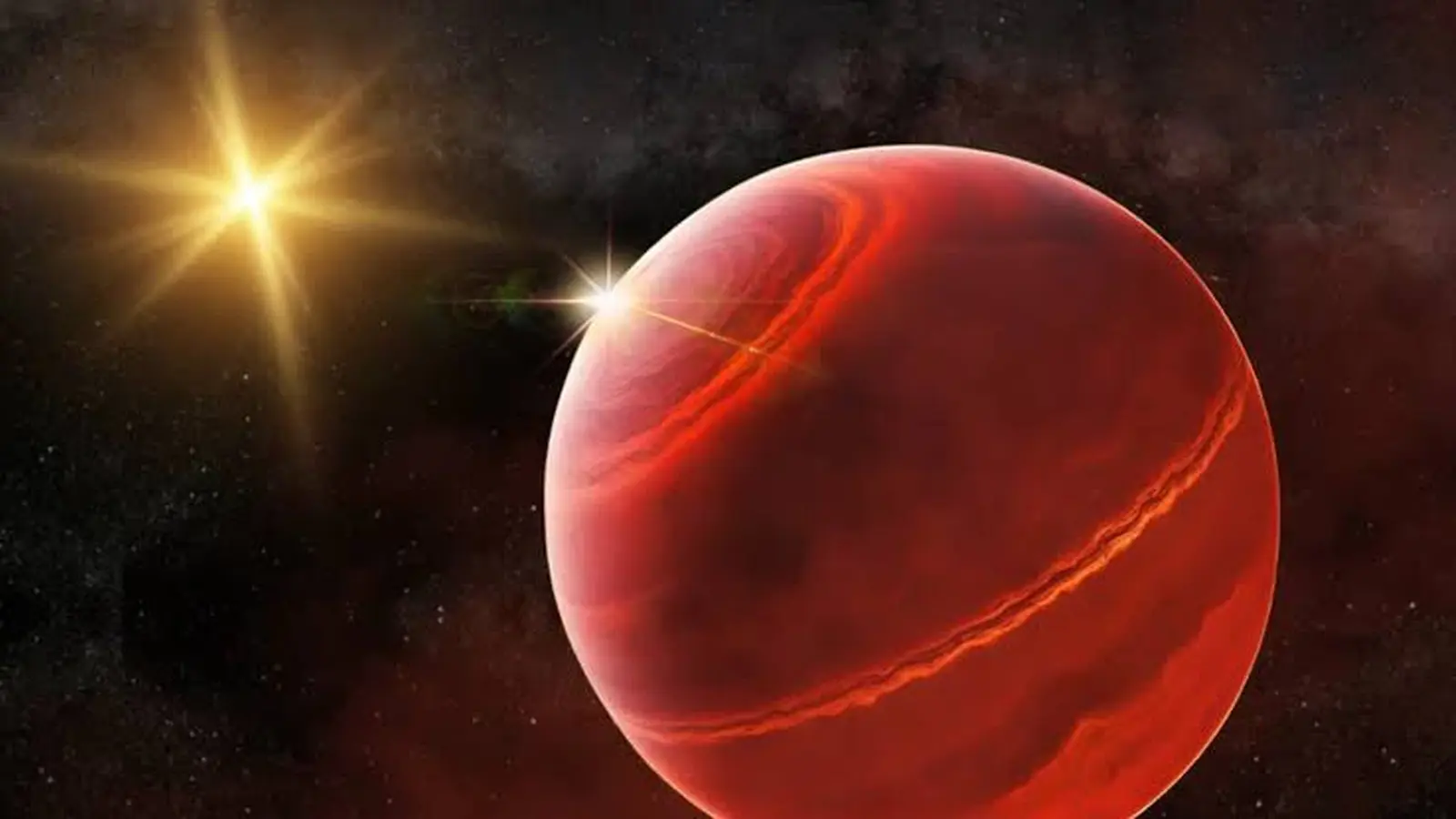
Imagine a world the size of Saturn, bathing in warmth that's closer to a scorching car interior than the frozen depths of our outer Solar System. That's TOI-199b: an exo-Saturn that refuses to fit the usual categories.
Discovered more than 330 light-years away, TOI-199b completes an orbit in roughly 100 days. Its days are hot—about 175 degrees Fahrenheit—but not blistering like the infamous hot Jupiters that hug their stars. Instead, this planet sits in a middle ground, a temperate giant where chemistry behaves differently and the atmosphere keeps secrets scientists are only just beginning to read.
How did astronomers pry those secrets loose? With the James Webb Space Telescope and a technique called transmission spectroscopy. When TOI-199b drifted across its star, JWST watched the star’s light filter through the planet’s gaseous veil. Molecules left fingerprints on specific wavelengths. The spectrum told a story.
The headline: methane. The spectrum shows clear absorption features that match methane’s signature. There are also tantalizing hints of ammonia and carbon dioxide, though those require more observations to be confirmed. Detection of methane on a giant planet with relatively mild temperatures aligns with long-standing theoretical predictions—but seeing the prediction in the data is always a thrill.

This is the first detailed atmospheric study of a temperate gas giant, revealing methane and opening a window on planet formation and atmospheric chemistry beyond our Solar System.
The team behind the discovery, led by astronomers at Penn State and NASA’s Jet Propulsion Laboratory, spent about 20 straight hours measuring the star to build a solid baseline, then recorded a seven-hour transit. Long observations like these are a luxury compared with the short, high-temperature transits common for hot Jupiters, and they were crucial for teasing out the subtle spectral clues in a cooler atmosphere.
Why does this matter? Temperate giants are rare finds. Most known gas giants either orbit far from their stars and remain frigid, like our own Jupiter and Saturn, or they circle too close and become torrid. TOI-199b occupies a 'Goldilocks' zone for giant planets—warm enough to host active chemistry but cool enough that complex molecules like methane can persist. That makes it an ideal laboratory to test models of atmospheric evolution and planet formation.
The implications reach beyond one exotic world. By comparing atmospheres across a variety of planets, scientists refine the models that explain how planets acquire and lose gases, how their interiors and atmospheres interact, and how conditions might evolve over billions of years. The composition of TOI-199b's atmosphere could help calibrate those models and point to processes that also shaped Earth’s early atmosphere.
Lead authors and co-investigators—from institutions including Penn State, JPL, Arizona State, Johns Hopkins, Caltech, and others—published their results in The Astronomical Journal in May 2026. Funding came through grants managed by the Space Telescope Science Institute, underlining the collaborative nature of modern exoplanet science.
TOI-199b raises as many questions as it answers. Is its methane primordial or generated by internal processes? Are ammonia and CO2 truly present, and in what proportions? The next step is clear: more telescope time, broader wavelength coverage, and careful comparisons with other temperate giants as they are discovered. The universe is offering a new kind of laboratory. Will we learn to read it?


Leave a Comment
Comments
No comments yet. Be the first.