
4 Minutes
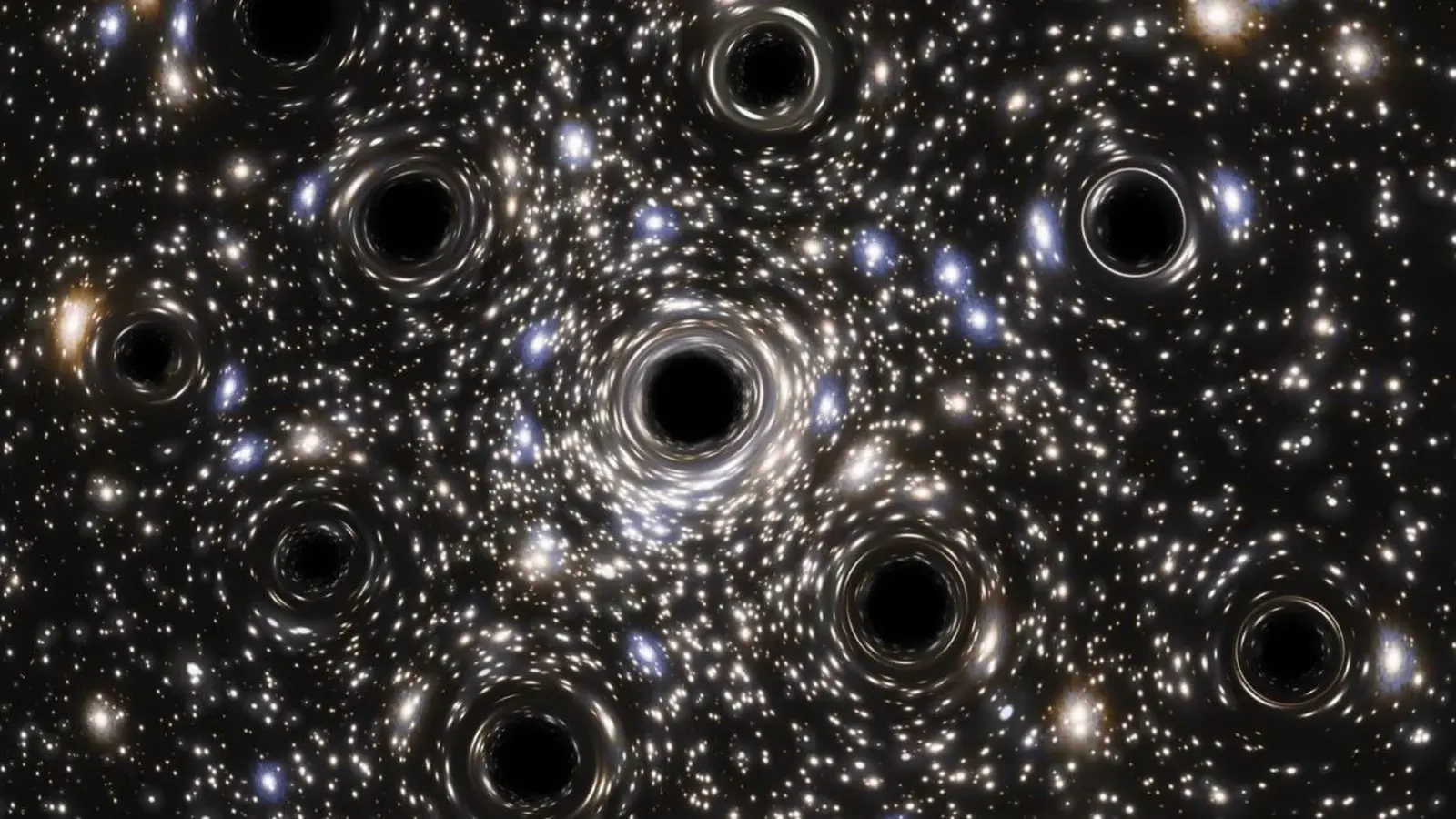
Imagine finding a skyscraper standing alone on a vacant lot, built before the neighborhood that should surround it. That odd image is startlingly close to what astronomers have stumbled upon: a supermassive black hole that appears to have grown large before its host galaxy had time to assemble.
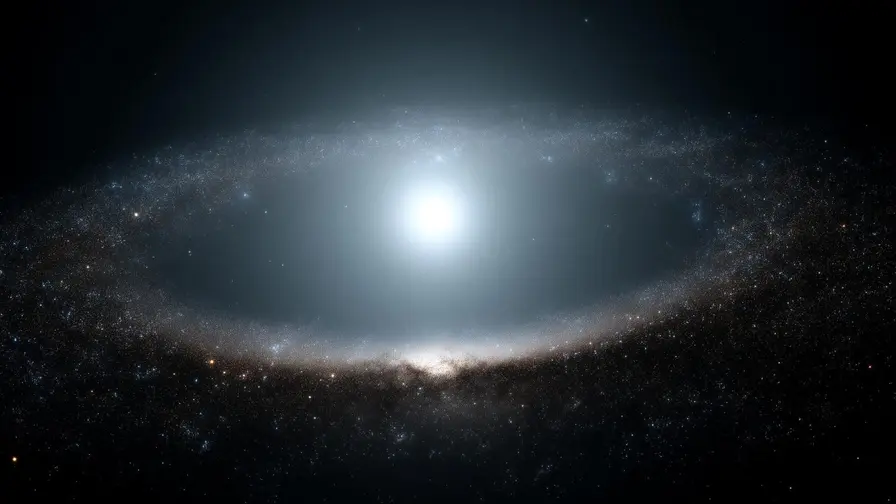
Telescope time on the James Webb Space Telescope turned up Abell2744-QSO1 — a so‑called Little Red Dot (LRD) sitting just 700 million years after the Big Bang. Tiny in astronomical terms, the object spans roughly 1,300 light‑years, yet it harbors a black hole far heavier than anyone expected for such an embryonic system.

How did they know? Gravitational lensing does the heavy lifting. The massive galaxy cluster Abell 2744, nicknamed Pandora's Cluster, magnifies and even triples the image of QS01, bringing fine detail into reach. With NIRCam and NIRSpec aboard Webb, researchers could map both the light and the motion of gas around the object — a key diagnostic for weighing the invisible.
Using NIRSpec's integral field unit to trace gas velocities and the fingerprint of elements, the team produced a direct dynamical measurement of the black hole's mass. The black hole clocks in at roughly 50 million solar masses and dominates its tiny host. That’s about 10 million more than earlier, indirect estimates suggested.
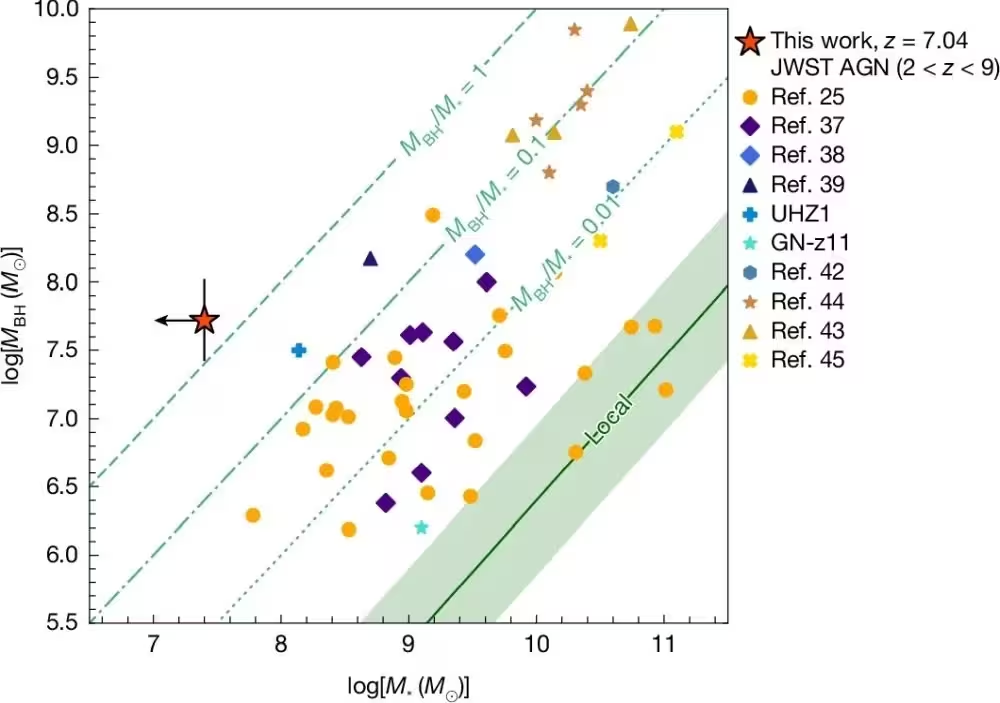
There’s more than a headline number at stake. The measured ratio between the black hole mass and the galaxy’s stellar mass sits wildly above the scaling relations we observe in the nearby Universe. In other words, the black hole is disproportionately massive for the galaxy around it — by nearly an order of magnitude compared with local examples and even past JWST finds.

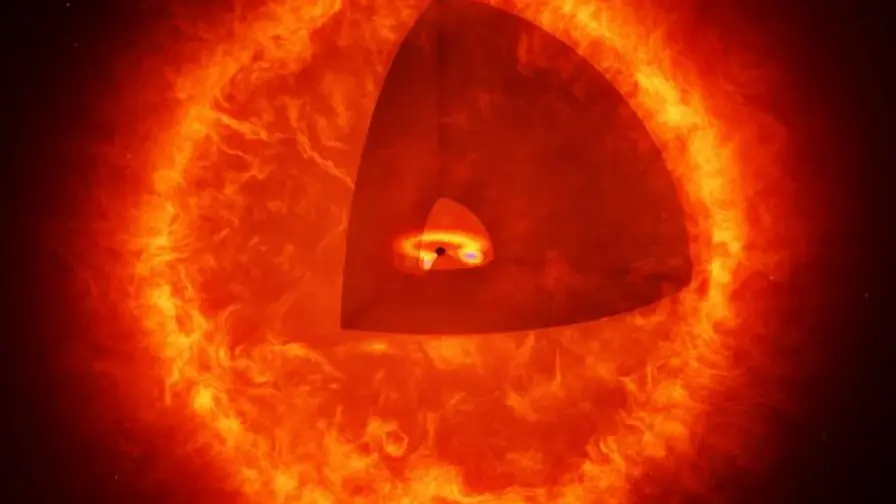
That imbalance forces a rethink. For decades, the prevailing picture held that supermassive black holes grow in step with their galaxies: small seeds from collapsing stars or direct collapse pockets accrete gas, merge with other black holes as galaxies collide, and gradually build up the billion‑sun behemoths we see in mature galaxies. QS01 looks like a counterexample. Its black hole seems to have sprinted ahead of the host rather than grown in lockstep.
The discovery is described in two companion papers led by teams at the Kavli Institute for Cosmology, Cambridge. One, in Nature, reports the direct mass measurement and is led by Ignas Juodžbalis. The other, in Monthly Notices of the Royal Astronomical Society, led by Roberto Maiolino, examines the environment and chemical youth of the system. Many authors overlap between the studies; the picture they paint is consistent and unsettling.
“This is a remarkable finding,” Maiolino told the press. “It’s a paradigm shift, a total revisiting of the classical scenarios of how black holes form and grow.” The system appears chemically unevolved, which only deepens the puzzle: how did such a massive black hole assemble inside a near‑pristine galaxy so early on?
Part of the breakthrough is methodological. Before Webb, mass estimates for black holes in the early Universe were typically indirect, relying on assumptions borrowed from nearby active galaxies. Here, the team measured the gravitational imprint directly on surrounding gas — a more robust approach that removes some of those assumptions and raises confidence that the large mass is real.
Does this single object overturn black hole theory? Not by itself. But QS01 joins a growing pattern of early‑Universe discoveries that challenge tidy, hierarchical growth models. The result widens the door to alternative formation channels: rapid, direct collapse of massive gas clouds; super‑Eddington accretion episodes that feed a black hole at blistering rates; or exotic, rare conditions in the first few hundred million years that favor early, accelerated black hole growth.
A healthy skepticism is in order, of course. Observational quirks, lensing models, and assumptions about the galaxy’s unseen stellar mass complicate any single measurement. Yet when independent teams and different instruments point to the same oddity, the anomaly deserves scrutiny.
For now, Abell2744‑QSO1 stands as one of the most direct measurements of a massive black hole within the first billion years after the Big Bang. It nudges a hole in our standard narrative and forces theorists back to the drawing board. The early Universe, it seems, still has tricks left to reveal.
As Webb continues to probe deeper and lensing clusters keep amplifying the faintest objects, more cases like QS01 may turn up — or they may remain rare, exotic exceptions that illuminate unusual pathways of cosmic growth. Either way, the hunt is on.

Leave a Comment
Comments (2)
whoa that skyscraper-on-a-lot image really hits — if that's real then textbooks need a rewrite, wow. kinda thrilling, kinda uneasy
Hold up, a 50M sun black hole in a 1,300 ly baby galaxy? Lensing and mass models can fool ya, right? Skeptical but curious...