

3 Minutes
Imagine taking a pill for high blood pressure and finding, years later in the lab, that it quietly nudges cells toward a longer life. Strange, yes. But that is exactly what researchers have begun to see with rilmenidine — a drug already prescribed for hypertension that, in animals, mimics the cellular signatures of calorie restriction and extends lifespan.
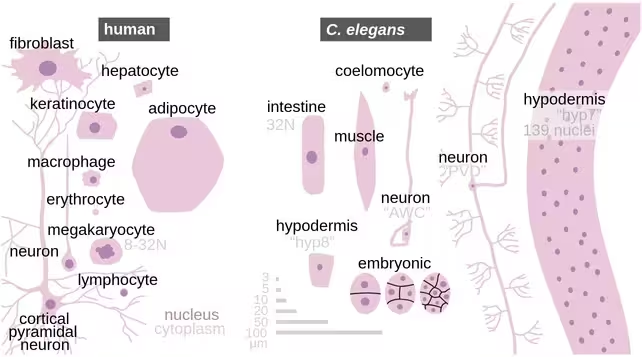
Work with the tiny roundworm Caenorhabditis elegans showed the first clear hint: worms given rilmenidine lived longer and looked healthier on a handful of common measures. The effect echoed what scientists expect when organisms eat less yet maintain essential nutrients — the celebrated calorie-restriction phenomenon that boosts longevity across many species. It’s a mimic rather than a miracle. But mimics can be useful.
Why worms? They are simple, yes, but efficient. Many of their genes have recognizable cousins in mammals, so they’re a quick way to test whether a chemical nudges aging pathways in the right direction. After the worm experiments came mouse tissue studies, and there too the fingerprints of caloric restriction showed up in kidney and liver gene activity after rilmenidine treatment. The same molecular pathways that respond to limited energy availability were flipping on.
One key player turned out to be a receptor called nish-1. Remove that receptor and rilmenidine’s lifespan benefits vanish. Put it back, and the benefits return. That kind of genetic dependency is exactly the sort of proof biogerontologists look for when they want to know whether an effect is real or just noise.
"For the first time, we have been able to show in animals that rilmenidine can increase lifespan," said molecular biogerontologist João Pedro Magalhães of the University of Birmingham, one of the scientists involved. The remark underlines two things at once: the result is novel, and it’s preliminary. Worms and mice are informative, but they’re not humans.
Practically speaking, rilmenidine is an appealing candidate for repurposing. It’s taken orally. It’s prescribed already. Side effects exist — palpitations, insomnia, drowsiness in a small number of people — but they are generally mild compared with the risks of experimental compounds that have never been used in patients. That lowers the bar for future trials looking at whether the drug can safely reproduce those anti-aging signals in people.

Still, caution is due. Calorie restriction in humans can cause real problems: hair thinning, dizziness, brittle bones. Scientists are asking whether drugs that act like calorie restriction — so-called calorie restriction mimetics — can deliver benefits without the harms of extreme dieting. Rilmenidine ticks some boxes, but questions remain about long-term effects and what ‘benefit’ will mean for different age groups and health backgrounds.
Rilmenidine is not the only familiar medication being eyed for longevity. Observational studies involving metformin, a common diabetes drug, have suggested reduced mortality and better odds of reaching advanced age for some patients — though such analyses can’t prove cause and effect. They do, however, add to a growing interest in repurposing safe, well-understood medicines as tools to extend healthspan rather than simply treating disease.
So what’s next? More animal work. More mechanistic studies to map exactly how rilmenidine alters cellular metabolism. And then carefully designed human trials that test endpoints relevant to aging: not just whether people live longer, but whether they stay healthier, more mobile and less frail.
Science rarely hands out easy answers. Yet the possibility that a widely available blood pressure drug could be nudged into a new role — helping to slow the march of age while avoiding the costs of extreme dieting — is precisely the kind of practical, optimistic proposition that drives translational geroscience forward.


Leave a Comment
Comments
No comments yet. Be the first.