
5 Minutes
NASA's X-59 breaks the sound barrier — quietly
On June 5, 2026, NASA's experimental X-59 Quiet Supersonic Technology (QueSST) aircraft flew faster than the speed of sound for the first time, reaching Mach 1.1 (about 713 mph / 1,358 kph) at 43,400 feet (13,228 meters). The milestone flight, piloted by Jim 'Clue' Less from Edwards Air Force Base, marks a major step toward the agency's long-running goal: enabling supersonic travel over land without the disruptive sonic booms that led governments to ban such flights decades ago.
Why this matters to the transport and automotive-minded reader
The X-59 isn't just an aviation experiment — it's a study in noise, aerodynamics, and design that has parallels with the auto industry. Engineers describe the program's aim as producing a sonic signature as faint as the closing of a car door. That phrase resonates with anyone who follows vehicle NVH (noise, vibration, harshness) development, lightweight materials, or aerodynamic optimization for fuel efficiency and performance.

From test program to real-world implications
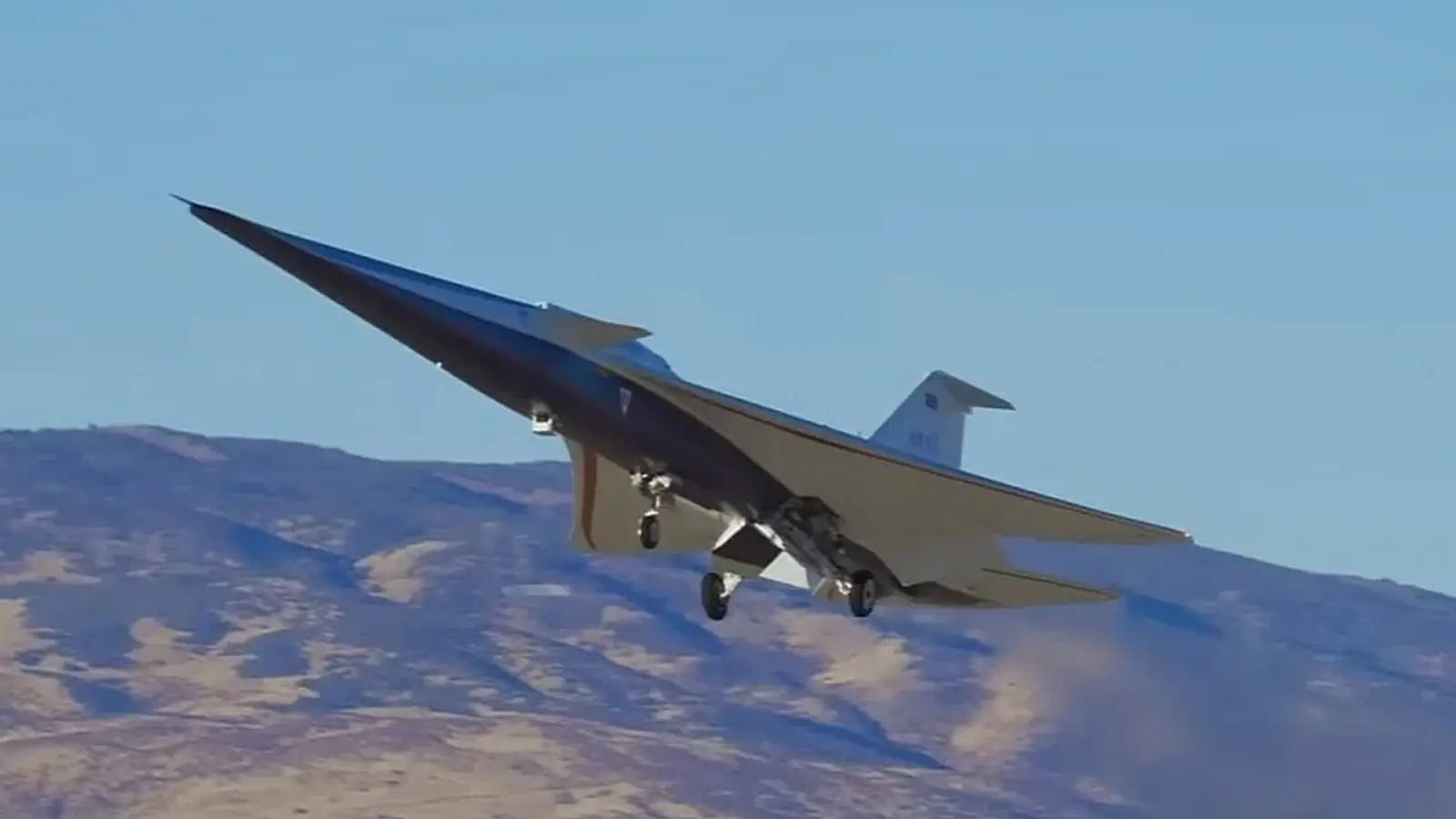
QueSST began in 2016 as a collaboration between NASA and Lockheed Martin's Skunk Works to prove that aircraft can be shaped so shock waves don't merge into the disruptive booms historically associated with supersonic flight. The prototype's unusual profile — long, arrow-like fuselage lines, a non-traditional forward cockpit with no forward-facing windows, and a GE Aviation powerplant mounted on the rear fuselage — is all about controlling aerodynamics and shock-wave dispersion.
The X-59 first appeared publicly in 2024 and took its inaugural ferry flight in October 2025, moving from Plant 42 in Palmdale to NASA Armstrong at Edwards. Early sorties climbed to around 12,000 ft and hit roughly 230 mph, but engineers slowly pushed the envelope across a carefully staged flight test campaign. After 16 subsonic test flights, the program achieved its first supersonic signature.

Flight details and immediate outcomes
The Mach 1.1 flight lasted 81 minutes, began at 11:08 a.m. PDT, and included a chase F-15 that unintentionally demonstrated a practical point: on this mission, the louder sonic booms from the F-15 masked any noise from the X-59. NASA says the flight was used to evaluate flying qualities across the transonic regime and to begin validating the quiet-boom shaping concepts under real atmospheric conditions.
Key flight data and next steps:
- Date: June 5, 2026
- Pilot: Jim 'Clue' Less
- Maximum altitude: 43,400 ft (13,228 m)
- Maximum speed: Mach 1.1 (713 mph / 1,358 kph)
- Duration: 81 minutes
- Chase aircraft: F-15 (pilot unnamed)

After a rapid data review, NASA plans to push the X-59 to higher envelope points within days, targeting Mach 1.4 (approximately 925 mph / 1,489 kph) and a program ceiling near 55,000 ft (16,764 m). Multiple repeated runs at these conditions will be needed before moving to the program's ultimate objective: overflight of populated areas to document human perception and measured sound levels of significantly reduced sonic events.
Design, performance and automotive parallels

The X-59's design philosophy has clear analogues to modern automotive engineering. Where car designers chase low drag, predictable handling, and minimal cabin noise, the X-59’s long nose and sculpted surfaces are about managing pressure gradients and shock formation to shape how sound propagates. Materials, composite construction, and precisely tuned engine placement all matter — much like packaging a performance powertrain to balance center of gravity and NVH in sports and luxury cars.
For car enthusiasts, the notable crossovers include:
- Aerodynamics: Both cars and supersonic aircraft rely on surface shaping to control airflow and reduce drag.
- NVH engineering: The concept of masking or reducing perceived sound is central to both industries.
- Powerplant packaging: Engine placement affects balance, noise transmission, and structural design.

Market and regulatory ripple effects
A quiet supersonic transport over land would be transformative for long-haul mobility. For the airline market it could mean drastically reduced point-to-point travel times and new premium service segments. Regulators will be cautious — NASA’s role is not to produce a commercial airliner but to provide rigorously gathered data so industry and policy-makers can consider new noise standards and certify designs.
Legacy airframers currently do not appear to have active supersonic passenger projects on the same scale as certain startups. Micro- and mid-sized companies, however, are already positioning themselves for a potential return of supersonic service:
- Boom Supersonic: Overture
- Spike Aerospace: S-512 Diplomat
- Venus Aerospace: Stargazer
(Several other projects have stalled or been cancelled.) If NASA’s data shows consistent quietness at regulatory altitudes and speeds, those startups could use the insights to de-risk development and speed market entry.
What to watch next
NASA will keep expanding the flight envelope and then perform community overflights to directly measure human responses. Those perception studies are crucial: technical quiet signatures have to translate into public acceptance before international flight rules change. Expect the next visible milestones to be:
- Reaching Mach 1.4 and 55,000 ft
- Multiple high-speed repeat flights to validate results
- Controlled overflights of populated corridors for perception studies
"If the X-59 proves reliably quiet in real-world conditions, it changes the conversation about supersonic transport over land," one aerospace analyst commented. For automotive and transport markets, the trickle-down could include new materials, simulation techniques, and NVH strategies borrowed from aerospace research.
Bottom line
The X-59’s first supersonic flight is a technical victory with broad implications. While consumers won't be booking Mach 1.4 transcontinental flights next year, the program is a crucial step toward regulatory change and new aircraft concepts. For engineers and enthusiasts who follow automotive performance and design, the project is also a reminder: advances in aerodynamics, noise control, and lightweight construction often cross industry boundaries, accelerating innovation in both sky and road.

Expect incremental but tangible shifts in aircraft and vehicle engineering as NASA's QueSST data enters the public domain — and keep an eye on startups that are ready to translate those lessons into the first generation of truly quiet supersonic transports.

Leave a Comment
Comments (2)
Is that F-15 masking thing for real? if the chase jet hides it how will civilians percieve a "quiet" sonic boom? skeptical but intrigued
wow this actually happened, quiet supersonic? sounds like sci fi but the door-close analogy nails it. curious how airports will react, hope not just hype