
5 Minutes
Imagine a gale so fierce it would shred a planet in seconds. Now multiply that by cosmic scale. That is the kind of violence astronomers have caught coming from a quasar called J2318 — a focused river of gas racing outward at nearly a third of light speed.
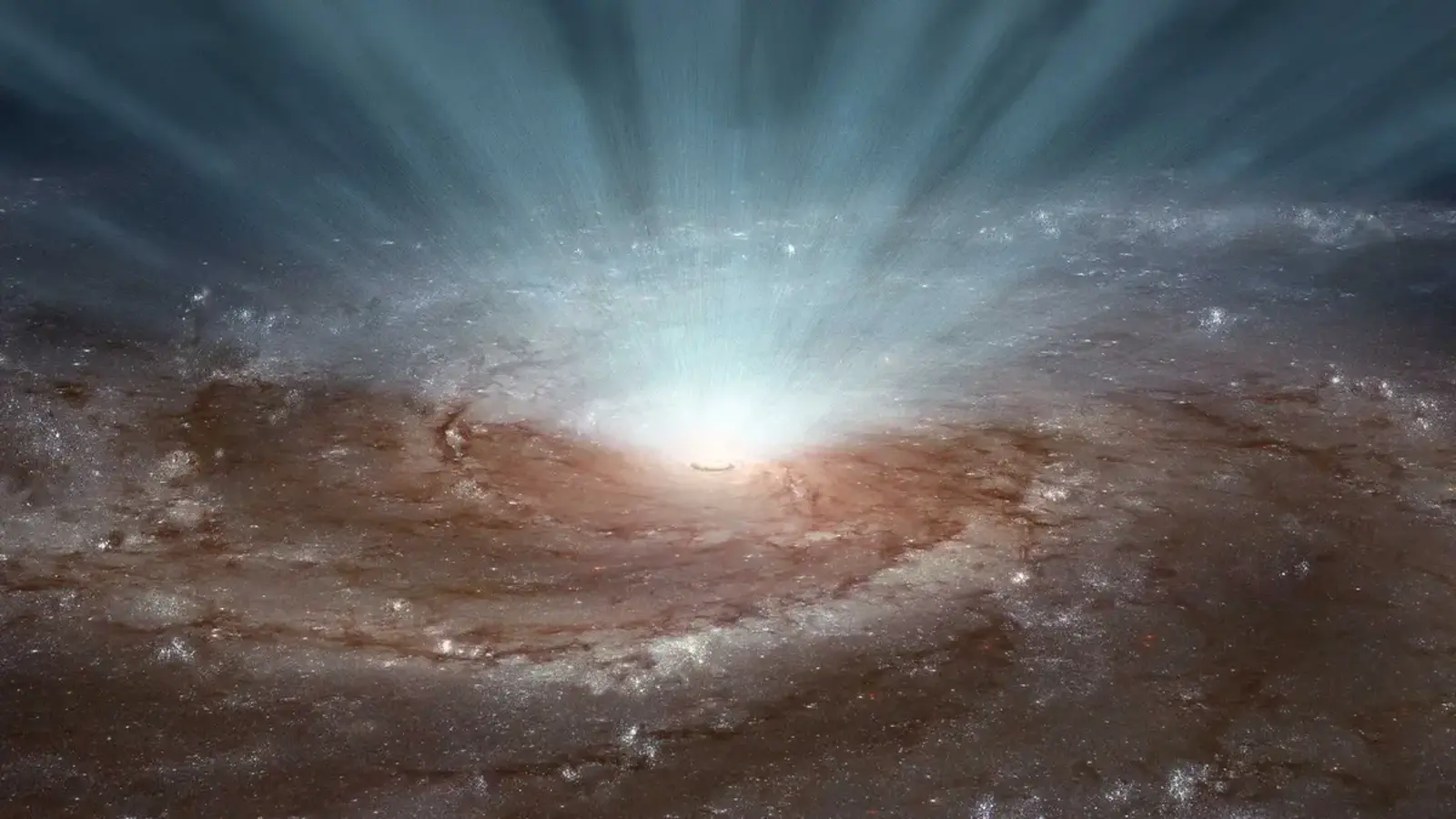
The source is a supermassive black hole tipping the scales at roughly 1.7 billion suns. Around it, a luminous accretion disk feeds the beast, while torrents of material are launched into space. In ultraviolet light, this outflow sets a new record: the fastest UV quasar wind ever seen, clocked at about 0.3c.
Short sentence. Big implication. How can gas stay visible when it is bathed in the black hole's own blinding radiation? Photons that accelerate the flow should also strip electrons, erasing the spectral fingerprints astronomers rely on. And yet, in J2318, carbon and silicon ions survive in the blast.
That puzzle is the heart of the discovery. It was first flagged in archival spectra from the Sloan Digital Sky Survey by an undergraduate with an eye for the odd. Graduate student Marianna Veltri noticed the unusual signatures, and with tools developed by undergraduate researcher Zezhou Zhu the team dug deeper. Follow-up observations with the Frederick C. Gillett Gemini Telescope in Hawai'i confirmed what the SDSS spectrum hinted at: a truly extreme ultraviolet outflow.

Lead researchers from York University describe a wind unlike anything we experience on Earth. Lucas Seaton likened its speed to a hurricane rating that makes our planet’s storms look leisurely; it is a metaphor meant to convey scale, not an exact analogy. The phenomenon belongs to the quasar family — compact, intensely bright objects powered by matter falling into supermassive black holes. But J2318 pushes the physics to its limits.
This is not just a record-holder for curiosity’s sake; it forces us to rethink how radiation-driven winds operate around the brightest black holes.
Why does that matter beyond the quasar itself? Because such outflows are central to the story of galaxy evolution. Powerful winds can heat and eject gas from a galaxy’s central regions, choking off star formation and redistributing heavy elements over vast distances. In simulations of galaxy growth, this so-called feedback from active galactic nuclei is a crucial ingredient. Observational anchors like J2318 help ground those models in reality.
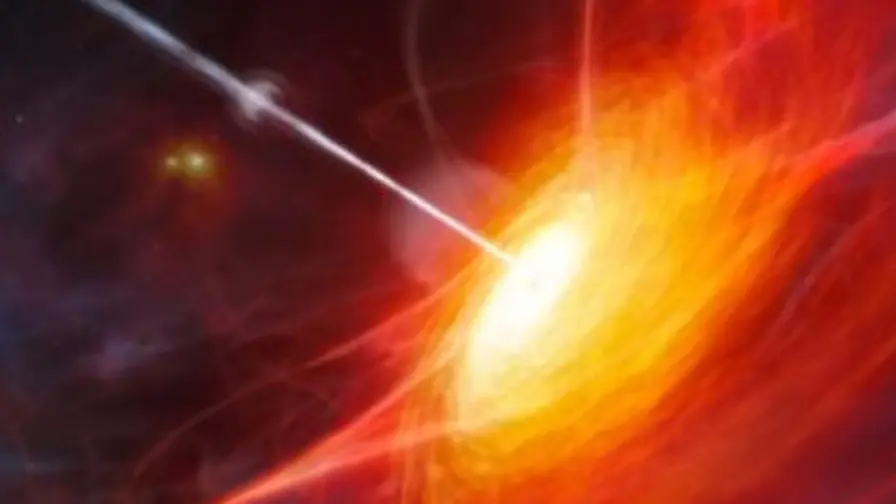
Many previous detections of blistering flows came in X-rays, where even faster components sometimes hide. But seeing such a velocity in ultraviolet light is surprising because the UV signatures demand partially stripped ions — the very species radiation should have obliterated.
So what could preserve those ions in the face of tsunami-like photon pressure? A few ideas are on the table. Dense clumps embedded in a more ionized wind can act as shields, surviving the onslaught long enough to imprint UV lines. Alternatively, the outflow could be highly structured, with regions of differing density and ionization that allow fragile ions to persist. Each possibility leads to different observational predictions, which astronomers hope to test by searching for more examples and by modelling the dynamics in detail.
It helps that the discovery came from a blend of archival treasure and fresh telescope time. The SDSS has been a revolution for stellar and extragalactic spectroscopy; by spreading light into detailed spectra it lets even non-specialists spot anomalies. In this case, the initial clue from SDSS spectra was decisive, and Gemini North supplied the sharper confirmation.
Members of the team emphasize that objects like J2318 are rare. Centuries of telescope time — compressed into decades of surveys — have produced surprisingly few analogues. That rarity makes each detection valuable. It also means that finding a faster ultraviolet outflow, if one exists, will be a needle-in-a-haystack hunt across vast datasets and across wavelengths.
Researchers such as Paola Rodríguez Hidalgo and Liliana Flores highlight the broader stakes: these winds could be the missing observational link between a black hole’s voracious center and the sprawling galaxy it inhabits. The energy carried by extreme outflows is not negligible. It can rework interstellar gas, influence where stars form, and even alter the chemical mix of a galaxy over time. Observing a wind at 30 percent of light speed gives theorists a stringent test — can current feedback prescriptions reproduce such extremes?
There is also an element of human story in this science: undergraduates and early-career researchers played decisive roles in spotting and verifying the phenomenon. It is a reminder that public surveys and open data continue to democratize discovery, putting frontier astrophysics within reach of sharp eyes and clever software alike.
Now the hunt broadens. Teams will comb both nearby systems and the most distant quasars we can see, looking for the spectral breadcrumbs that mark violent winds. New instruments, deeper surveys, and more cross-wavelength follow-up will be needed to build a statistical picture: how common are these UV-speed demons, how do they relate to X-ray components, and what do they ultimately do to their host galaxies.
For now, J2318 stands as a vivid example of how extreme the universe can be — and how much we still have to learn about the interplay between light, matter, and gravity at the centers of galaxies.

Leave a Comment
Comments (2)
Is this even true? UV lines surviving feels odd, maybe X-ray bits hide the nastiest ionization. if that's real then sims gotta catch up fast
Wow, a 0.3c wind?? Mind blown. How do carbon ions survive that tsunami of photons… dense clumps? shielding? this is wild, makes me rethink feedback