
3 Minutes
Imagine a silvered school of fish flashing like a mirror and, somehow, knowing when a light has changed. Strange as it sounds, that may be precisely what some tropical fishes are doing.
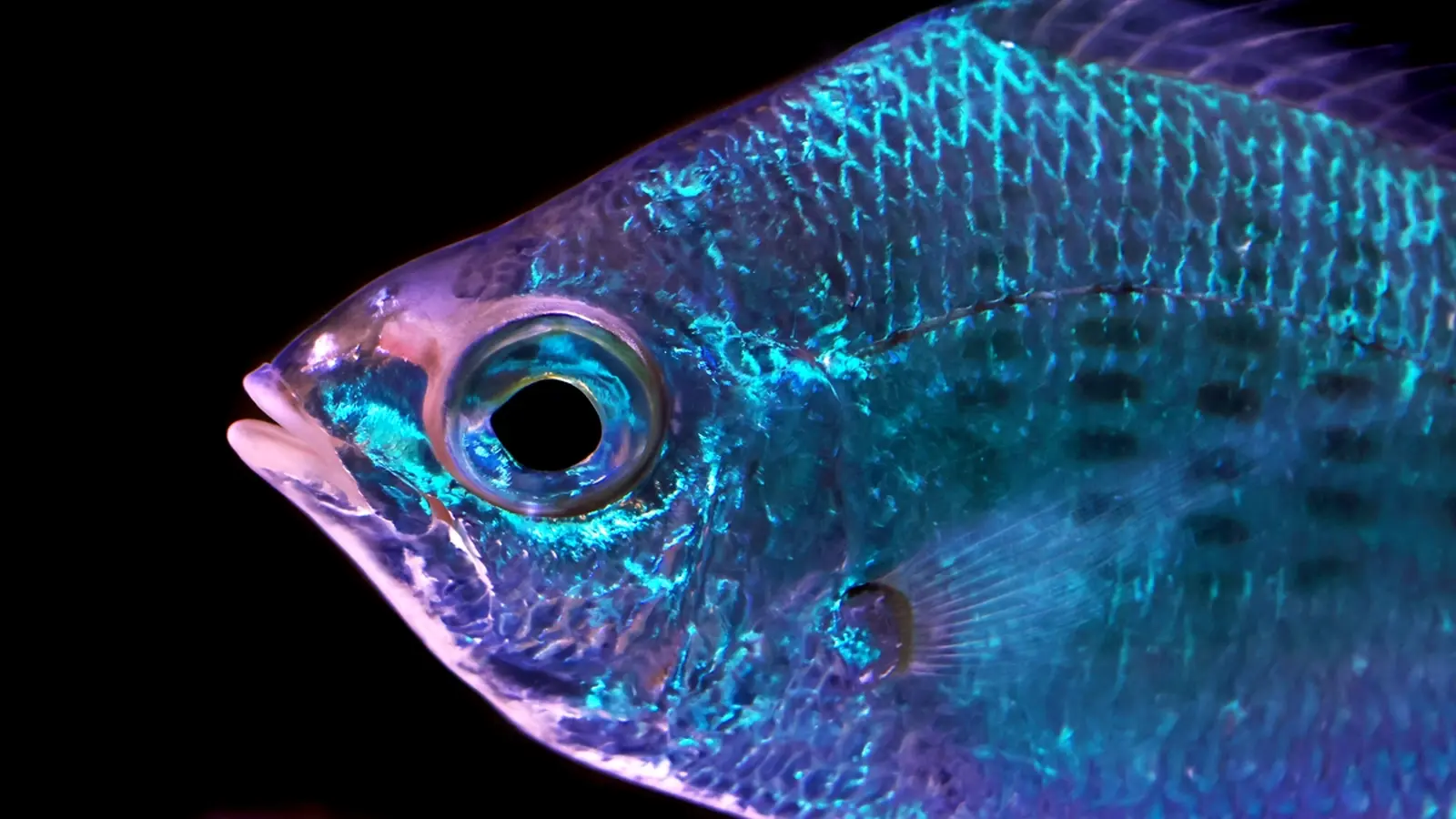
Masakazu Iwasaka, an interdisciplinary engineer at Hiroshima University, has spent years watching how light plays across fish bodies. In a recent preprint, he describes tiny pores and cells in the skin of the cobalt silverside (Hypoatherina tsurugae) that do more than bounce photons—they appear to respond to them.
Unlike pigments, these fish rely on iridophores: skin cells packed with stacks of guanine crystals that reflect and scatter light by structure rather than color molecules. The result is not paint but physics—angles and layers shifting wavelengths to produce that metallic shimmer. But Iwasaka saw something unexpected. Certain patches along the fish's back would flick between three visible modes: persistently bright, rapidly sparkling, and briefly dark. The changes happened even when the fish held perfectly still.

Methods used to inspect the fish's iridophores, as established in an earlier experiment.
He tested 22 wild-caught specimens in aquarium conditions. Some fish were briefly anesthetized so their skins could be examined under a microscope while LEDs and lasers of different colors were swept across them. With a steady white lamp, the reflective patches stayed bright. Cut the direct beam, and many spots went dark almost immediately, then eased back to brightness within seconds. Blue light produced the strongest effect; green and red were far less effective.
The switches were quick. Fast enough, in fact, to make simple physical rearrangements inside cells an unlikely sole explanation. Instead, the pattern points to faster processes—perhaps intrinsic photoreception inside the skin, or even neural input modulating the reflectors. Iwasaka raises opsins, the same light-sensitive proteins that power animal retinas, as plausible actors, though he did not test for them directly in this study.

This is behavior at the intersection of optics and biology: crystals changing how they send light back out, in tune with the environment. Could a fish use that to communicate? To hide? To sense the quality of light in shallow coastal waters? The experiments do not answer function, only reveal possibility.
This work is a preprint posted on bioRxiv and has not yet undergone peer review; its findings should be treated as preliminary.
Whether these shimmering cells are simple reflectors, light detectors, or part of a nervous circuit is a question that will need molecular probes and neurobiology to settle. For now, the glint of a silverside has gained a new intrigue: it might be looking back at the world, in its own crystalline way.


Leave a Comment
Comments
No comments yet. Be the first.