
3 Minutes
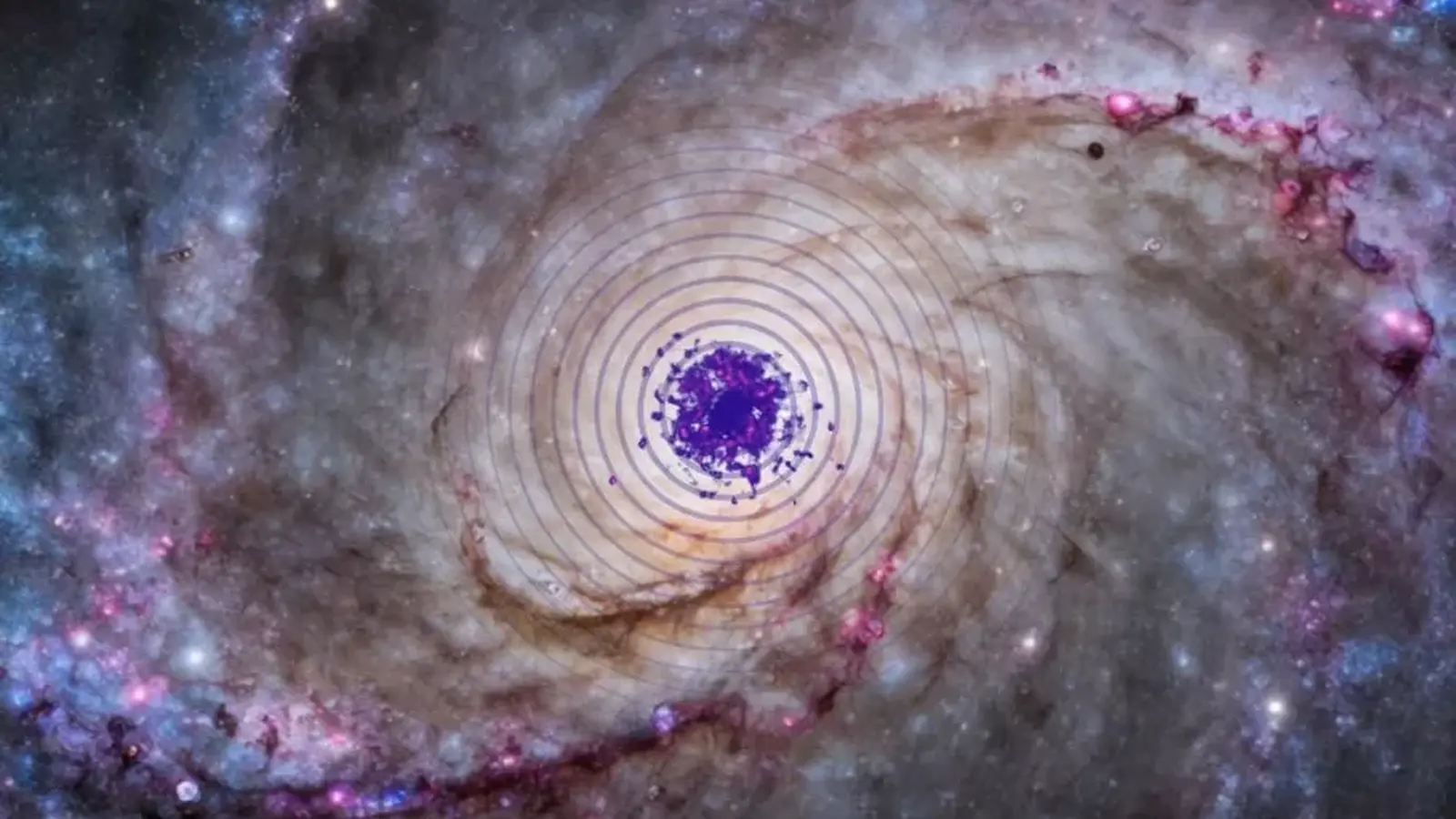
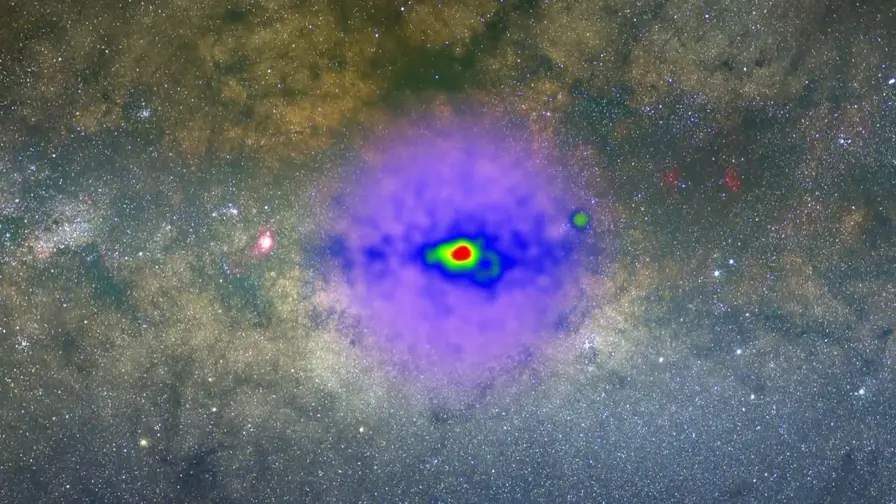
Imagine gamma-ray photons as fingerprints left behind when matter meets its mirror image. They show up at a very specific energy—511 kiloelectronvolts—signaling the annihilation of a positron and an electron. For decades astronomers have been tracing those fingerprints across the Milky Way, trying to pin down where the Galaxy makes its antimatter. The map has never quite added up.
The problem is simple to state and stubborn to solve: we see far more positron annihilation radiation than conventional sources—supernovae, pulsars, black holes, known radioactive isotopes—seem able to produce. Where are all those positrons coming from? And how far do they travel before they meet an electron and vanish in a flash of gamma rays?
New detective work with two decades of observations from ESA's INTEGRAL gamma-ray observatory nudges that puzzle in a startling direction. When researchers stitched together the telescope's full dataset, patterns emerged in unlikely places—signals coming not from the crowded galactic plane but from high above it, linked to large streams of gas moving through the halo.
Two regions stood out. One is Complex C, a vast cloud of hydrogen gas plunging toward the Milky Way. The other traces back to the Magellanic Stream, the long gaseous wake pulled from the Small and Large Magellanic Clouds by tidal forces. Neither cloud is a natural factory of positrons. Yet both show the faint, telltale glow of 511 keV photons.

That combination pushes a different story: positrons are being born inside the Galaxy and then traveling long distances—escaping the disk and lighting up the halo as they finally annihilate. In other words, the Milky Way may be leaking antimatter into its outskirts, not confining annihilation to the crowded central regions where we first noticed the excess.
If this interpretation holds, the Galaxy could be producing roughly two to three times more positrons than previous estimates suggested—an enormous shift in scale for a phenomenon that has frustrated astronomers for decades.
Scientists were careful. They broke the INTEGRAL data into chunks, rebuilt images over different time spans and added up years of observations to see whether the signals persisted. They did. The pattern strengthens as more data are stacked, which argues against instrumental quirks or random noise. Statistically, the detection sits around four sigma: unlikely to be a fluke, but still shy of the five-sigma bar traditionally required for a formal discovery in high-energy astrophysics.

So what could produce so many mobile positrons? Known astrophysical engines certainly contribute, but not enough. Either familiar sources inject positrons with velocities or transport mechanisms we underestimated, allowing them to ride galactic winds and magnetic fields into the halo, or there are missing contributors—perhaps exotic particle physics or unrecognized populations of compact objects.
Answers will hinge on sharper eyes. INTEGRAL's lifetime of data provided the first hint that antimatter can escape the disk. The next act belongs to a new generation of instruments. NASA's planned Compton telescope and spectrometer, slated for launch in 2027, is designed to map faint gamma-ray lines with better sensitivity and will be crucial for confirming the halo signals and measuring their intensity.
The discovery flips a question about location into a broader question about galactic ecology: how particles are born, carried and extinguished across vast volumes of space. The Milky Way is not a closed box. It breathes, and sometimes that breath appears to carry antimatter out into the dark.

Leave a Comment
Comments
No comments yet. Be the first.