
3 Minutes
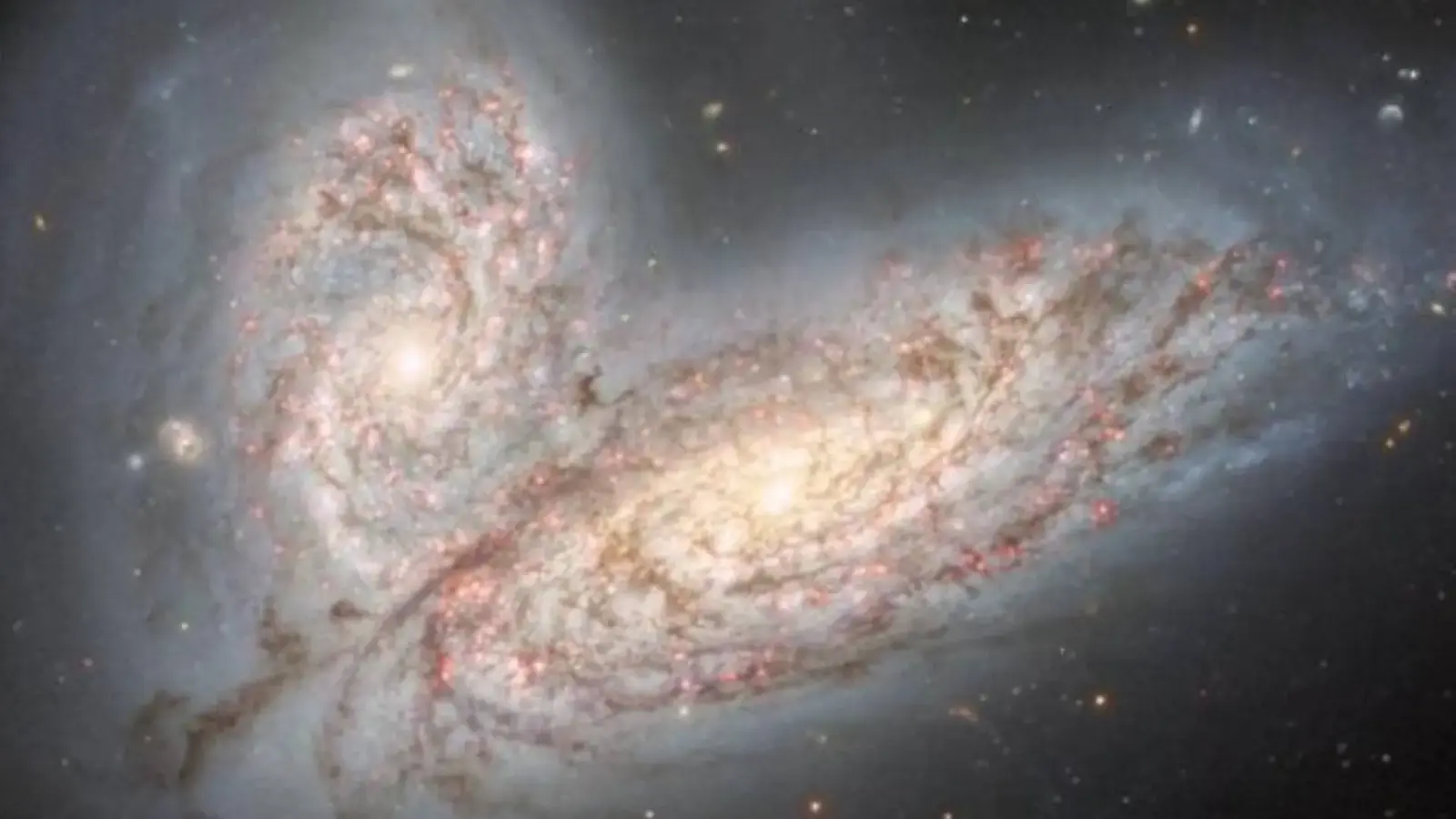
Imagine the Milky Way taking a slow, cosmic pirouette—so slow you could hardly notice in a human lifetime, but dramatic enough to rewrite the Galaxy's memory. That is the image emerging from new simulations: a long-ago encounter with a dwarf galaxy nicknamed Gaia-Enceladus-Sausage may have tipped our galactic disk by more than 90 degrees.
Our galaxy looks ordinary at first glance: a barred spiral with a dense central bulge, sweeping spiral arms embedded in a thin stellar disk, and a sparse, rounded stellar halo. All of it sits inside a vast dark matter halo that dominates the Milky Way's mass. Yet the stellar halo behaves oddly. Using precise motions from ESA's Gaia observatory, astronomers noticed the halo was rotating much more slowly than expected. Why does the halo lag so much?
To answer that, a team led by Kirill Batrakov at Durham University ran detailed cosmological simulations. They wanted to see what kind of histories produce slowly rotating stellar halos in galaxies like ours. The simulations pointed to a striking possibility: a head-on merger that torqued the galactic disk, leaving the halo with a reduced net spin.

The suspect is the well-known Gaia-Enceladus-Sausage merger, an ancient collision in which a dwarf galaxy plunged into the Milky Way. The debris from that event shows up in Gaia data as a sausage-shaped distribution of stars—hence the memorable nickname. Batrakov told IFLScience that two ingredients make a slow halo: the presence of these Gaia-Enceladus-Sausage–like structures and a significant disk reorientation during the merger.
Numbers make the story concrete. The simulations reproduce a stellar halo whose stars rotate at roughly 25 km/s. That sounds fast until you compare it to the Sun's orbital speed around the Galactic center—about 220 km/s. Even more telling: without a disk tilt, the halo's mean rotation in the models would be closer to 50–60 km/s. The encounter, the models suggest, shaved tens of kilometers per second off the halo's angular momentum.
The research team reached these conclusions by tracing the evolution of 25 Milky Way analogues inside the Auriga suite of cosmological simulations. The common thread in the slow-halo cases was a major, angled interaction early in a galaxy's life.
Timing matters. This dramatic reorientation likely happened around 10 billion years ago—long before the Sun or the planets had formed. And it was not an instantaneous smash and catastrophe in the Hollywood sense. These galactic dances play out over hundreds of millions to more than a billion years. A full disk rotation produced by such an encounter could take anywhere from roughly 150 million up to over a billion years, slowly nudging the disk's orientation while leaving the halo to lag behind.
The aftermath also helps explain later features. For example, the central bar of the Milky Way may not have developed until roughly 5 billion years ago, well after the merger, suggesting our Galaxy continued to settle and reshape itself long after that ancient collision.
One intriguing ripple from the study is the apparent link between the stellar halo and the dark matter halo. The results indicate these two components probably evolved together under the influence of repeated mergers, implying that the dark matter halo carries a subtler dynamical memory of past encounters alongside the visible stars.
This collision could have rotated the Milky Way's disk by more than 90 degrees and left the stellar halo unusually sluggish.
If true, the Milky Way still bears the tilted fingerprints of a long-ago visitor—an old, slow-motion encounter whose echoes Gaia and future surveys are only beginning to unravel.


Leave a Comment
Comments
No comments yet. Be the first.