

4 Minutes
Imagine a narrow ribbon of photonic circuitry that can make a beam of light hesitate—on command. It sounds like science fiction, but researchers in Seoul have built a programmable chip that does exactly that: it delays, reshapes, and even shifts the frequency of optical pulses inside a single photonic chip.
Why slow light at all? Because speed is not always the friend of information processing. Light transmits vast amounts of data, yet that very speed complicates tasks that require holding, synchronizing, or routing signals inside optical networks and next-generation computing hardware. Electronic buffers and converters add latency and drain power. A compact, reconfigurable optical buffer would be far cleaner.
Enter a team led by Namkyoo Park and Sunkyu Yu at Seoul National University, with collaborator Xianji Piao at the University of Seoul. They rethought a familiar trick in photonics—coupled-resonator-induced transparency, or CRIT—by adding reconfigurable elements that make the device flexible after fabrication. The result is a programmable photonic integrated circuit that can tune how fast light moves through it and what shape the transmitted signal takes.
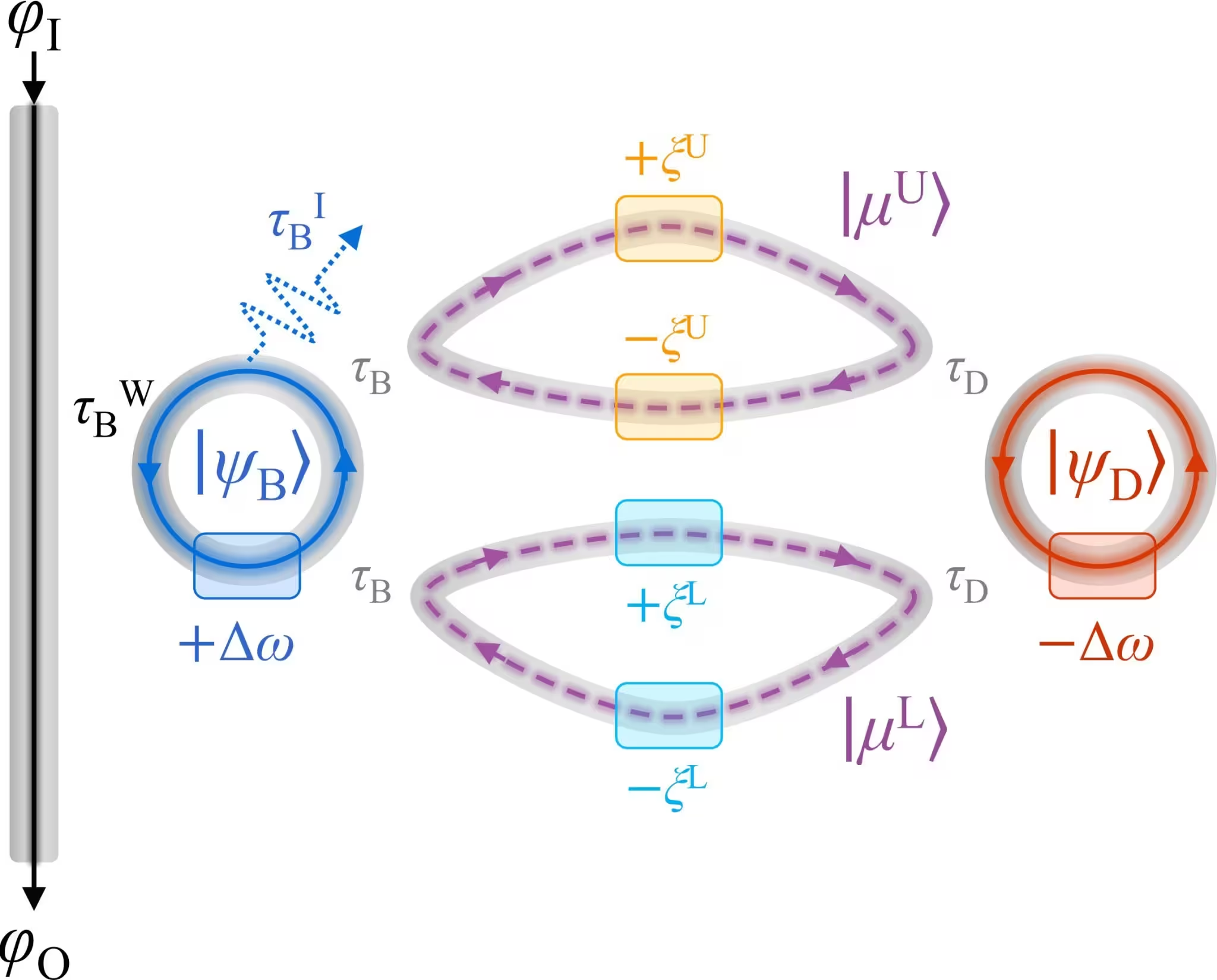
Traditional CRIT relies on interference between two resonant states: a bright mode that couples to an input and a dark mode that does not. Conventionally, those interactions are fixed once the chip is built. The Seoul team treated the bright and dark modes not as separate constraints but as one malleable parameter, then introduced two adjustable loop couplers to the resonator network. The effect is dramatic. Where previous designs offered a single, baked-in delay or frequency window, the new architecture lets engineers dial the passband width, the delay time, and even conversion between frequencies while the circuit is running.

They didn’t stop at circuit diagrams. Rigorous numerical simulations indicate these controls work in realistic conditions. Three-dimensional electromagnetic models show the design is compatible with silicon nitride (Si3N4) photonic platforms—materials already used in many photonic chips. The team also tested the design against the messy realities of fabrication and operation: material loss, mismatched resonator quality, backscattering, imperfect couplings, phase drift in the loops, and thermal crosstalk. The circuit’s performance remained robust under those nonidealities.

Short sentences. Big implications. A single, programmable chip could serve as a variable optical buffer, a timing synchronizer for complex photonic circuits, and a frequency converter—all without adding bulky ancillary components. For data centers and AI servers consuming ever more power, switching certain tasks from electrons to photons is attractive, but only if light can be managed on chip. This work offers a practical route.

The paper, published in Advanced Science, shows that two simple tunable couplers expand a resonator network’s capabilities far beyond static delay lines. By controlling interference between modes, the researchers can reshape the passband and steer pulse timing across a chain of coupled resonators rather than inside an isolated cavity. That system-level flexibility matters when many signals must be synchronized across an optical network.
There are technical subtleties. Dynamically slowing light often comes at a cost: reduced transmission, distortion, or greater sensitivity to losses. The simulations reported here suggest the new CRIT architecture can adjust delay while preserving acceptable throughput, and even enable frequency conversion without extra components. That combination—tunable delay plus spectral control—could simplify photonic designs where space, energy, and latency are at a premium.
Co-first authors Seungkyun Park and Beomjoon Chae emphasized that the key insight was a fresh interpretation of resonator physics. By viewing bright and dark states as a unified design freedom, they unlocked behaviors that conventional thinking had left unexplored. The team plans to push from simulation to fabrication, scaling the concept toward larger programmable photonic circuits and integrating it with silicon photonics and photonic AI platforms.
Think of it as software-defined optics made literal: one chip that can be retasked in the field, trimming hardware overhead and energy use while packing more functionality into a smaller footprint. The same design ideas could be applied beyond CRIT to other resonator-based systems, broadening the toolkit for optical signal processing.
Practical hurdles remain—manufacturing tolerances, thermal stability across large arrays, and experimental validation at scale—but the paper maps a clear route. If the concept translates from simulation to foundry, future data centers, autonomous systems, and optical networks may rely on chips that choreograph light with the flexibility of code. How quickly that choreography arrives will depend on the next phase: turning these simulated circuits into devices you can hold in your hand.


Leave a Comment
Comments (2)
Hmm, love the idea. Seen resonator tricks in the lab, they rarely behave as cleanly as sims. If that's real then cool, but fabrication will bite back.
Whoa, that programmable chip sounds wild. If it works like they say, data centers could change. Curious about real-world losses tho, hope they fab it soon