
9 Minutes
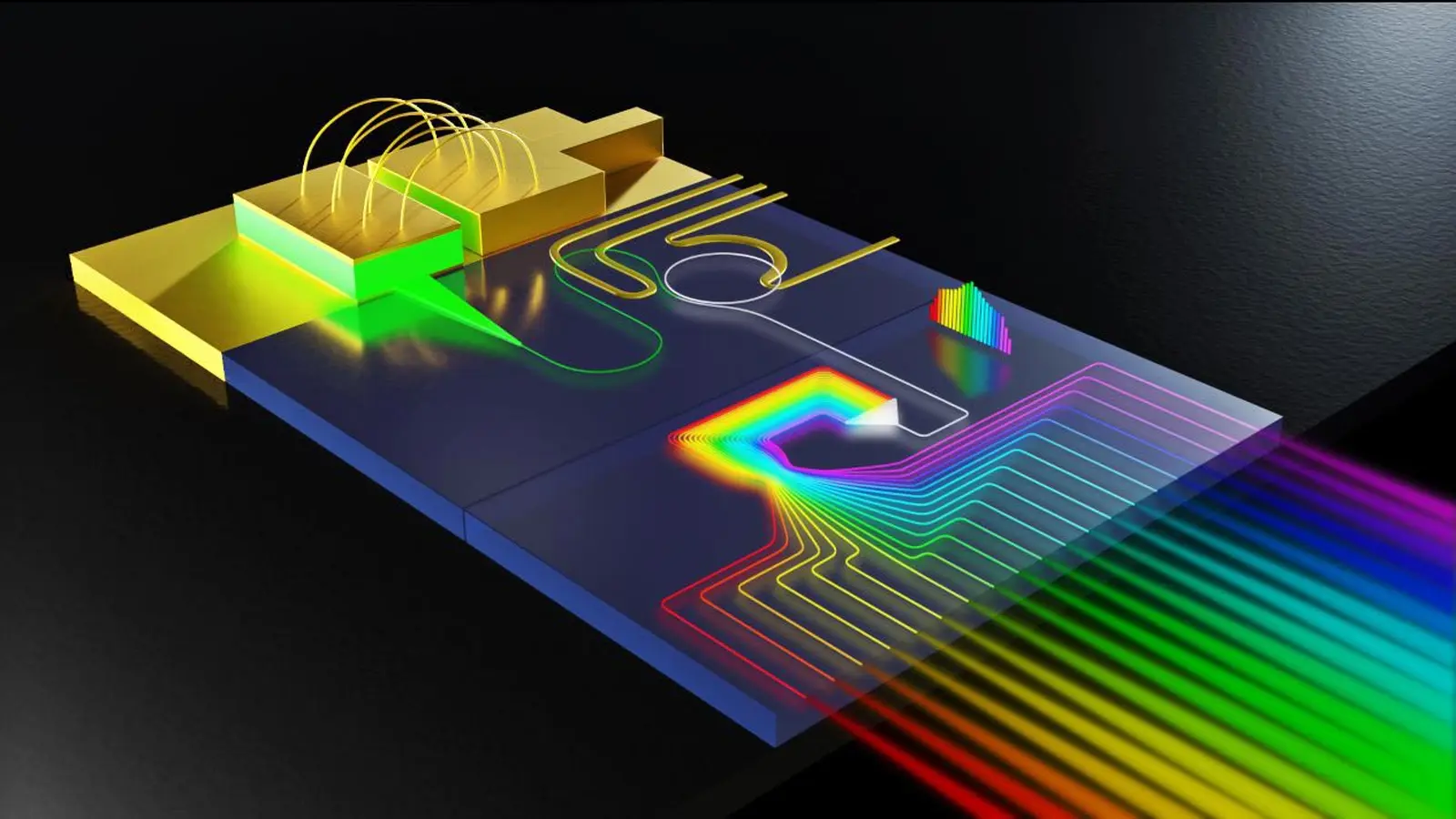
They turned one laser into many colors — and did it without fiddly heaters or endless tuning. Imagine a single, compact photonic chip that takes a telecom-wavelength laser and, like a tiny prism with superpowers, spits out red, green, and blue light. No extra lasers. No delicate temperature control. Just light entering on one side and several brand-new frequencies emerging on the other.
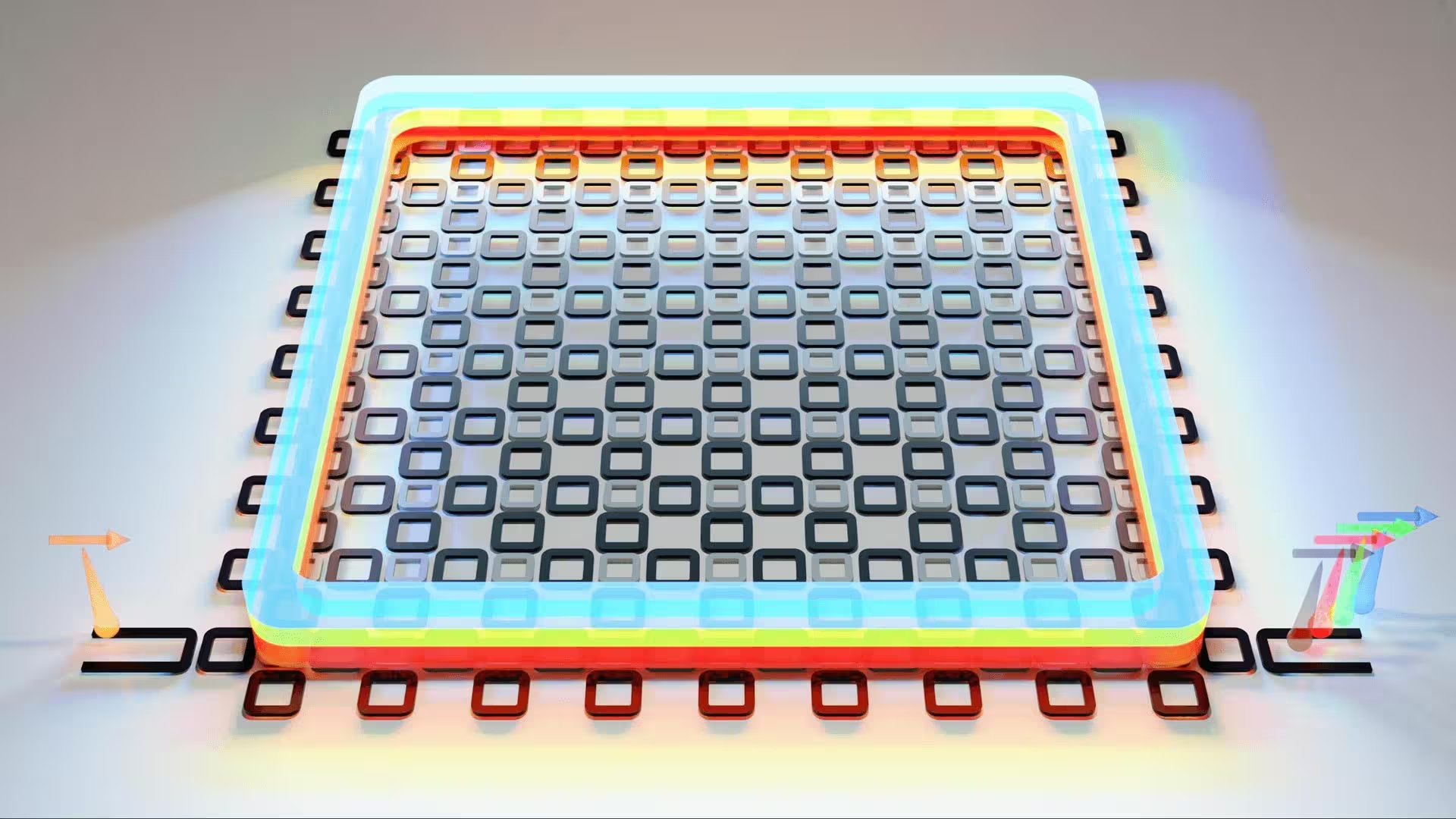
Researchers at JQI have designed and tested new chips that reliably convert one color of light (represented by the orange pulse in the lower left corner of the image above) into many colors (represented by the red, green, blue and dark grey pulses leaving the chip in the lower right corner). The array of rings—each one a resonator that allows light to circulate hundreds of thousands or millions of times—ensures that the interaction between the incoming light and the chip can double, triple and quadruple its frequency.
From a curious smudge to a stubborn engineering problem
Nonlinear optics has a history of surprises. The first reported evidence of second harmonic generation in 1961 was so faint that an editor mistook it for a printing blemish. That tiny smudge marked the beginning of a field built on harnessing weak effects: intense light alters material properties, and those altered properties push the light into new frequencies. These processes — doubling, tripling or quadrupling an input frequency — are the heart of frequency conversion and underpin applications in metrology, quantum information, and telecommunications.
But nonlinear effects are often stubbornly weak. For decades, the practical route to stronger interactions has been to trap light inside resonators so photons can make many passes through the nonlinear medium. Each pass nudges the process forward. Hundreds of thousands, or even millions, of round trips amplify an otherwise infinitesimal effect. Yet making a device that reliably produces multiple harmonics on a chip, and doing so across many manufactured samples, has remained elusive.
Why is it so hard? Because frequency conversion on a chip demands two things at once: the resonator must support photons at both the input and the target frequency, and those photons must stay phase-matched — in sync — as they circulate. Get either one wrong and the process collapses. Tiny nanometer-scale variations in fabrication shift resonant frequencies and group velocities. A design that works on one wafer might fail on another. The result: a hit-or-miss enterprise where only a fraction of produced chips perform as intended.
Two clocks, one reliable conversion
That hit-or-miss problem is precisely what the team at the Joint Quantum Institute (JQI) attacked differently. Mohammad Hafezi, Kartik Srinivasan, and collaborators, including Mahmoud Jalali Mehrabad and Lida Xu, revisited an architecture they had used in earlier work: not a single ring but an array of tiny ring resonators. Their insight was to stop trying to force an exact resonant alignment and to ask whether the geometry itself could make matching more likely.
What they found was elegantly simple. The resonator array produces two natural timescales. Light whips quickly around each small ring — a fast, local circulation. At the same time, the whole array behaves like a larger “super-ring” that guides light around its perimeter more slowly. Those two distinct circulation rates act like two clocks ticking at different speeds inside the same chip.
Having those two clocks changes the rules. Instead of requiring a single, precise frequency-phase match, the system offers multiple temporal pathways for photons to interact and build harmonics. The fast trips give many opportunities for local nonlinear interactions, while the slower super-ring circulation helps align phases across the whole structure. The upshot: second, third and even fourth harmonics appear robustly and passively, without active compensation such as integrated heaters.
Experiments that prove the point
The team tested six chips fabricated on a single wafer. They launched a standard 190 THz laser—the telecom-frequency light common in fiber optics—into each device and watched what came out. Every one of the resonator-array chips produced second, third, and fourth harmonics. Measured at the device output, the new frequencies corresponded to red, green, and blue light for that particular input. The effect persisted across a reasonable range of input frequencies and pump powers.
For comparison, the researchers fabricated single-ring resonators and equipped some of them with tiny heaters for active tuning. Even with those heaters, the single rings produced second harmonic generation only rarely and only within narrow heater-temperature and input-frequency windows. The contrast was telling: two-timescale arrays worked passively and broadly; single rings needed precise, power-hungry intervention.
When the team increased the input intensity, the chips began to produce additional spectral lines around each harmonic, reminiscent of the nested frequency combs the group had previously engineered. That observation hints at richer nonlinear dynamics within the array architecture — dynamics that can be harnessed for frequency metrology and on-chip optical synthesis.
How the resonators do the work
Local resonances and the super-ring
Picture a handful of tiny racetracks for light laid out like beads on a necklace. Each bead is a ring resonator tuned to support certain optical modes; its size and refractive index determine which frequencies can ride around it. A single ring supports discrete resonant frequencies, much like a guitar string supports certain notes. But when you couple many rings together in an array, coupling pathways open up and new collective modes appear. The array supports both highly localized cycles within individual rings and extended cycles that traverse the array edge — the super-ring mode.
Mathematically, this introduces multiple time and length scales into the problem. Physically, it gives the nonlinear process more opportunities to satisfy the frequency and phase relationships necessary for efficient conversion. Small fabrication errors that would ruin a single-ring design are less likely to simultaneously spoil both the local and super-ring resonances. In short: redundancy built into geometry.
Scientific context and why this matters
Compact, reliable frequency converters are a longstanding goal. In quantum photonics, they can translate wavelengths from convenient laser sources to the frequencies required by atomic transitions used for memory and entanglement. In metrology, frequency combs derived from harmonic generation enable ultra-precise clocks and distance measurements. For integrated photonics and optical communications, an on-chip source that produces multiple channels of light could simplify systems currently reliant on many discrete lasers.
Until now, achieving those transformations on a chip typically required painstaking design, trial fabrication, and, often, active tuning hardware that complicates both production and deployment. The two-timescale resonator arrays relax those constraints. They reduce sensitivity to tiny fabrication shifts and remove heaters and associated power and control systems from the equation. For manufacturers, that is huge: more yield, lower cost, and a clearer path from lab prototypes to real-world devices.
There are technical subtleties, of course. The strength of nonlinear conversion depends on material properties — the nonlinear susceptibility — and on the quality factors of the resonators, which determine how long photons stay trapped. The JQI devices leverage carefully engineered ring layouts and high-Q resonances, but the underlying principle — using geometry to add temporal degrees of freedom — is broadly adaptable. Different materials, from silicon nitride to lithium niobate, could benefit from similar array strategies tailored to their nonlinear strengths.
Potential applications and future prospects
Consider several near-term opportunities. First, integrated frequency converters could enable compact, chip-scale atomic clocks that currently rely on multiple discrete optical sources. Second, quantum communications systems could use on-chip harmonics to bridge the gap between telecom-wavelength fiber transmission and the visible or near-infrared transitions used by quantum memories. Third, nonlinear photonic processors — devices that use light for computation rather than electrons — could exploit passive multi-harmonic generation to expand operational bandwidths and signal-processing capabilities.
Beyond these, the work points to a design philosophy that prizes resilience. When an optical circuit succeeds because its geometry offers many successful pathways rather than a single narrow one, mass production becomes practical. Engineers can shift focus from micro-managing every fabrication parameter to optimizing circuit topology for robustness and performance.
Expert Insight
“What’s striking is how a simple architectural choice changes the engineering calculus,” says Dr. Elena Morales, a fictional but typical photonics engineer with two decades of experience in integrated optics. “You move from a brittle system that needs active fixes to one whose structure absorbs variability. That’s the kind of thinking that transitions devices from research demos into products. It’s a difference between proof-of-concept and reproducible manufacturing.”
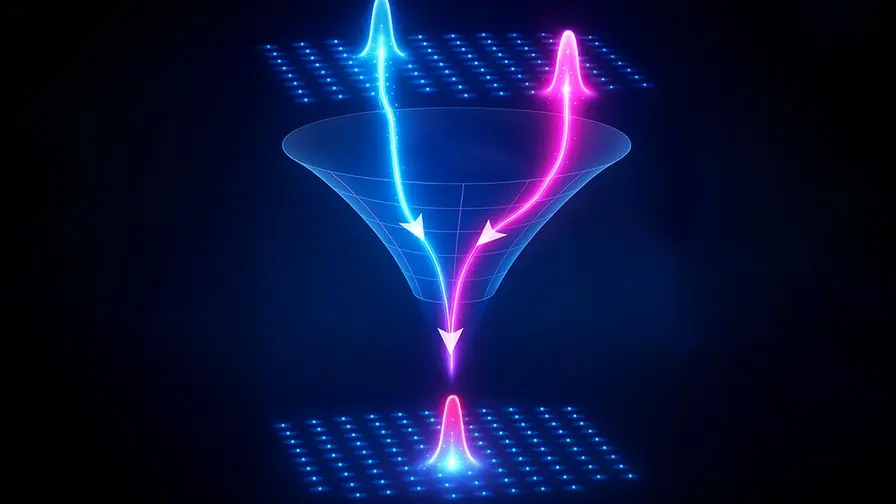
Her observation echoes the practical benefits the JQI group emphasizes: reduced need for calibration, simpler thermal budgets, and better device yields — all crucial for commercializing integrated photonic tools.
Broader scientific ripple effects
When a platform reliably produces multiple harmonics, experimentalists can attempt new measurements and protocols that were previously impractical. Frequency-comb spectroscopy, which relies on precise arrays of optical frequencies, becomes easier to implement on small footprints. Quantum experiments that require matching photon colors across different systems see a path toward compact converters rather than large tables of discrete lasers and alignment stages.
There are also theoretical angles worth exploring. Arrays with engineered disorder, intentionally introduced, might perform even better by widening the ensemble of available pathways. Nonlinear dynamics in multi-timescale systems can exhibit unexpected behavior — synchronization phenomena, emergent comb structures, or controlled chaos — that researchers can harness for signal generation or sensing.
What remains to be done
Challenges remain. Scaling the approach to produce stronger conversion efficiencies at lower pump powers will be important for energy-sensitive applications. Integrating such arrays with other on-chip components — modulators, detectors, and waveguides optimized for the newly generated wavelengths — will determine how seamless the technology becomes within larger photonic systems. And, naturally, long-term stability and packaging for outside-the-lab environments will be necessary to meet industrial standards.
But the direction is clear. Passive, geometry-enabled matching reduces complexity and opens doors. The JQI results illustrate that sometimes the solution is not more control, but more opportunities: more routes for light to find the right interaction and more tolerance for the imperfections that come with real-world fabrication.
If the goal is reliable, on-chip production of new optical colors, then designing devices with built-in temporal redundancy seems a sensible path. The arrayed resonator approach is practical, elegant and, crucially, reproducible — the three ingredients industry looks for when moving from clean-room novelty to mass-produced component.
What will groups build when multicolor light is available on-chip as reliably as electronic signals are on a circuit board? Expect compact atomic sensors, simplified quantum networks, and new classes of optical processors, each drawing on the straightforward but powerful idea that multiple timescales can replace active tuning.
Researchers will keep tuning designs in the lab. Industry will watch the yield numbers. And engineers will ask: how many more tricks can geometry teach us about controlling light?

Leave a Comment
Comments (3)
Looks promising yet feels a tad overhyped. Passive matching is nice but real world integration will bite back, imo
Nice idea, but is conversion efficiency practical at low powers? Also packaging and wavelength routing seem nontrivial, no?
Wow, that's wild! A tiny chip spitting RGB from one laser? mind blown, but curious abt stability over months..