
5 Minutes
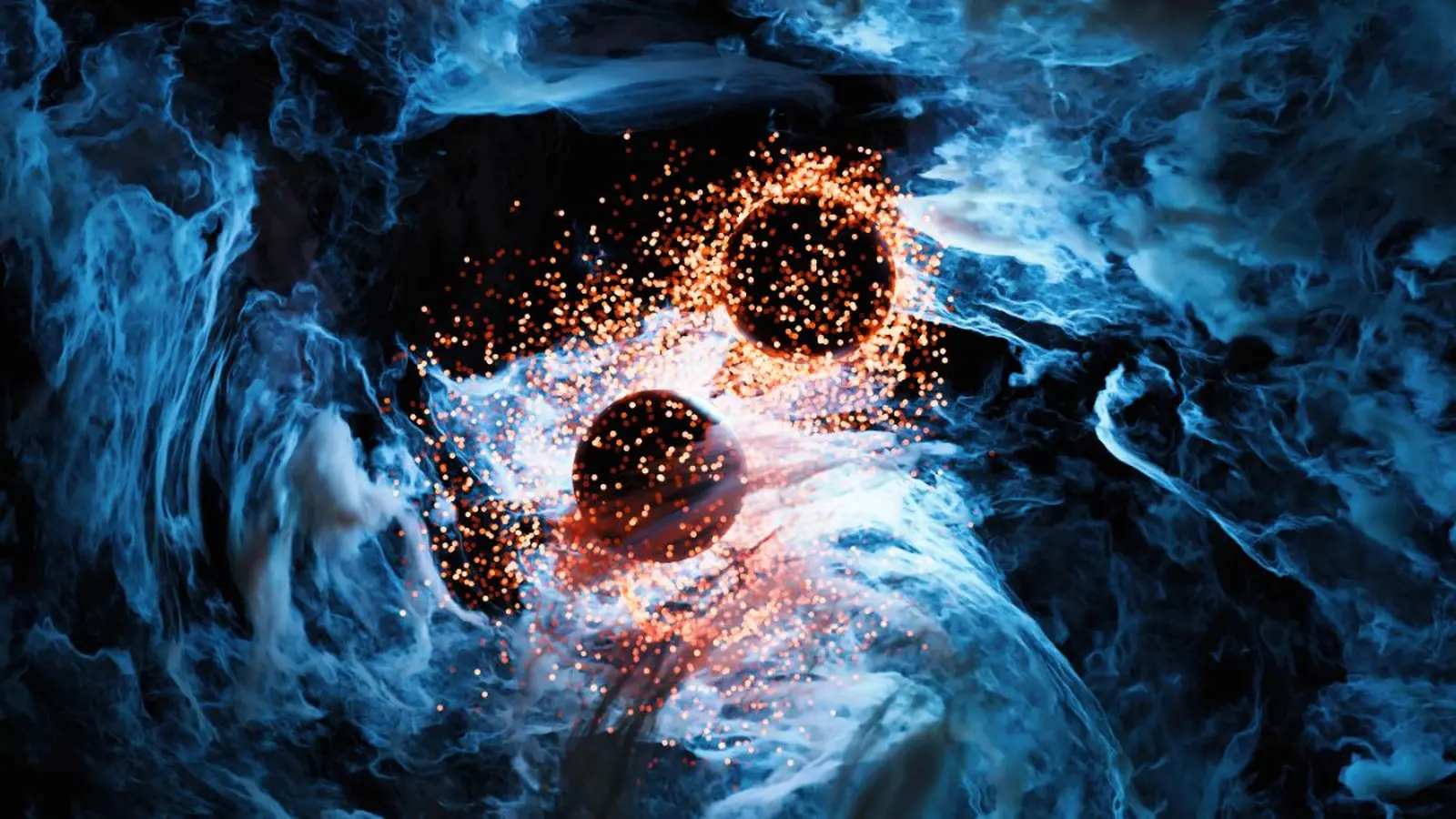
Imagine a sea so hot and dense you cannot point to a single particle and say, "There it is." Instead, everything flows together. That is what physicists believe existed for the briefest flicker after the Big Bang: a trillion-degree, ultradense liquid called quark-gluon plasma, or QGP. New results from teams at MIT and CERN make the metaphor literal — they have finally seen signs that this primordial substance behaved like a cohesive liquid, producing wakes and swirls when struck by a speeding quark.
Recreating the infant Universe inside the LHC
To study conditions that lasted only microseconds after the Big Bang, scientists turn to heavy-ion collisions. At CERN’s Large Hadron Collider (LHC), lead nuclei slam together at near-light speed. The kinetic fury of those collisions briefly melts protons and neutrons into their constituent quarks and gluons, producing droplets of QGP the size of a nucleus and the temperature of a trillion degrees.
These droplets live for a staggeringly small time — a quadrillionth of a second — and erupt into showers of particles as they cool. Hidden inside the particle spray are subtle clues about how the plasma responded to disturbances. Did a quark pass through this medium and leave a clean, boat-like wake? Or did the quark scatter energy into the medium in a way more like random collisions among gas molecules?
The MIT–CERN team adopted a clever solution to tease out that signal. Instead of the common quark–antiquark pairs, they hunted for events where a quark was produced alongside a Z boson — a neutral particle that does not interact with the QGP. The Z boson acts like a silent reference point: it tells you the original quark’s energy and direction without muddling the plasma itself. Out of roughly 13 billion collisions the team analyzed, only about 2,000 yielded such quark–Z events, but that rarity was exactly the strength of the method.
Tracking the debris with the Compact Muon Solenoid (CMS) detector, the researchers mapped how energy and momentum were redistributed in the wake of the quark. The pattern they reconstructed looks decidedly fluid: energy piled up and flowed with the passing quark, producing splashes and vortices rather than a random scatter.
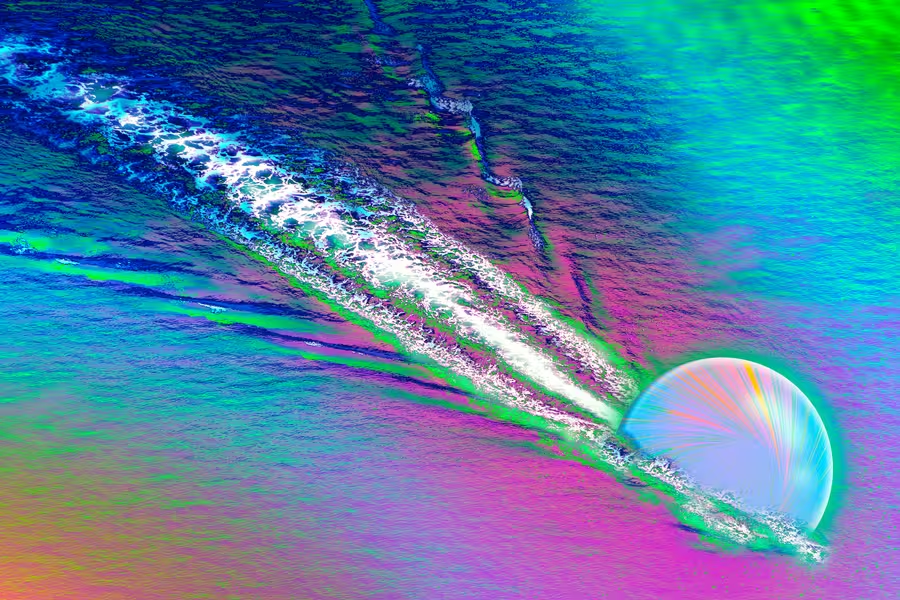
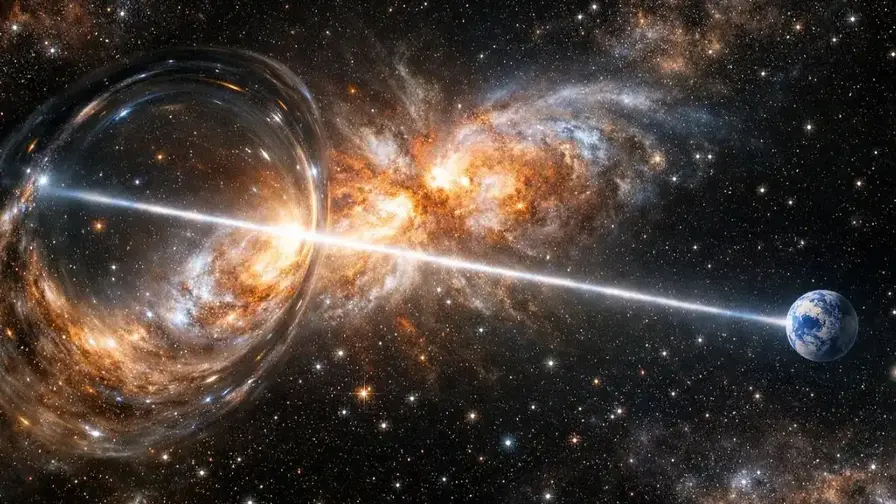
An illustration of a quark creating a wake as it moves through the ultra-hot, super-dense quark-gluon plasma that permeated the primordial Universe for a fraction of a second before it coalesced into matter like neutrons and protons.
Why a wake matters
Wakes are not merely poetic. They are the diagnostic fingerprints of a medium’s transport properties — viscosity, density, how momentum diffuses. If QGP acts like a near-perfect liquid, a fast-moving quark should slow down and hand off momentum to the surrounding fluid, creating a trailing flow. That’s exactly what the new analysis indicates: the plasma is dense enough to decelerate a quark significantly and to support coherent, hydrodynamic responses.
Krishna Rajagopal of MIT, who helped develop theoretical models of QGP as a fluid, has long argued that the plasma should behave collectively. The new measurements align well with those predictions: where earlier experiments hinted at fluid-like behavior, this study isolates the single-quark disturbance and reads the medium’s reply with unprecedented clarity.

The experimental challenge cannot be overstated. Quarks never travel alone inside detectors; they are produced with partners and almost immediately hadronize into jets of particles. Sorting a faint, coordinated wake out of tens of thousands of interacting tracks in an environment hotter than a billion suns requires both clever event selection and meticulous statistical control. Using the Z boson as a non-interacting marker simplified that task, but extracting a clean signal remained painstaking work.
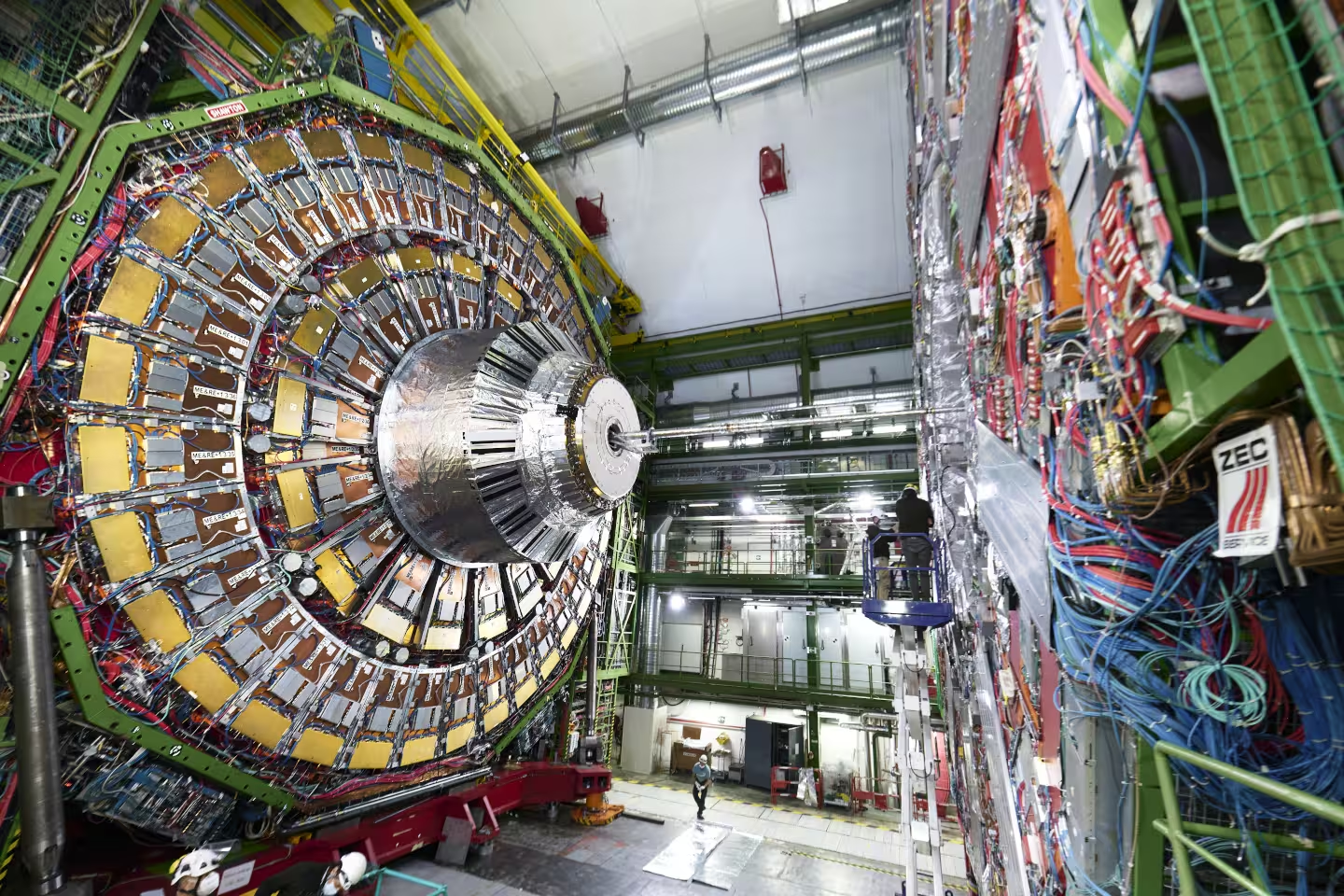
The Compact Muon Solenoid (CMS) at CERN, the detector that was used to detect the quark wake effects explored in the study.
Implications for theory and cosmic history
Confirming liquid-like response in QGP sharpens our picture of the early Universe and strengthens theoretical tools used across high-energy physics. The plasma’s low viscosity and strong coupling influence how we model thermalization after the Big Bang, the formation of the first hadrons, and even aspects of neutron star mergers where similar extreme conditions arise. In short: knowing that QGP sloshes like liquid gives physicists a firmer grip on how matter organized itself in the Universe’s opening act.
At the same time, scientific debate will follow. The study provides compelling evidence, but extraordinary claims still attract close scrutiny. Independent analyses, different collision energies, and complementary detectors will test the result’s robustness. If confirmed across multiple approaches, the quark wake technique could become a standard probe for studying strongly coupled plasmas in other contexts.
Expert Insight
"Seeing a wake in the plasma is like watching a fingerprint develop," says fictional Dr. Maya Singh, an astrophysicist who studies extreme states of matter. "It tells you not just that the medium exists, but how it behaves under stress — how momentum and energy flow. That information is indispensable if we want to translate collider data into reliable models of the early Universe and of dense astrophysical objects."
The experiment also points to practical advances in analysis techniques. By pairing rare Z-boson events with high-precision tracking, researchers have a template for isolating small signals in extremely noisy environments. That could bear fruit in other searches where tiny effects hold big answers.
Physics at this scale thrives on controlled destruction. Smash something at nearly light speed and watch how the remnants rearrange themselves. If the primordial fireball really does behave like a liquid, then the story of the Universe’s first instants becomes a story of flow, drag, and dissipation — a violent, elegant choreography written in quarks and gluons.
This research appears in Physics Letters B, and it opens new avenues for probing one of nature’s most exotic forms of matter.





Leave a Comment
Comments (2)
Interesting trick using Z as a marker, but 2k events from 13B? feels tenuous. Need crosschecks, alt detectors, energies. not convinced yet.
wow this is wild... QGP making wakes like a boat? Mind blown, but also kinda poetic. how do they pull a signal out of that chaos tho, amazing