

4 Minutes
Imagine being told your blood is older than you are. Not a metaphor, but a measurable fact. That is the provocative outcome of a new study from the University of Konstanz: a set of blood markers that together can pick out whether someone is aging faster or slower than their calendar years suggest.
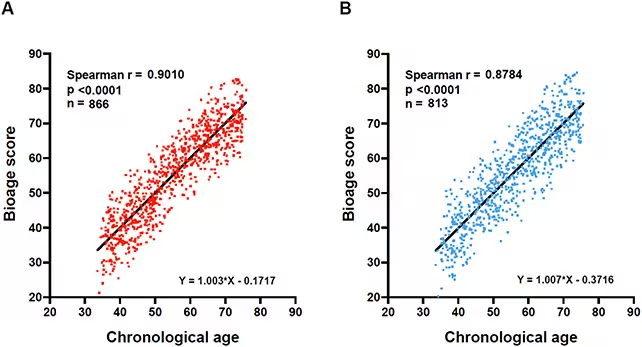
Researchers examined a vast biochemical landscape — 362 different blood parameters — drawn from more than 3,300 adults aged 35 to 74. They were not hunting for a single smoking gun. Instead, they let statistical modeling and machine learning identify the patterns that mattered most. What emerged were compact panels: ten biomarkers for men, and a distinct set of ten for women. Each panel is a signature of what blood typically looks like at different chronological ages.
How the test was built and why sex matters
Why two lists? Because men and women do not age identically. Hormones, immune responses, and metabolic pathways diverge across sexes, producing different biochemical footprints. The Konstanz team compared every candidate marker — chemical, genetic, cellular, and signaling molecules — against chronological age. The combinations that most closely predicted age were kept. The result is less a magic bullet than a mosaic: multiple signals that together estimate a person’s biological age more reliably than any lone marker could.
The scientists then pushed their model against reality. They tested groups already known to show altered biological aging: people with trisomy 21 (Down syndrome), habitual smokers, and women undergoing hormone therapy. The panels produced sensible, expected shifts: accelerated aging signatures in smokers and trisomy 21, and nuanced changes among women on hormonal treatment. Those checks strengthened confidence that the score was not a statistical fluke but a biologically meaningful signal.
“The biological aging process is very complex,” biologist Maria Moreno-Villanueva of the University of Konstanz observes. “It affects all of the body's tissues and organs, and it is not the result of a single cause.” Her point underlines a practical truth: single biomarkers rarely capture a person’s aging trajectory. Composite scores, by contrast, can reveal a fuller picture.
Drivers and bystanders: reading the blood for causes, not just clues

One of the study’s intriguing outcomes is the distinction between markers that appear to drive aging and those that merely mark it. Some molecules seem mechanistically linked to the aging process — potential drivers — while others behave like bystanders, informative but not causal. That distinction matters. If a biomarker is a driver, it offers a target for interventions. If it’s a bystander, it still helps track progress but is less useful for therapy design.
Practical applications are emerging quickly in imagination if not yet in clinics. A blood-based bioage score could be used to stratify patients for preventive care, to benchmark lifestyle changes, or to evaluate whether an anti-aging therapy is doing more than shifting a single lab value. The test could also help public-health researchers understand population-level trends in biological aging as societies grow older.
“Against the backdrop of current research on the aging effects of smoking, hormone replacement therapy, or trisomy 21, all of these results are plausible and confirm the validity of our bioage score,” says molecular toxicologist Alexander Bürkle from the same institution. That kind of external plausibility is reassuring when a model relies on complex data and advanced algorithms.
Expert Insight
Dr. Elena Ross, a gerontologist not involved in the study, offers a caution and a nudge: “Composite blood scores are a powerful step toward individualized aging assessments, but we must remember they are probabilistic. They tell you risk and trend, not destiny. Used wisely, they can motivate targeted prevention and help evaluate interventions.” Her remark reflects the study’s dual promise and limitation: greater precision without absolute certainty.
Beyond diagnostics, this approach opens research pathways. Distinguishing drivers from bystanders focuses laboratory work on mechanisms. Large-scale panels enable longitudinal studies that ask not only who ages faster, but why, and whether that pace can be slowed or reversed. The Konstanz work is a blueprint: rich data, careful modeling, and validation against real-world groups.
There is also an ethical and social dimension. If a blood test labels someone biologically older than their peers, how should that information be used? Insurance, employment, and psychological impacts must be considered as these tools move toward broader use. For now, the immediate value is scientific: a more compact, practical assay for biological aging and a sharper lens on the biology behind it.

When researchers group people born in the same year and look at their bioage scores, the spread is striking. Some individuals look decades younger on a molecular level; others older. That variability reminds us that chronological age is only part of the story. The rest is written in our blood — and, increasingly, readable if we know how to look.













Leave a Comment
Comments (2)
Is this even reliable? Lots of markers + machine models, but cohort bias, lab variability could skew results. Promising, but cautious
Wow, didn't expect blood to 'age' you like that. Kinda unsettling. If a test says you're older, what happens? insurance, jobs, life choices? curious…