
5 Minutes
Waking up refreshed may have less to do with how quietly your brain slept and more to do with what your mind was doing while you were out.
A new sleep study from researchers at the IMT School for Advanced Studies Lucca in Italy suggests that vivid, immersive dreams could play an unexpected role in how deeply rested we feel in the morning. That idea cuts against the usual assumption that the most restorative sleep is always the most silent, blank, and dream-free. In reality, the sleeping brain may be telling a more complicated story.
The team followed 44 healthy adults and gathered data across 196 nights in a sleep laboratory, where participants were monitored as they slept and were repeatedly awakened during periods that would usually be described as dreamless sleep. Each time, researchers asked what had been going through their minds and how deep or shallow their sleep had felt.
A striking pattern emerged. People tended to report the deepest, most restorative sleep after two very different kinds of experience: either complete mental silence, with no awareness of anything at all, or rich, absorbing dreams that felt vivid and immersive. By contrast, the least restful sleep was linked to fragmented, blurry mental states in which participants felt half-aware, vaguely present, but not fully dreaming.
That distinction matters. It suggests that sleep is not judged by the brain in a simple on-or-off way. Some mental activity during the night may actually support the feeling of having slept well, while other forms of activity seem to undermine it. As neuroscientist Giulio Bernardi and his colleagues argue, the key may be immersion. When a dream fully captures the mind, sleep may feel deeper, even if brain activity looks closer to wakefulness on a monitor.
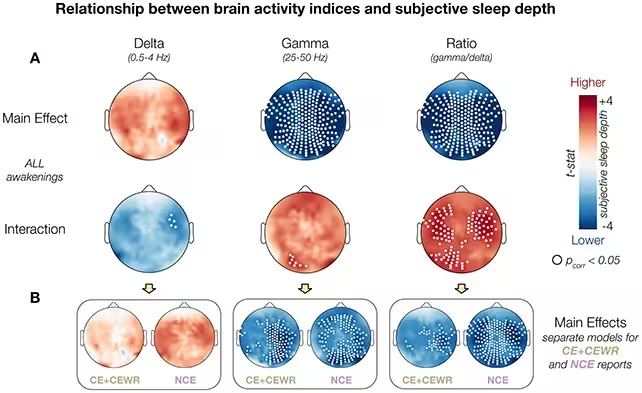
At first glance, that sounds backward. Deep sleep is usually associated with reduced brain activity and fewer conscious experiences, so common sense would say that the less going on in the mind, the better the rest. Yet sleep science has been hinting for years that things are not so straightforward. Earlier research has repeatedly found that REM sleep, the stage most associated with vivid dreaming, often lines up with people reporting a more satisfying and restorative night.

This new study turned attention to N2 sleep, a stage of non-REM sleep that makes up a large portion of the night. That is what makes the findings especially intriguing. Even outside the classic dream-heavy REM stage, the texture of mental experience appears to shape how sleep is perceived from the inside.
The researchers propose that vivid dreams may act like a psychological buffer. In simple terms, an immersive dream could smooth over the brain's internal fluctuations and help create the impression of continuous, deep sleep. Instead of noticing subtle shifts in arousal or fragmented mental activity, the sleeper remains wrapped in a coherent experience. The mind stays occupied, and sleep feels deeper because of it.
That effect seemed to become even stronger toward morning. As sleep pressure naturally declined over the course of the night, dream vividness increased. So did reports of deeper sleep. In other words, as the body needed sleep less, the mind may have compensated by generating more immersive dream experiences that preserved the feeling of solid rest.
The implications reach beyond curiosity about dreams. Plenty of people wake up convinced they slept badly, even when sleep trackers or clinical measures suggest their sleep was normal. This research offers one possible explanation: the issue may not be the amount of sleep alone, but the kind of subjective experience unfolding during it. If dreams help maintain the sense of uninterrupted rest, then changes in dreaming could partly explain why some people feel unrefreshed despite technically adequate sleep.
There is an important caveat. The study does not prove that vivid dreams directly cause better sleep, and it did not measure next-day performance, physical recovery, or long-term health outcomes. What it captured was subjective sleep depth: how deep sleep felt to the sleeper, not necessarily how restorative it was in every biological sense. Still, that distinction is not trivial. Perceived sleep quality has a major impact on well-being, mood, and how people function during the day.
That is where the research starts to get especially interesting for insomnia and sleep therapy. If future studies confirm that immersive dreaming can improve the feeling of restful sleep, scientists may eventually explore ways to influence dream experiences on purpose. Controlled sensory cues, cognitive methods, or even pharmacological approaches could one day be used to encourage dream states that make sleep feel more continuous and restorative.
For now, the study adds another layer to one of neuroscience's oldest mysteries. Dreams may not be random mental noise or decorative side effects of sleep. They may help the brain manage the experience of sleeping itself, stitching the night into something that feels whole by the time morning arrives.

And that raises a strangely comforting possibility: sometimes, the mind's most vivid nighttime stories are not interrupting rest at all. They may be part of what makes sleep feel truly deep.

Leave a Comment
Comments (2)
Is this causal tho? If dreams buffer sleep can we actually train them, or is it just subjective trickery. curious but skeptical, needs more on real recovery not just how it felt in the morning…
wow this flips my sleep assumptions. vivid dreams = feeling more rested? weird, but kinda makes sense… sometimes I wake up groggy yet remember a movie-like dream, other nights totally blank and fine. brain is wild