
4 Minutes
Change three small things in your daily routine and you might change your heart's future. It sounds modest. It is not trivial.
A team at the University of Sydney analyzed health data from more than 53,000 adults and found that tiny, consistent shifts about 11 extra minutes of sleep, roughly 4.5 additional minutes of moderate-to-vigorous physical activity, and a quarter-cup more vegetables each day were associated with a roughly 10 percent lower risk of major cardiovascular events over eight years. Those events included heart attacks, strokes and heart failure.
Study design, data sources and what the numbers mean
This was an observational cohort analysis, not a randomized clinical trial. That matters. Observational studies reveal patterns and associations across populations; they do not by themselves prove cause and effect. Still, large cohorts can illuminate practical, population-level interventions and point to priorities for controlled trials.
The researchers combined objective measurements from wearable devices used to capture sleep duration and physical activity with self-reported dietary questionnaires. They adjusted the analysis for age, sex, smoking status, alcohol use and other common cardiovascular risk factors. The sample had an average age of 63, so the findings are most directly applicable to middle-aged and older adults.
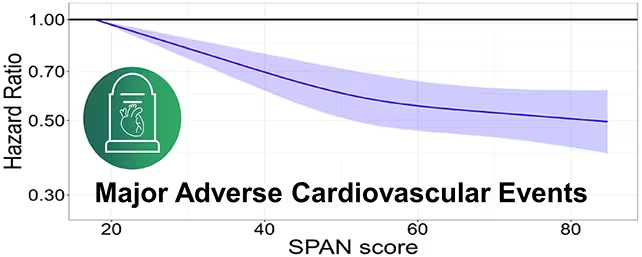
What sounded striking in the paper was the scale of effect from modest changes. The incremental combination just minutes of extra sleep and activity plus a small boost of vegetables was linked to a 10 percent reduction in major cardiovascular events during follow-up. By contrast, the study’s ‘‘optimal’’ behavior profile 8–9 hours of sleep, about 42 minutes or more per day of moderate-to-vigorous activity, and a higher diet quality score was associated with a 57 percent lower risk compared with the least healthy profile in the cohort.
Moderate-to-vigorous physical activity here means movement that raises heart rate and breathing: brisk walking, climbing stairs, or carrying groceries with purpose. Diet quality reflected higher intakes of fruits, vegetables, fish and whole grains and lower consumption of processed meats and sugary drinks. Sleep was counted as nightly duration, which ties into circadian biology and sleep physiology areas increasingly linked to cardiovascular health.
Why combine behaviors? Because sleep, activity and diet don’t act independently. Better exercise often improves sleep. Healthier eating can change energy levels and physical capacity. Examining them together offers a more realistic picture of daily life and how cumulative small changes can add up to measurable risk reduction.

Limitations and the path forward
The authors are careful: correlation is not causation. Residual confounding—factors not fully captured by available data remains possible. Wearable sensors and questionnaires each have measurement limits. Yet these devices are the same class of tools now used in diverse fields from public-health surveillance to spaceflight physiology studies: continuous, longitudinal measurements that reveal patterns lost to clinic snapshots.
Looking forward, the team plans to translate these epidemiological signals into digital tools that nudge people toward sustainable habits. That means user-centered design, community engagement and attention to the everyday barriers time, cost, motivation that make even small changes hard to sustain.
“We show that combining small changes in a few areas of our lives can have a surprisingly large positive impact on our cardiovascular health,” says Nicholas Koemel, a nutritional scientist at the University of Sydney. “This is very encouraging news because making a few small, combined changes is likely more achievable and sustainable for most people when compared with attempting major changes in a single behavior.”
Emmanuel Stamatakis, the study’s senior author, adds that the next step will be practical: building digital supports to help people embed modest improvements into daily routines through evidence-based, accessible interventions.
Expert Insight
“From an epidemiology standpoint, this study is valuable because it frames risk reduction as achievable rather than extreme,” says Dr. Maya Chen, an epidemiologist and science communicator. “Small, measurable behavior shifts are easier to test in real-world settings and to scale. We also shouldn’t overlook the role of technology: wearables and remote monitoring are bridging clinical research and everyday life, offering a practical route to preventive cardiology.”
Cardiovascular disease remains the world’s leading cause of death. Studies like this do not rewrite medical guidance overnight, but they add a pragmatic layer to prevention messaging: tiny, persistent changes in sleep, activity and diet measured and reinforced over time can move the needle.
If you’re looking for a starting point, try one small tweak this week: go to bed 10 minutes earlier, take a brisk five-minute walk during a break, or add an extra few tablespoons of vegetables to a meal. Small by themselves. Cumulative in effect. That’s where impact lives.













Leave a Comment
Comments (2)
So observational, right? Can a 10 min earlier bedtime really lower heart risk or is that just confounding? still, gonna try a 5 min brisk walk daily, why not
this rings true from clinic days. nudging sleep 10 min, a quick 5 min brisk walk, and extra veg is doable. not magic, but adds up over months, imo