
5 Minutes
Half a billion light-years away, a galaxy called Mrk 501 may be staging one of the most dramatic events in the universe—and by cosmic standards, it could happen almost immediately. Astronomers now believe two supermassive black holes may be circling each other at the heart of this blazing galaxy, so close that a collision could arrive in less than a century.
That kind of timescale is astonishing. In astronomy, where processes usually unfold over millions or billions of years, a possible black hole merger within 100 years feels almost like watching weather form on a distant planet. If the evidence holds up, Mrk 501 could become one of the most important targets in modern astrophysics.
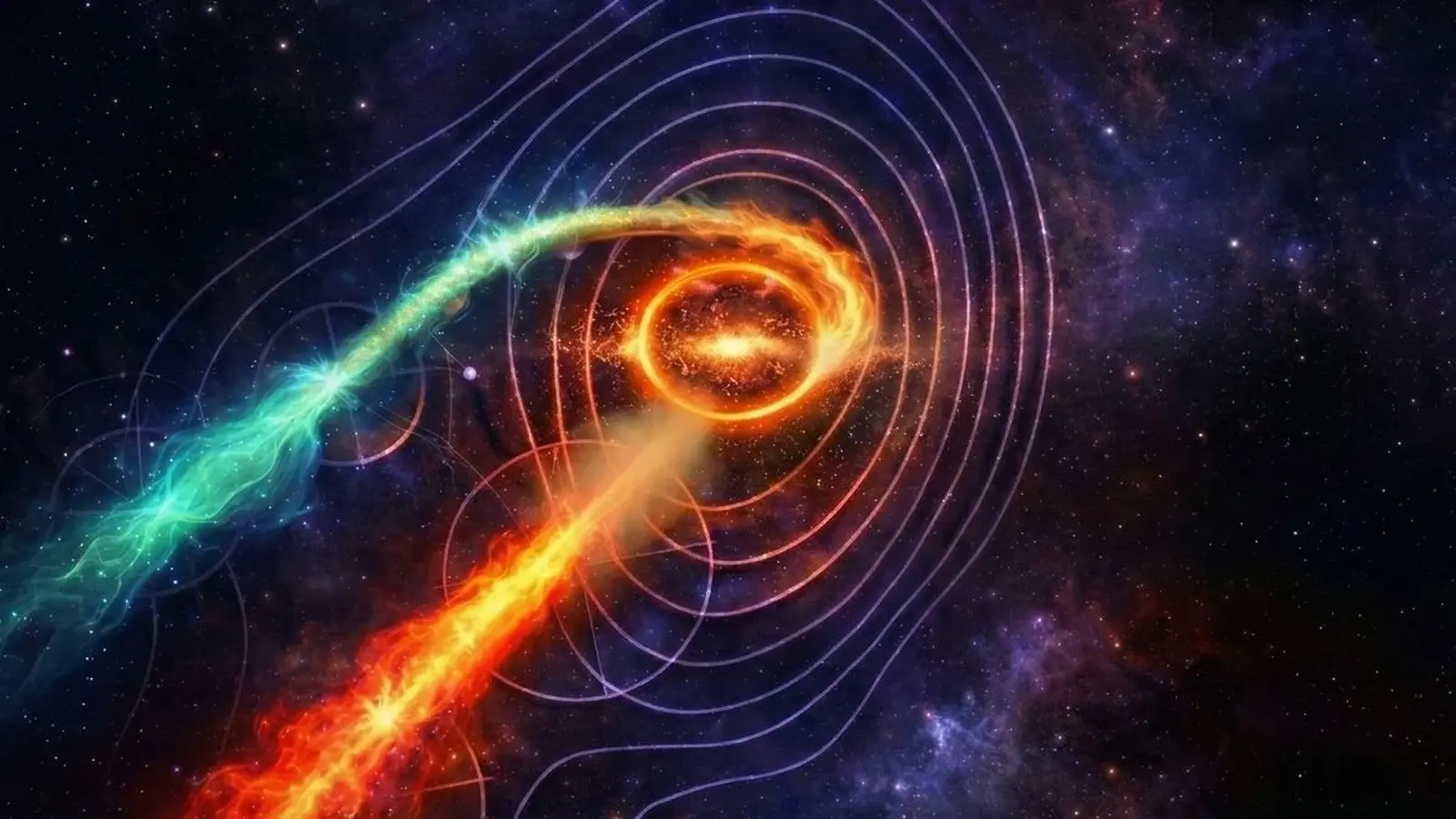
The new research, led by Silke Britzen of the Max Planck Institute for Radio Astronomy, points to an unusual explanation for the galaxy’s strange radio behavior: not one jet, but two. Each jet would be powered by its own supermassive black hole. The claim is not yet a final confirmation, but the team argues it is the strongest interpretation available for what telescopes are seeing in the blazar’s core.
That matters because astronomers have long suspected that galaxy mergers should eventually produce pairs of supermassive black holes. We have seen galaxies collide. We know most large galaxies host giant black holes in their centers. Put those facts together, and binary supermassive black holes should exist. The real challenge has been catching them clearly, especially when they are packed into the turbulent, bright heart of an active galaxy.

Mrk 501 is not an easy object to decode. It is a blazar, a type of active galaxy whose jet is aimed almost straight at Earth. That makes it incredibly bright across the electromagnetic spectrum, but it also complicates the view. The glare is intense. The center is messy. Signals overlap. It is a bit like trying to study the mechanics of a lighthouse while staring directly into the beam.
To get around that problem, the researchers relied on ultra-high-resolution radio observations collected over roughly 23 years. By tracking bright structures moving through the jet at different radio wavelengths, they reconstructed how matter behaves near the galaxy’s central engine. What emerged was not a simple one-jet story. Instead, the data hinted at a second, fainter jet looping around the core in a counterclockwise pattern.
Britzen described the analysis as feeling like standing on a ship, with the whole jet system in motion. That image captures the puzzle nicely. The structure does not appear stable or neatly aligned. It seems to sway. One possible reason is that the orbital motion of two black holes is causing the jet system itself to wobble.
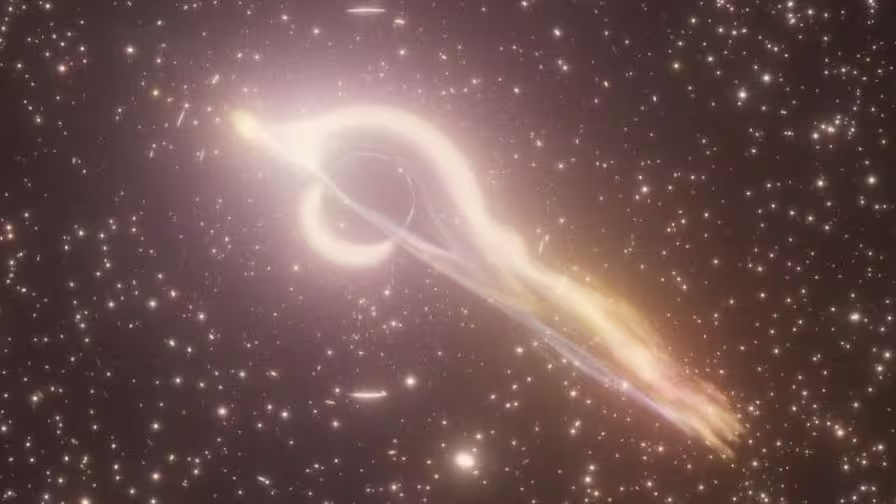
When the team modeled the motion, they found two repeating timescales hidden in the galaxy’s changing light. One cycle lasted about seven years, which fits the idea of a jet wobble, similar to the unsteady motion of a spinning top. The second cycle was much shorter—around 121 days. According to the researchers, that shorter rhythm may reflect the orbital period of the two black holes themselves.
If so, the pair is separated by only about 250 to 540 times the distance between Earth and the Sun. For supermassive black holes, that is incredibly tight. In more formal terms, the gap may be no more than 0.0026 parsecs. That number is tiny, but it carries enormous weight in black hole physics because it brushes up against one of the field’s most stubborn puzzles: the final parsec problem.
Here is the issue. As two supermassive black holes spiral toward one another, they lose orbital energy by interacting with surrounding stars and gas. That process should gradually shrink their orbit. But theory suggests a bottleneck appears when they get to around one parsec apart. At that stage, there may no longer be enough nearby material to keep draining their energy efficiently, potentially causing the inspiral to stall for longer than the age of the universe.
And yet, if Mrk 501 really does host a binary black hole at such a tiny separation, then somehow nature has found a way past that barrier. That would be a major clue in the long-running effort to understand how supermassive black holes grow, merge, and shape the galaxies around them.
The stakes go even higher when gravitational waves enter the picture. Unlike the black hole mergers detected by LIGO, which involve much smaller stellar-mass black holes, a supermassive black hole binary would produce low-frequency gravitational waves. Those are not picked up the same way. Instead, astronomers search for them using pulsar timing arrays, which monitor the steady radio pulses of dead stars spread across the galaxy. A passing gravitational wave can subtly disturb that rhythm.
If Mrk 501 is truly nearing a merger, it could become an extraordinary laboratory for this next era of astronomy. Researchers may be able to track not just a suspicious jet or fluctuating light curve, but the slow rise in gravitational-wave frequency as the two giants tighten their orbit on the road to impact.
No one is claiming the case is closed. Direct imaging of a double-jet system in a blazar core has not been achieved before, and extraordinary claims demand patience. Still, the picture forming around Mrk 501 is hard to ignore. A nearby blazar, a possible binary supermassive black hole, a separation far smaller than theory is comfortable with, and a merger that might unfold on timescales relevant to human observers—this is the kind of cosmic story astronomers wait decades to tell.
If future observations confirm it, Mrk 501 will stop being just another bright galaxy on a radio map. It will become a front-row seat to one of the rarest spectacles in the known universe.


Leave a Comment
Comments (2)
Is the 121 day period robust? could be aliasing or simple jet turbulence, calibration issues etc... I'm skeptical until more data shows up
wow, a black hole smash in <100 yrs? mind blown. feels unreal but also kinda poetic. if true, astronomy will flip its script. fingers crossed