
3 Minutes
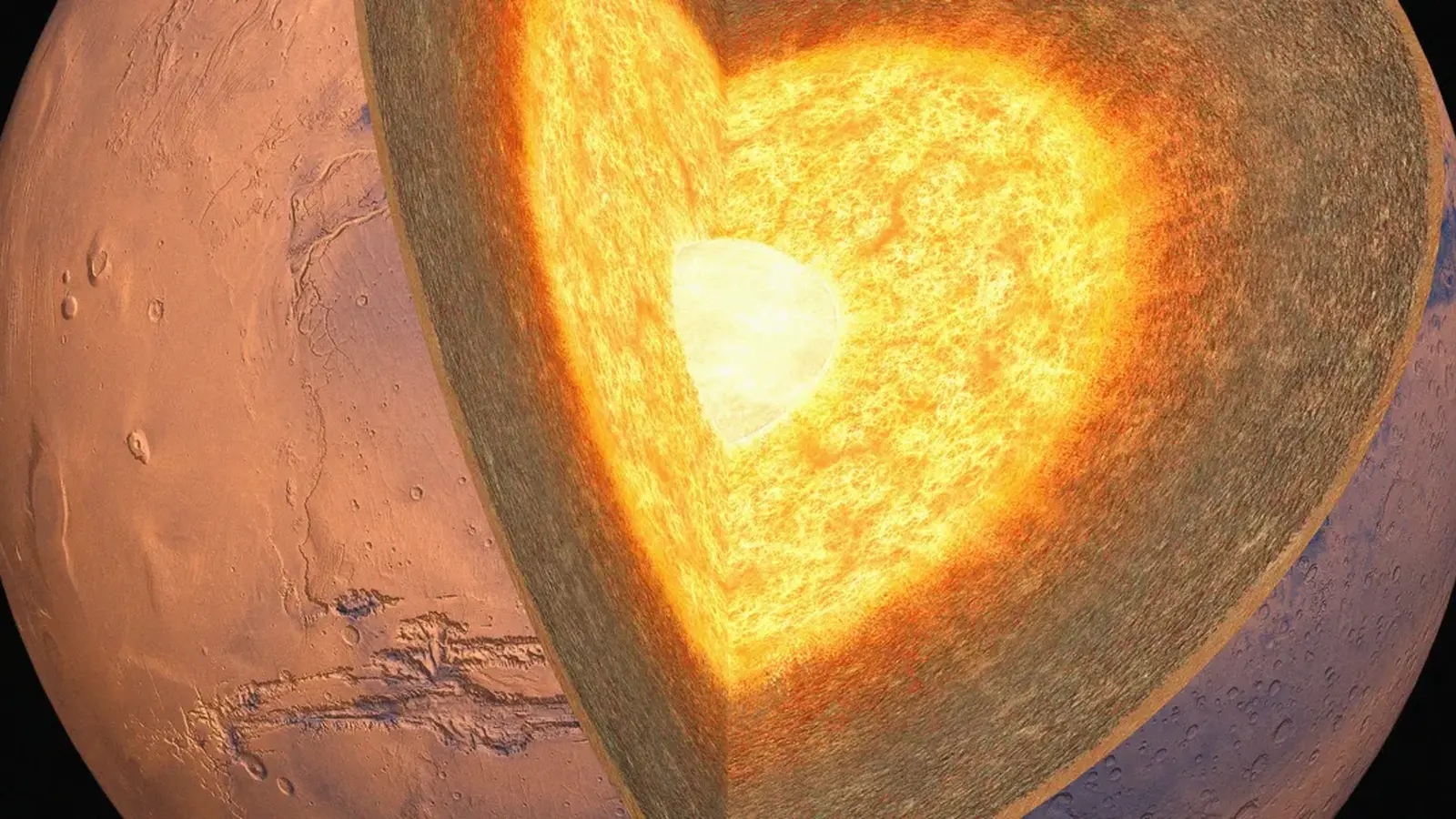
Mars is trimming fractions of a millisecond off its day. It sounds trivial, but for planetary scientists, that tiny change is a clue — a fingerprint of motion deep below the planet's rusty crust.
Data from NASA’s InSight lander, examined alongside measurements taken by the Viking missions in the 1970s, revealed a subtle acceleration in Mars’ rotation. Over years, the Red Planet’s day has grown shorter by minute increments. The question that followed was simple: what is moving underneath Mars to produce such an effect?
Plumes, mass anomalies and a spinning planet
Researchers at Delft University of Technology think they have an answer. Their models point to a large, buoyant plume of mantle material beneath Tharsis, the vast volcanic province near Mars’ equator that hosts Olympus Mons and its neighboring volcanic giants. This plume would be less dense than surrounding rock — what the team calls a “negative mass anomaly.”
What does that mean in plain terms? Imagine a spinning skater. When the skater pulls in a leg, the body spins faster. On a planet, moving material outward or inward relative to the rotation axis changes the distribution of mass, and that alters spin rate. If lighter, upwelling mantle material rises near the equator, heavier material elsewhere must sink closer to the axis — and the whole planet can rotate a touch faster as a result.
“The Martian surface is so old and shows all these complex but largely not well understood processes,” said Bart Root, the study’s lead author and an assistant professor in planetary exploration at Delft. He argues that linking interior dynamics with surface geology gives a clearer picture of Mars’ evolution: the history is literally written in the red soil.
The team used InSight’s seismic and gravity-sensitive observations to constrain their simulations. Their results suggest that a mantle plume beneath Tharsis could periodically supply melt pockets to the lithosphere — a rigid shell roughly 310 miles thick — producing volcanic activity over long timescales. That intermittent melting and replacement of material fits both the geological record and the measured spin-up.
Implications for Martian geology and future study
If this picture is right, Mars is not as geologically dead as once thought. Deep reservoirs of heat and buoyant material may still be mobile, driving surface volcanism in fits and starts and subtly altering the planet’s rotation. The Tharsis rise, then, may be more than ancient volcanoes: it could be the surface expression of a persistent, global-scale internal process.
There are, of course, uncertainties. The Delft team’s back-of-the-envelope calculations reproduce the observed order of magnitude of the spin change, but the authors acknowledge that more refined, three-dimensional models are needed to pin down the dynamics. Direct measurements of Mars’ gravity field with higher precision would help enormously.
So what’s next? The researchers make a clear recommendation: send a dedicated gravity mission to Mars. Such a mission could map subsurface mass distributions with the resolution required to confirm a negative mass anomaly beneath Tharsis, or to falsify the idea entirely. Until then, the hypothesis remains compelling but provisional.
As ever in planetary science, tiny signals can unlock big stories. A few fractions of a millisecond per day might one day tell us how Mars' interior works, how its volcanoes lived and died, and how rocky worlds change from the inside out.










Leave a Comment
Comments
No comments yet. Be the first.