
5 Minutes
For years, black hole jets have been treated like the universe’s ultimate power move: narrow, violent beams of plasma launched at nearly the speed of light, blasting far beyond their birthplace. Cygnus X-1 seemed to fit that picture perfectly. But new research has revealed something far more surprising. In this famous black hole system, the jets are not simply dominating their surroundings—they are being pushed around by a stellar wind.
That twist changes the story. And not by a little.
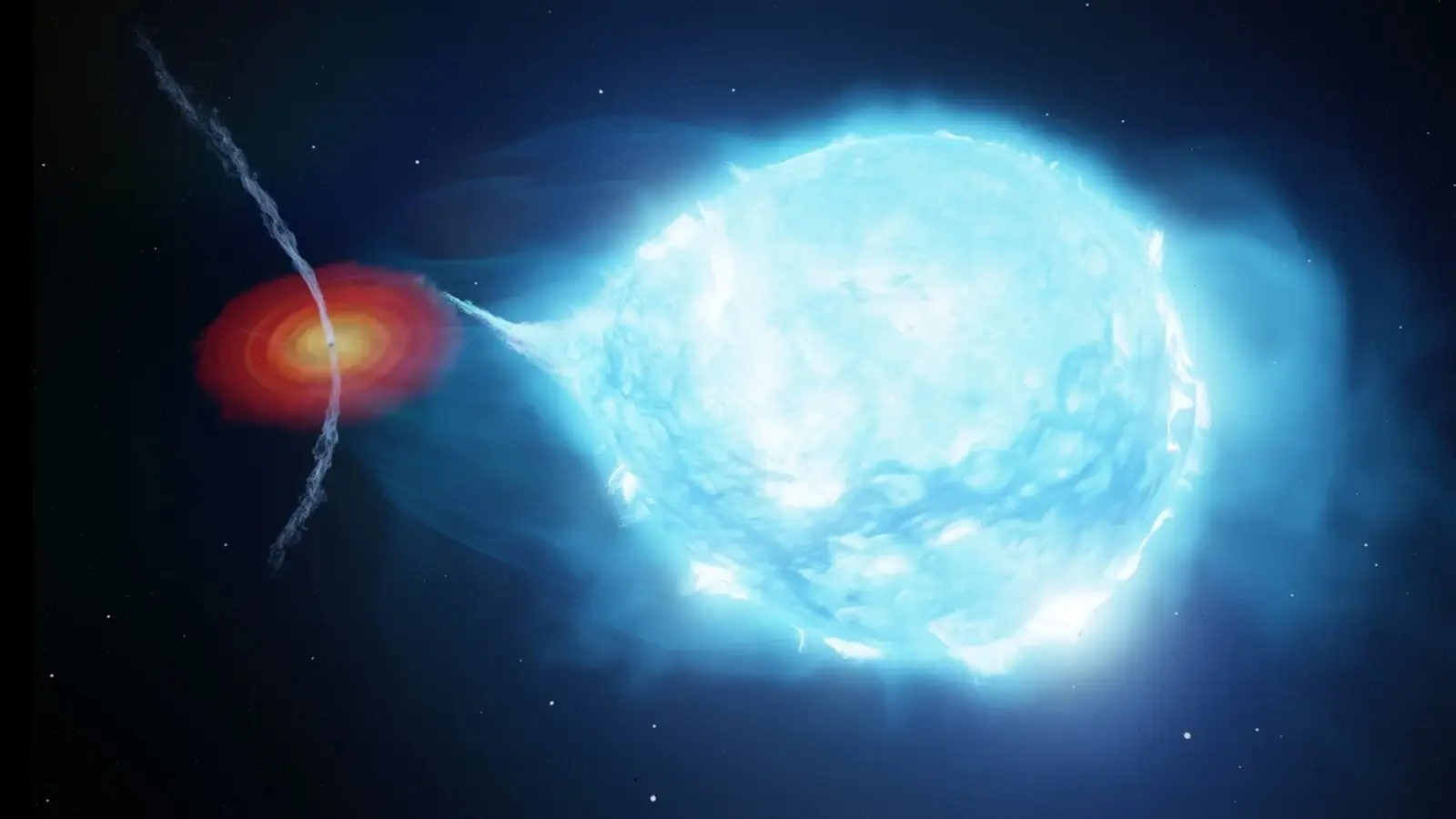
Published in Nature Astronomy, the new study focuses on Cygnus X-1, one of the best-known black hole systems in the sky and the first black hole ever identified. It pairs a black hole about 21 times the mass of the Sun with a giant companion star close to 40 solar masses. The two objects circle each other every 5.6 days in a tight, relentless orbit, locked in what looks less like a peaceful binary system and more like a gravitational tug-of-war.
The black hole has been feeding on its companion for roughly 20,000 years, drawing in material from the star’s powerful outflow. Some of that gas vanishes beyond the event horizon, never to return. Some of it does something even more dramatic: it helps power magnetic fields that launch twin jets outward at relativistic speed, carrying energy across an astonishing 16 light-years and inflating a vast bubble of hot gas in interstellar space.
That much astronomers already knew. The missing piece was the harder one: how powerful are those jets at any given moment?
It sounds like a simple question. It isn’t. Black hole jets are bright, fast, and spectacular, but pinning down their real-time energy output has been notoriously difficult. This time, researchers got closer by using extremely high-resolution radio observations, combining telescopes spread across thousands of kilometers. It is the same basic technique that made the first black hole image possible, and here it allowed scientists to track the shape and motion of the Cygnus X-1 jets in exceptional detail.
What they found was striking. The companion star’s stellar wind is so fierce that it bends the black hole’s jets as the system orbits. Instead of shooting out in a perfectly fixed direction, the jets sway under pressure, almost like streams of water being shoved sideways by a hard gust of wind. From Earth, that creates the impression that the jets are dancing in step with the orbit.
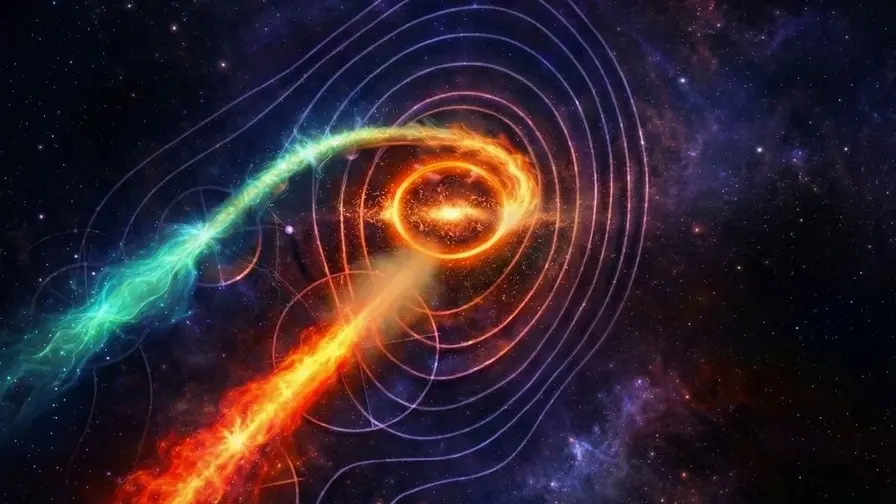
This is not just a visual curiosity. It is the key to the measurement.
By modeling how the jets are deflected by the star’s wind, the team was able to estimate the jets’ instantaneous power for the first time. Their result puts the output at roughly the equivalent of 10,000 Suns. That is an extraordinary figure by any everyday standard, yet it also carries a deeper scientific punch: even a black hole jet, one of the most extreme phenomena in astrophysics, can be shaped by the environment around it.
The companion star in Cygnus X-1 is no ordinary neighbor. Its stellar wind strips away mass at a rate around 100 million times greater than the solar wind from our own Sun, and it drives that material outward at roughly three times the Sun’s wind speed. In other words, this is not a gentle breeze. It is a cosmic hurricane, and it is strong enough to shove around matter being hurled from the edge of a black hole.
That matters well beyond this one system. Black holes do not just consume. They also give back—violently. As matter falls inward, some of the energy is redirected into jets that heat and disturb the surrounding environment. In the case of supermassive black holes at the centers of galaxies, that feedback can regulate star formation, alter galactic gas, and influence structures on enormous scales.
Yet astronomers have long faced a bookkeeping problem. X-rays can reveal how quickly a black hole is feeding, because the infalling gas heats up intensely on its way in. But measuring how much of that energy is being siphoned into jets in real time has been much harder. Without that number, models of black hole feedback remain incomplete.
Cygnus X-1 now offers a way forward. By comparing the black hole’s feeding rate with the power carried off by its jets, researchers can begin to balance that cosmic energy budget more accurately. That, in turn, can sharpen simulations of how black holes shape galaxies and the wider universe.
What makes this discovery memorable is not just the number attached to the jets, but the lesson behind it: even in the most extreme corners of the cosmos, context matters.

A black hole may be one of nature’s fiercest engines, but in Cygnus X-1, a nearby star still gets a say. And that is what makes this system so compelling—because sometimes the universe reveals its secrets not in brute force alone, but in the choreography between competing powers.

Leave a Comment
Comments (2)
so the jets power is 10k Suns at once? sounds huge, but how sensitive is that model to wind assumptions? curious.
wait, the star wind actually bends the jets? wow, didnt expect a 40-solar-mass star to boss around a black hole. if that's real then…