
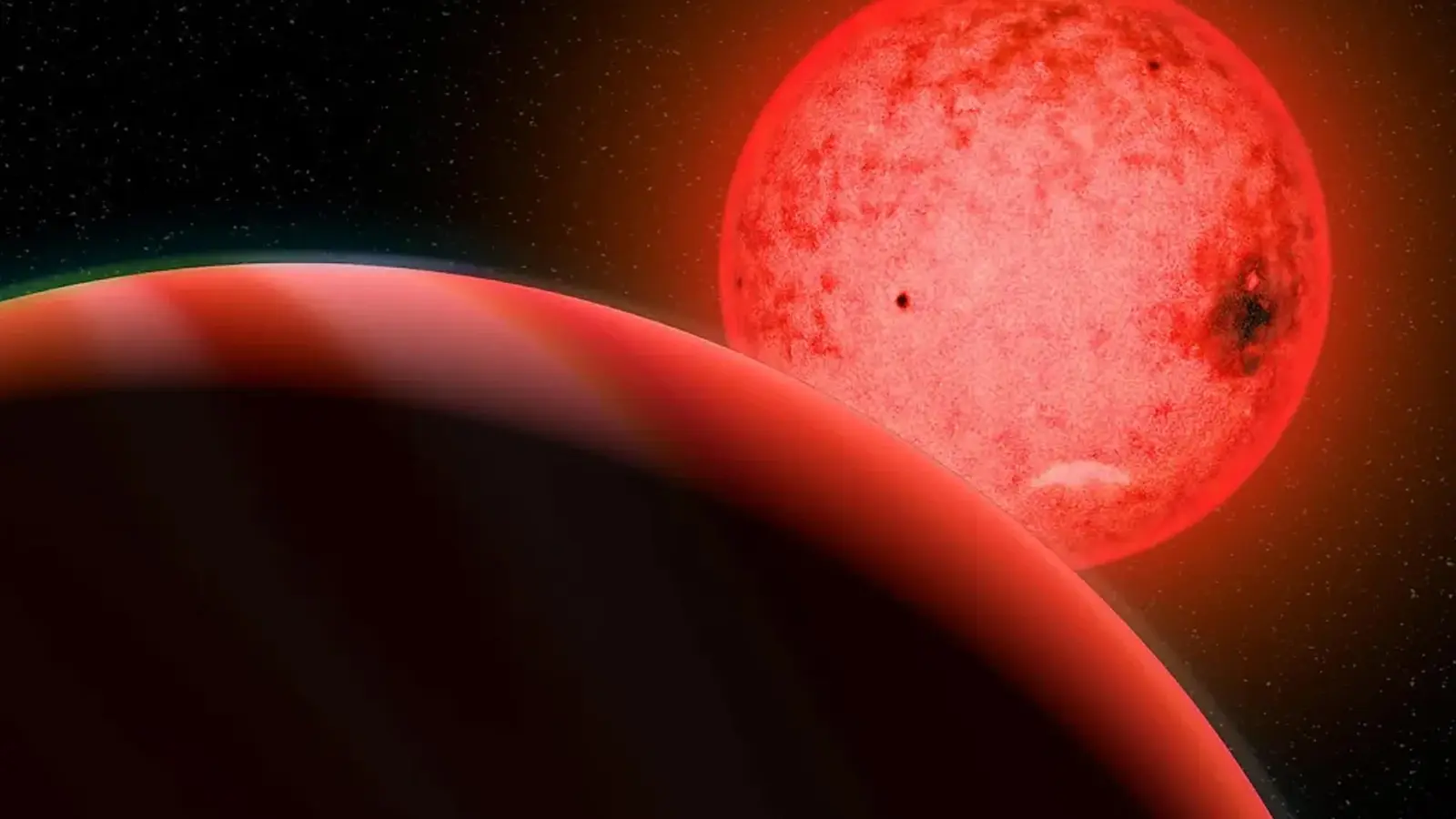
A planet this big has no business circling a star this small. And yet TOI 5205b is right there, forcing astronomers to rethink some of their most trusted ideas about how worlds are born.
The strange system first turned heads when researchers studying a modest red dwarf spotted a gas giant roughly the size of Jupiter. On paper, that may not sound extraordinary. We already know giant planets are common across the galaxy. But scale changes everything. TOI 5205b is enormous compared with its host star, measuring nearly a quarter of the star’s size. Each time it crosses in front of that dim red sun, it wipes out about 7 percent of the starlight, making it one of the deepest exoplanet transits ever recorded.
That alone would have made it memorable. What makes it truly puzzling is the star itself. Red dwarfs are small, cool, and light compared with stars like our Sun. The one hosting TOI 5205b has only about 40 percent of the Sun’s mass. Under standard planet formation models, a star like that should not have had enough raw material in its surrounding disk to build a giant planet in the first place. That is why astronomers started calling TOI 5205b a “forbidden” planet, not as a dramatic flourish, but because the usual rules seem to break down here.
Now the mystery has deepened. Using the James Webb Space Telescope, scientists took a closer look at the planet’s atmosphere and found fresh clues that make this oddball world even harder to explain. Their results, published in The Astronomical Journal, point to an atmosphere with a surprisingly low amount of heavy elements relative to hydrogen. In planetary science, those heavier elements, everything beyond hydrogen and helium, are described as metallicity. And in this case, TOI 5205b appears poorer in those ingredients than Jupiter and Saturn.

That matters. A gas giant’s atmospheric makeup can preserve fingerprints from its earliest history, hinting at where it formed, what materials were available, and how its interior evolved over time. TOI 5205b does not seem to follow the chemical pattern astronomers would expect from a giant world orbiting such a small star. Even more intriguing, the planet appears to have lower metallicity than its own host star, a mismatch that could carry major implications for theories of giant planet formation.
Lead author Anjali Piette of Carnegie Science said the findings could reshape how researchers think about the earliest stages of building giant planets. That is not an overstatement. The standard picture begins with a young star surrounded by a spinning protoplanetary disk made of leftover gas and dust. Inside that disk, material gradually clumps together. Rocky planets can emerge this way, and so can the solid cores of future gas giants. Once one of those cores reaches a critical mass, often estimated at around ten times the mass of Earth, it can rapidly pull in large amounts of gas and balloon into a world like Jupiter.
Here is the catch: around a small red dwarf, there should be less building material to work with. Reaching that critical core size ought to be much harder. So how did TOI 5205b manage it? That question remains open.
The new Webb observations hint that the answer may lie deep inside the planet. One possibility is that heavy elements migrated inward as TOI 5205b formed, leaving its upper atmosphere relatively poor in metals while enriching its interior. If the atmosphere and deep layers are no longer mixing efficiently, the planet could preserve that unusual chemical split for a very long time. Co-author Shubham Kanodia noted that the data may point to an atmosphere rich in carbon but poor in oxygen, another sign that this world may have assembled in a very different way from the gas giants in our own solar system.

That is what makes TOI 5205b so compelling. It is not just a weird exoplanet. It is a stress test for planetary science. Every time astronomers find a world that should not exist, they get a chance to discover that nature is more inventive than the models built to describe it. And with Webb now peeling back the atmospheres of distant planets in unprecedented detail, the universe may be about to hand us many more so-called forbidden worlds.

Leave a Comment
Comments (2)
Wait, are we sure metallicity estimates aren't skewed by clouds or data limits? Sounds huge but maybe there's a simpler fix, tho.
No way, a Jupiter-sized planet around a tiny red dwarf? Mind blown. If models fail, rewrite textbooks.. wild