
3 Minutes
A robotic probe skimmed past Mars on May 15 and left the Red Planet with more than a faster orbit. It left with pictures, data and a precisely timed shove that saved onboard propellant — a neat bit of celestial choreography.
The Psyche spacecraft closed to within 2,864 miles (4,609 kilometers) of the Martian surface to perform a gravity assist: a maneuver that used Mars’ mass to tweak the craft’s speed and tilt its orbital plane without burning fuel. Short. Efficient. Elegant. While the main objective of this six-year voyage remains unchanged — to rendezvous with the metal-rich asteroid Psyche in 2029 — the Mars encounter doubled as a dress rehearsal for the instruments and operations that will be needed at the target.
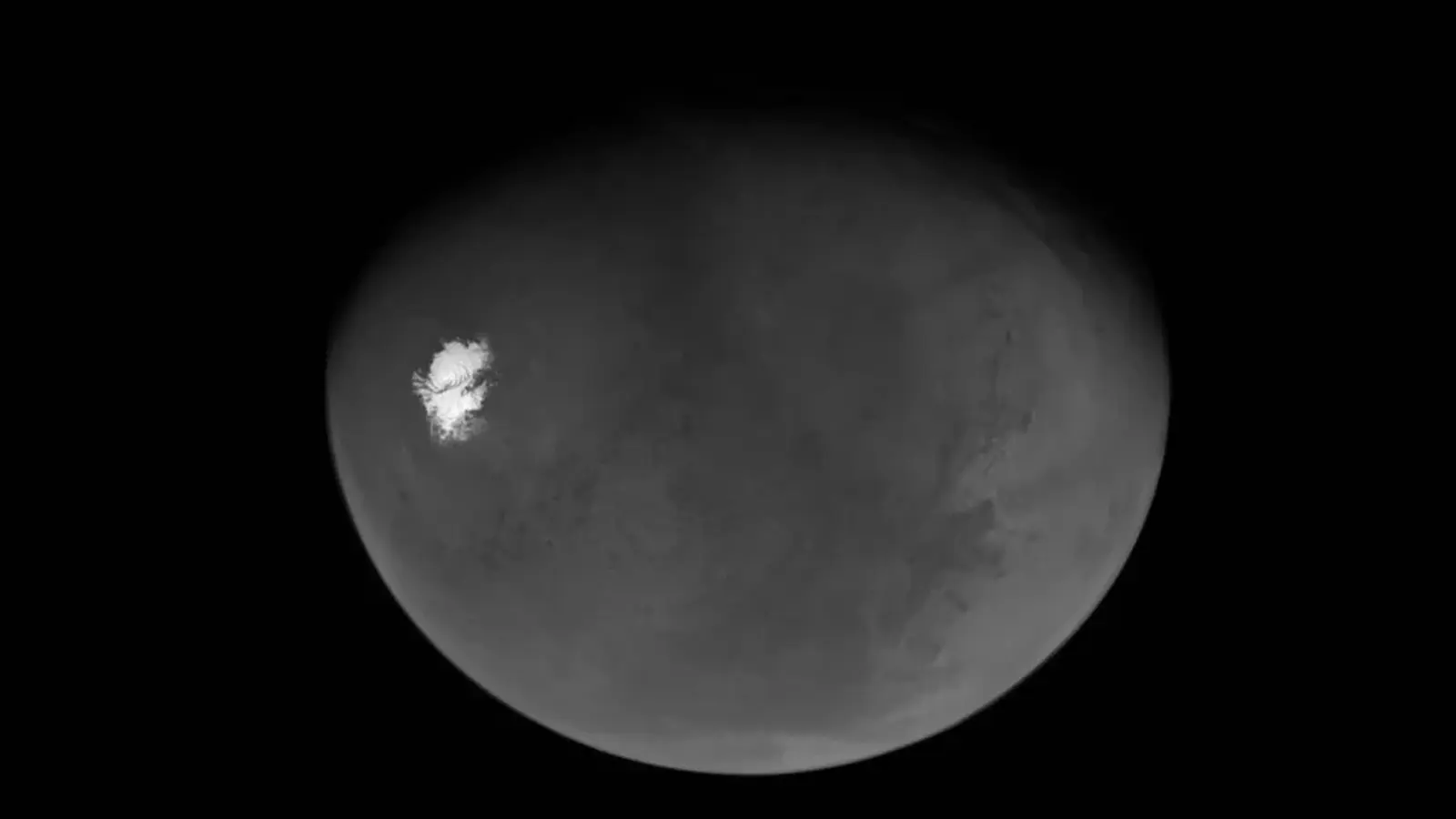
Mission engineers powered up magnetometers, gamma-ray and neutron spectrometers, and the multispectral imager during the approach. The payoff was immediate. Psyche returned rare views of Mars from a high-phase perspective, showing the planet as a thin, dusty crescent. Atmospherically scattered sunlight lit the crescent differently than the familiar disk photographs, giving scientists a fresh look at how airborne dust shapes Martian light and color.
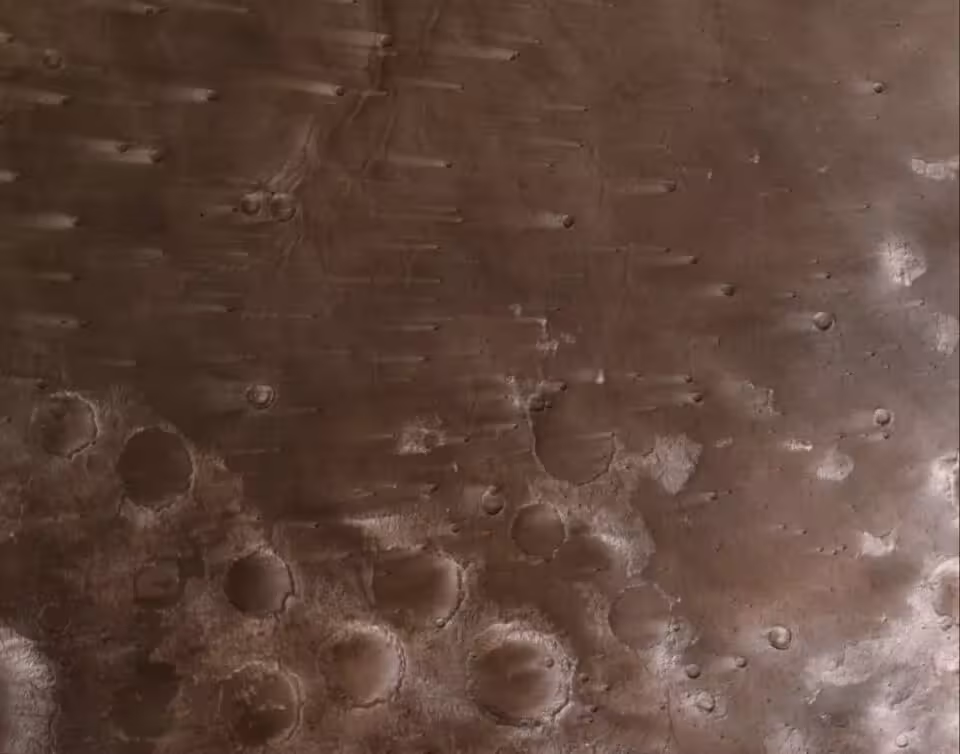
Closer in, the imager captured rapid sequences as the spacecraft transitioned from night into day above the Syrtis Major region. Wind streaks carved downwind from impact craters are visible, stretching roughly 30 miles (50 kilometers). Those streaks aren’t just scenic; they’re natural wind vanes that help the team test image processing pipelines and calibrate sensors meant for the asteroid encounter.
Calibration is more than bookkeeping. These early measurements let the science team characterize the cameras and refine the algorithms that will turn distant pixels into geology back at asteroid Psyche. Jim Bell and colleagues at Arizona State University have been using the Mars dataset to stress-test imaging software and confirm the instruments behave as expected in flight.

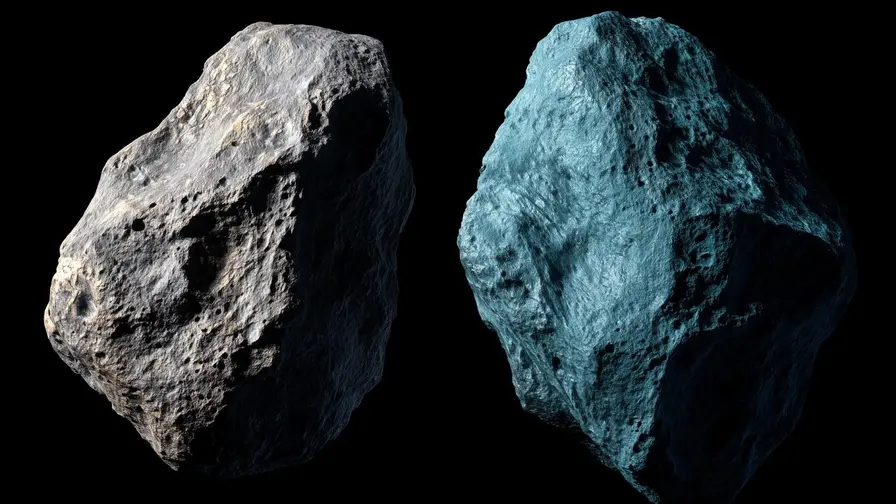
Psyche launched in October 2023 and will cruise to the main asteroid belt using solar-electric propulsion, the efficient ion-thrust system that quietly nudges the craft along between gravity assists. The target is a roughly 173-mile-wide (280-kilometer) body orbiting between Mars and Jupiter that many scientists suspect may be an exposed core of an early planetesimal — essentially a piece of proto-planetary plumbing left bare by violent collisions during the solar system’s infancy.
Communications checks via NASA’s Deep Space Network confirmed the flyby refined Psyche’s trajectory exactly as planned. Psyche is now on course for the asteroid after a precise, fuel-free slingshot past Mars. With instruments tuned and navigation validated, the spacecraft has resumed its steady ion-drive trek toward a rendezvous planned for late July 2029.
Why does this matter? Because probing an exposed metallic core could rewrite parts of the story of planetary formation. A single close shave with Mars has widened our view — literally and figuratively — of what the Psyche mission might reveal about worlds we once only imagined. Watch this space; the best images and surprises are still ahead.








Leave a Comment
Comments
No comments yet. Be the first.