
5 Minutes
Something small on Mars caused something large. An intense but localized dust storm, the kind that would be easy to miss on a headline about global storms, appears to have shoved far more water into the planet’s upper atmosphere than anyone expected. That surge then accelerated the escape of hydrogen—and with hydrogen gone, water follows. Simple in idea. Profound in consequence.
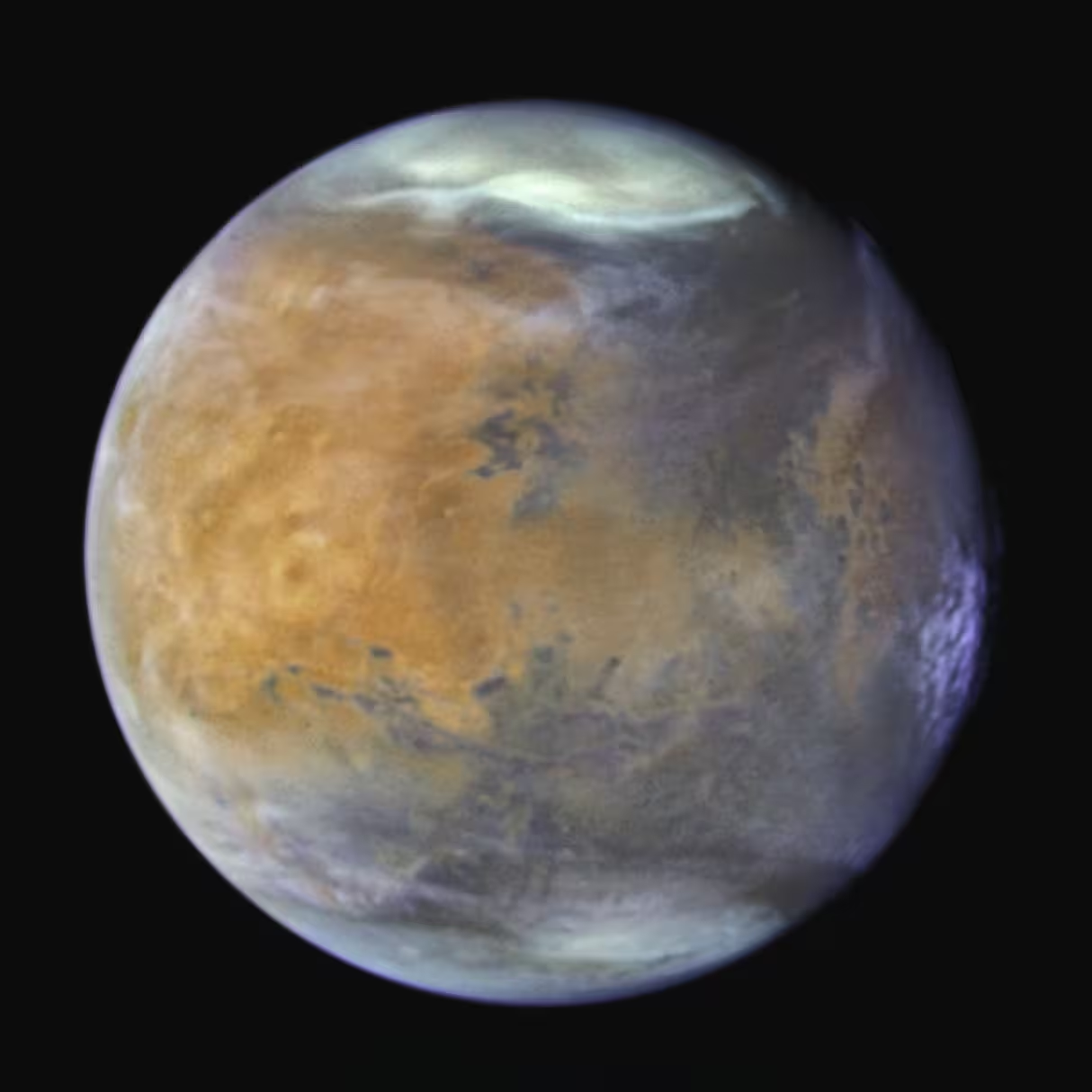
Composite images of Mars taken by the Hubble Space Telescope in 2024. Thin clouds of water ice, visible in ultraviolet light, give the Red Planet an icy appearance. The frigid north polar ice cap was experiencing the beginning of Martian spring.
For decades the story of Mars has been one of dramatic change. Ancient valleys carved by flowing liquid and minerals altered by persistent water argue that the planet was once far wetter and more habitable than it is today. Scientists have identified many mechanisms that can strip water from an atmosphere—solar wind sputtering, photochemical breakup, and escape driven by thermal and non-thermal processes among them. Still, models and observations left a large gap between the known drivers of water loss and the total missing water suggested by geology.
Now, an international research team led by Adrián Brines (IAA-CSIC) and Shohei Aoki (University of Tokyo and Tohoku University) has shown that short-lived, regional dust storms can punch a surprisingly big hole in Mars’ atmospheric water budget. Their paper in Communications: Earth & Environment documents an event in the northern summer of Martian year 37 (2022–2023 on Earth) when a localized storm over Syrtis Major lifted water vapor deep into the middle and upper atmosphere—altitudes that make escape far easier.
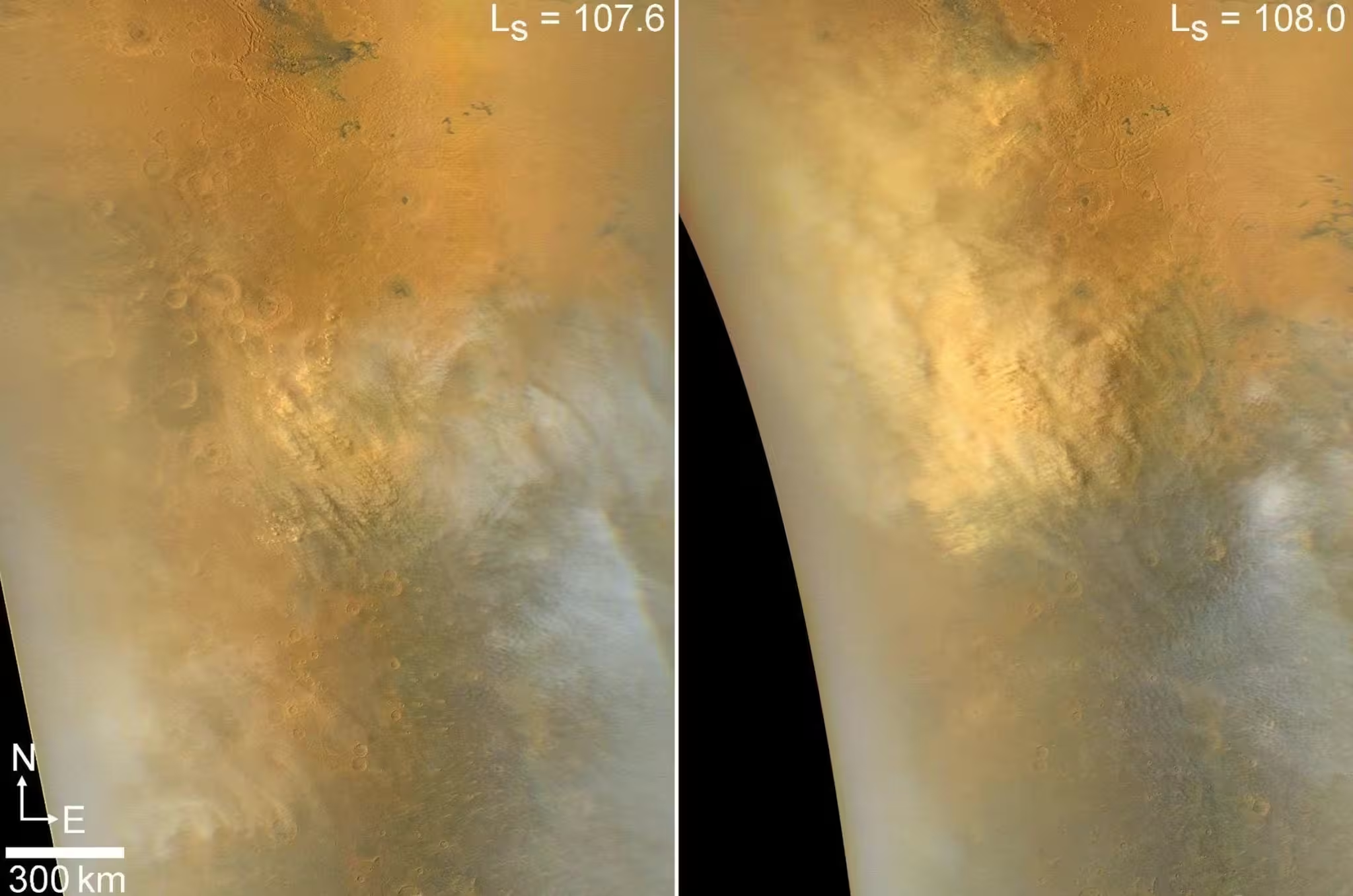
Daily MRO-MARCI global map images of the initial growth of a rare regional dust storm in northwestern Syrtis Major, observed on August 21, 2023, at Ls = 107.6° (left) and August 22, 2023, at Ls = 108.0° (right), reaching an extent of 1.2 × 10⁶ km².
How a localized storm became a hydrological amplifier
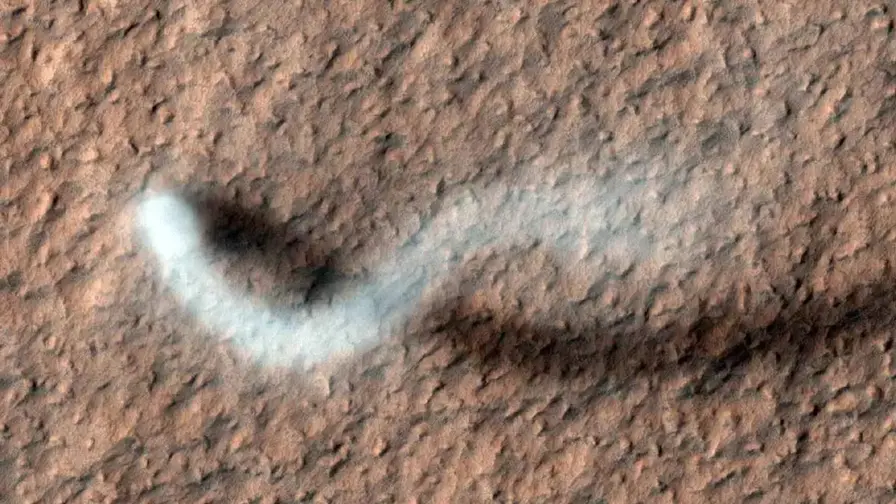
Dust matters on Mars. When airborne, it absorbs sunlight and heats the surrounding atmosphere. That warming changes circulation patterns, strengthening vertical motions and lifting moisture higher than usual. In the reported event, water vapor concentrations in the middle atmosphere were measured at levels up to ten times higher than typical for the season—an anomaly not predicted by current climate models. Hours to days later, instruments recorded an increase in hydrogen near the exobase, the tenuous shell where the atmosphere transitions into space. Hydrogen counts climbed to roughly 2.5 times the values seen during comparable seasons in earlier years.
Why watch hydrogen? Because much of Mars’ water loss is stealthy: UV light splits H2O into hydrogen and oxygen. Hydrogen, light and swift, can escape to space more readily. Track hydrogen and you get a tracer for net water loss over time. The unusual sequence of events observed by the research team—regional dust storm, water lofting, hydrogen spike—creates a plausible short-lived but effective pathway for water to leave the planet.

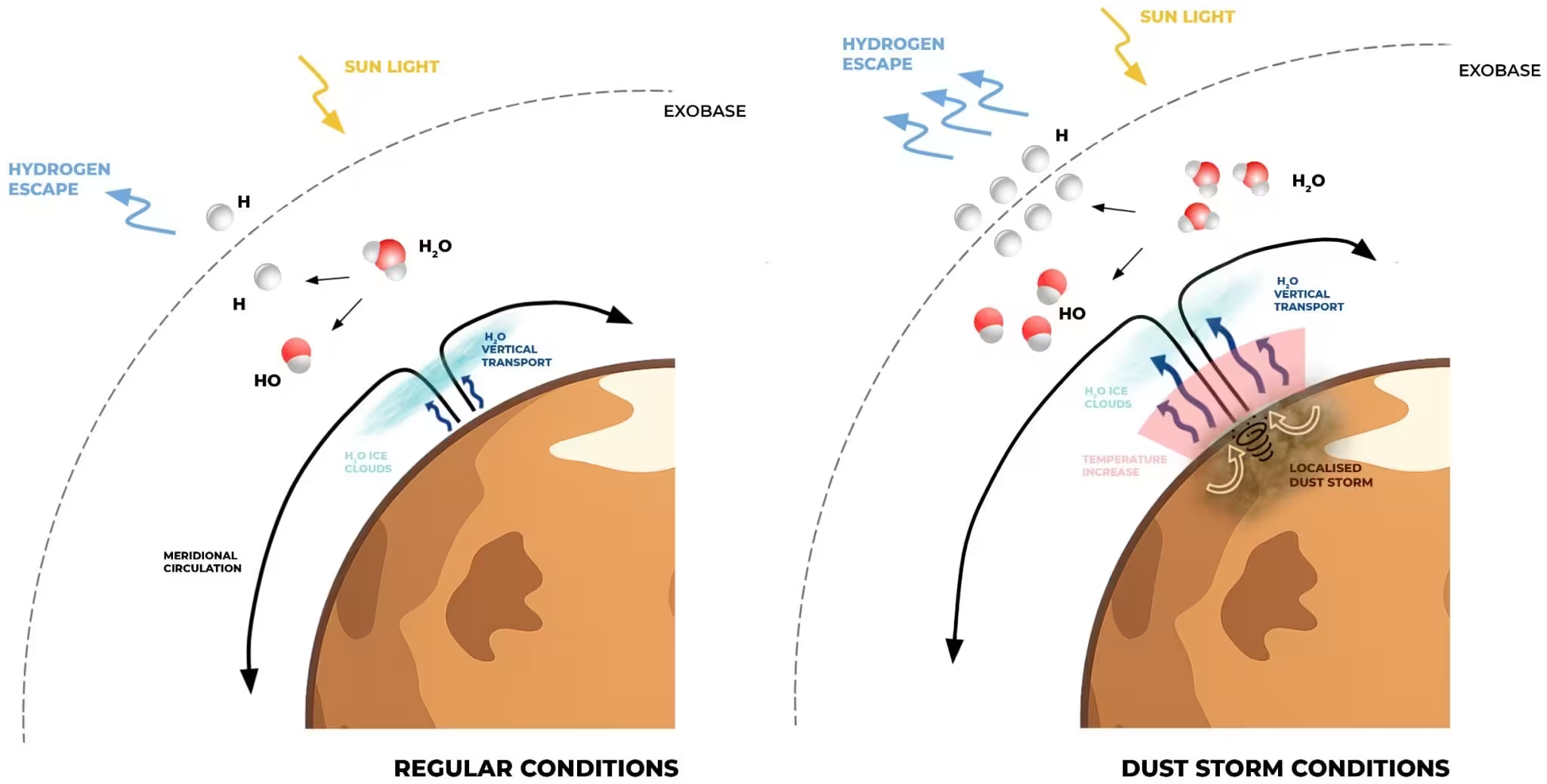
Diagram illustrating the atmospheric response to a localized dust storm in the Northern Hemisphere during the local summer season. High dust concentrations significantly increase the absorption of solar radiation, leading to greater atmospheric warming, especially in the middle atmosphere. Furthermore, the increased atmospheric circulation associated with the dust storm enhances the vertical transport of water vapor from the lower atmosphere, promoting water injection at higher altitudes and increasing hydrogen escape from the exobase.
Until now, much of the community’s attention focused on southern summer and on planet-encircling dust events as the main drivers of escape. Those seasons and storms are energetic—no question. But this study reframes the problem: you don’t need a global gale to make a dent in Mars’ water inventory. Brief, intense regional storms occurring at the right time and place can do the job too. The implication is that cumulative losses over geological time may include many such episodic events that previous models underestimated.
Evidence, instruments and the limits of prediction
The team combined orbital observations of atmospheric composition and imaging to reconstruct the storm’s evolution and its atmospheric consequences. Remote sensing tools recorded the sudden water vapor spike and the subsequent hydrogen increase at the exobase. Existing climate models failed to anticipate this pattern, revealing gaps in how we represent dust–radiation feedbacks and vertical mixing under regional storm conditions. In short: Mars’ atmosphere is more nonlinear than our models assumed.
Scientists caution that one event is not a full rewrite of Mars’ climate history. But it is a strong correction. Short episodes—brief, local, intense—may have been efficient at stripping hydrogen over millions to billions of years. Accounting for them changes estimates of how much primordial water Mars could have lost and alters scenarios for past habitability and the longevity of surface water reservoirs.
Expert Insight
"The surprising part is how focused and fleeting the mechanism was," says Dr. Lila Moreno, a planetary scientist at the Jet Propulsion Laboratory who was not involved in the study. "Dust does more than obscure the view; it reorganizes atmospheric energy and motion. When that happens in mid- to high-latitude summers, even regional storms can pull moisture into escape-friendly altitudes. We need models that capture these bursts, otherwise we risk underestimating Mars’ long-term water loss."
The new results also have practical consequences for future missions. Instruments designed to monitor atmospheric composition and escape need the temporal sensitivity to catch short-lived spikes. Designing observing campaigns that look for regional storms in critical seasons will sharpen estimates of water loss and refine the story of Mars’ climatic transition from wet to dry.
Short-lived, hard-hitting events often leave the deepest marks. On Mars, tiny storms may have been slow architects of the planet’s great drying. The next step is to fold these episodic drivers into models and observational plans—and to ask where else in the Solar System brief episodes might quietly steer planetary futures.

Leave a Comment
Comments (2)
Is this even true? One regional storm... can it really push that much water up? Feels like we need more events to trust it, or am I missing something
whoa, tiny dust storm doing big damage? kinda spooky but brilliant, we really underestimated Mars' sneaky ways. if true this flips some models..