

4 Minutes
Ultrafast ultraviolet light has taken a major step forward: researchers have demonstrated a system that can both create and detect femtosecond pulses in the UV-C band, enabling new possibilities for free-space optical communication, ultrafast spectroscopy, and compact photonic devices.
Femtosecond UV-C Photonics
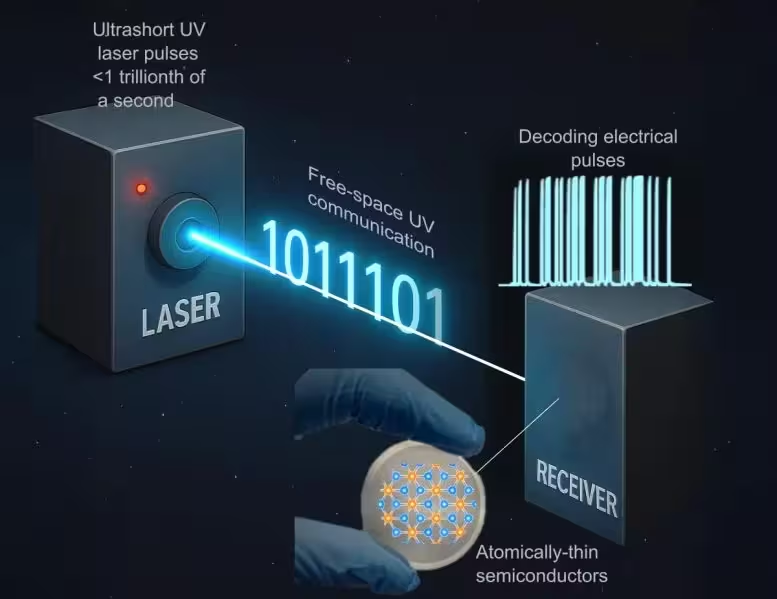
Schematic configuration for generation and detection of femtosecond UV-C laser pulses in free space. A message is coded by a UV-C laser source-transmitter and decoded by a sensor-receiver. The sensor is based on an atomically-thin semiconductor grown by molecular beam epitaxy on a 2-inch sapphire wafer (inset).
Why UV-C and femtosecond pulses matter
UV-C light (100–280 nm) is prized in several scientific and industrial fields because of its strong atmospheric scattering and high photon energy. That scattering can be an advantage: unlike infrared or visible light, UV-C can support non-line-of-sight communication, where information is transmitted even when obstacles block a direct beam. When those UV-C bursts are shortened to femtoseconds—one quadrillionth (10^-15) of a second—the temporal resolution and data-carrying potential increase dramatically.
Until now, the lack of practical, scalable hardware has limited progress. Generating UV-C light efficiently is difficult, and detecting ultrashort UV-C pulses at room temperature has required specialized equipment. The new platform combines advances on both fronts: an efficient, cascaded nonlinear conversion source for femtosecond UV-C pulses and compact photodetectors built from atomically thin (2D) semiconductors.
How the new system works: source and sensor
Generating femtosecond UV-C pulses
The laser source relies on cascaded second-harmonic generation and phase-matched second-order processes inside nonlinear crystals. By carefully designing the nonlinear stages and the phase-matching conditions, the team achieved high conversion efficiency and produced UV-C pulses that last only a few femtoseconds. High conversion efficiency matters: it keeps the source compact and lowers the power demands, making practical devices more feasible for lab and field use.

Detecting ultrashort UV-C flashes with 2D semiconductors
On the detection side, the researchers used photodetectors based on gallium selenide (GaSe) layered with a wide band-gap oxide (Ga2O3). These atomically thin materials—grown by molecular beam epitaxy on two-inch sapphire wafers—operate at room temperature and show promising responses to femtosecond UV-C pulses. Notably, the photocurrent response transitions from linear to super-linear with increasing pulse energy, a behavior that makes the detector versatile across a broad range of pulse energies and repetition rates.
Demonstration: free-space communication in action
To validate the platform, the team built a free-space link: information was encoded into the UV-C femtosecond pulse train by a transmitter and decoded by the 2D-semiconductor-based receiver. The experiment proved two important points simultaneously—the source can generate ultrashort UV-C pulses reliably, and atomically thin sensors can detect and decode those pulses at room temperature. This marks a practical step toward UV-C photonic systems that can operate in cluttered environments where line-of-sight links are impractical.
Implications for photonics, imaging, and communications
This combined capability opens multiple pathways. Integrated photonic chips that monolithically combine UV-C sources and 2D detectors could support ultrafast spectroscopy, broadband imaging, and secure short-range communication between autonomous systems or robots operating indoors or in smoke-filled or obstructed environments. Fast UV-C pulses also enable time-resolved measurements with femtosecond precision, enhancing studies of ultrafast chemical and solid-state dynamics.
Scalability is another key advantage: the materials and nonlinear crystal approaches used are compatible with manufacturing methods that can be scaled down and integrated into compact modules. That matters for researchers and industry groups aiming to move UV-C photonics from specialized labs into broader applications.
Technical takeaways and research context
- Nonlinear optics: Cascaded second-harmonic processes and careful phase matching make efficient UV-C generation possible without overly complex pump lasers.
- 2D semiconductor detectors: GaSe/Ga2O3 heterostructures show room-temperature sensitivity to femtosecond UV-C pulses and a favorable photocurrent scaling with pulse energy.
- Free-space potential: Strong atmospheric scattering of UV-C is a double-edged sword—challenging for long-distance line-of-sight links but advantageous for non-line-of-sight communication and short-range, obstacle-tolerant links.
Expert Insight
Dr. Elena Márquez, an optical engineer not involved in the study, comments: "This is a timely advance. Combining efficient UV-C generation with compact 2D detectors addresses two of the biggest hardware gaps in the field. If the performance holds up under real-world conditions—varying temperatures, optical clutter, and longer links—we could see a new class of ultrafast UV-C modules for lab instruments and robotic communications."

Looking ahead, researchers will focus on improving conversion efficiency further, integrating sources and detectors on-chip, and testing robustness in practical environments. As components mature, expect to see demonstrations of UV-C photonic integrated circuits, femtosecond imaging systems, and new free-space optical protocols that exploit UV-C scattering for reliable data transfer in complex settings.











Leave a Comment
Comments (2)
So they made room-temp UV-C detectors? sounds big, but how about durability, temp drift and eye safety regs? real-world tests?
Wow, femtosecond UV-C? mind blown. Non line of sight comms in smoke or clutter, that's wild. Hope safety's ok tho, UV-C is nasty to skin!