
5 Minutes
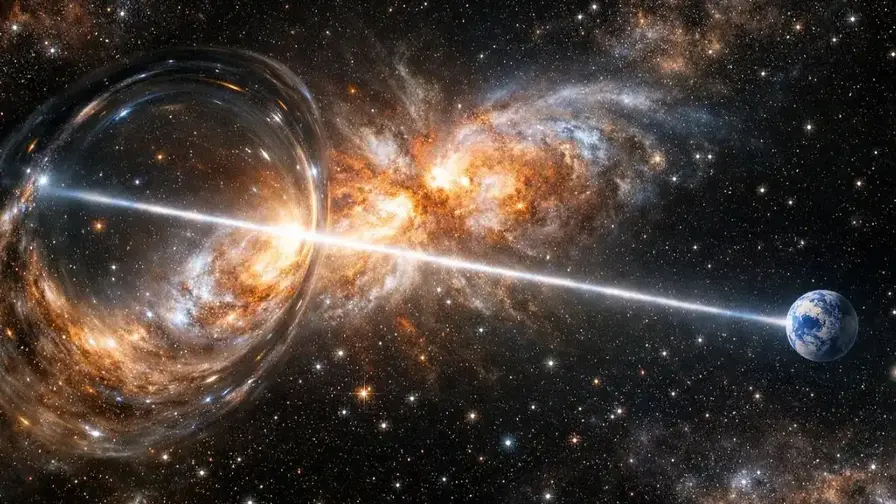
A sleeping giant has stirred. In radio waves stretching nearly a million light-years, astronomers have caught a supermassive black hole in the act of turning its jets back on after almost 100 million years of near silence.
Think of it like a volcano that lay dormant for eons and now belches again — not lava, but magnetized plasma fired from the galaxy’s heart. The revived streams carve and collide with the hot gas of a surrounding galaxy cluster, producing striking bends, compressed lobes, and a layered fossil record of repeated outbursts.
How the restart was seen
The reawakening of J1007+3540 was revealed by deep radio imaging from two complementary interferometers: LOFAR (the Low Frequency Array) and India’s upgraded Giant Metrewave Radio Telescope, uGMRT. Together they map faint, aged plasma at low radio frequencies and the brighter, compact emission close to the black hole. The result is a picture that reads like geological strata — fresh, bright jets nested inside an older, diffuse cocoon.
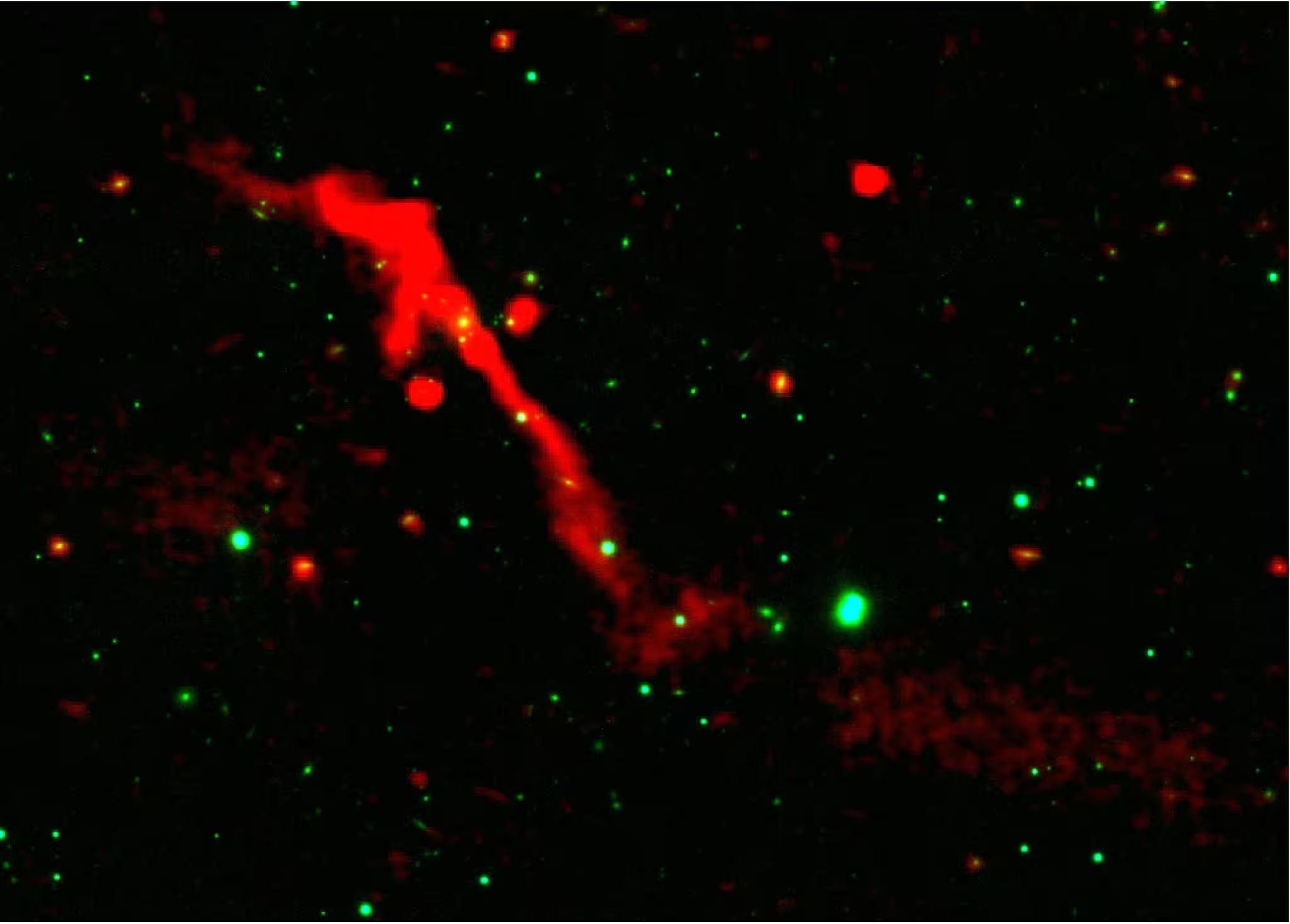
This LOFAR DR2 image of J1007+3540 superimposed over an optical image by Pan-STARRS shows a compact, bright inner jet, indicating the reawakening of what had been a ‘sleeping’ supermassive black hole at the heart of the gigantic radio galaxy.
Lead author Shobha Kumari (Midnapore City College) describes the scene as dramatic. The inner jet is compact and luminous, a clear marker of recent activity. Surrounding it are the dimmer, older lobes: plasma that was expelled during earlier episodes and has been cooling for tens to hundreds of millions of years. The juxtaposition of fresh and fossil emission is the smoking gun of episodic AGN behavior — active galactic nuclei that switch on, shut down, and ignite again over cosmic time.
The team’s analysis shows the northern lobe is particularly distorted. Rather than smooth plumes, the radio maps reveal compressed, curved structures and backflow signatures where older plasma appears shoved sideways by external forces. The uGMRT data show that the compressed region has an ultra-steep radio spectrum, meaning its relativistic particles are old and energy-depleted — a fingerprint of long exposure to the cluster’s harsh environment.
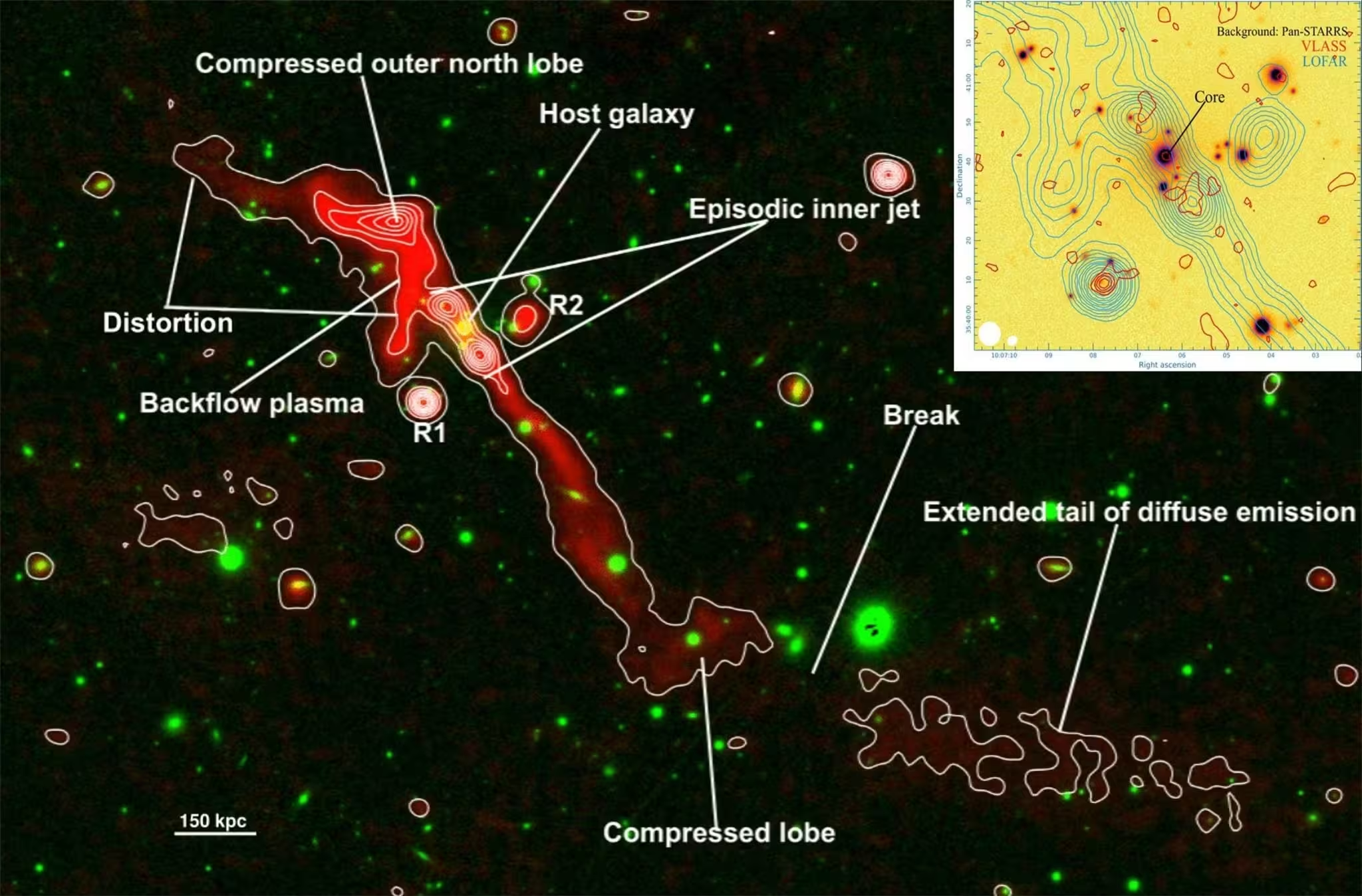
The same images with labels showing the compressed northern lobe, curved backflow signature of plasma and the inner jet of the black hole.
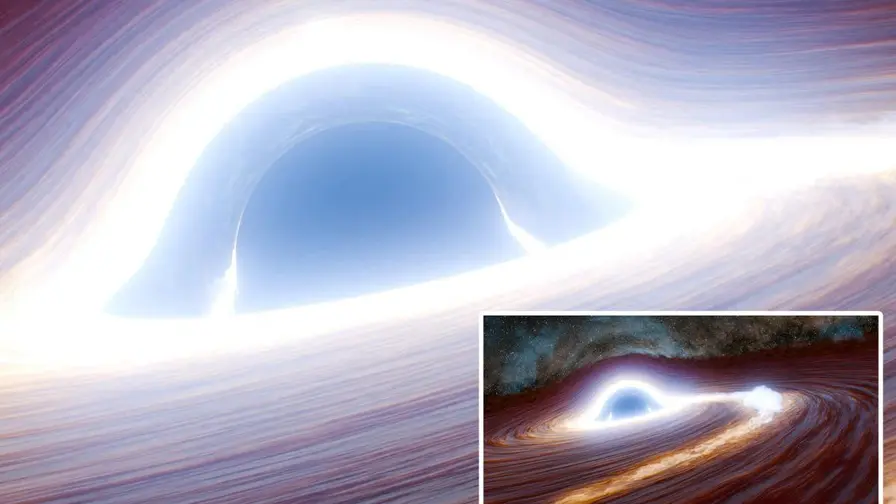
Why does this matter? Because it places the black hole’s activity inside a living environmental context. J1007+3540 is not isolated. It lives in a massive cluster of galaxies filled with extremely hot, X-ray–emitting gas that exerts enormous pressure. When newly launched jets plow into that medium, they are bent and squeezed, sometimes shredded, and often left trailing long, faint tails of magnetized plasma dragged by the cluster flow.
Implications for galaxy and cluster evolution
These observational details illuminate several broader questions in extragalactic astronomy. How often do supermassive black holes cycle between on and off states? How does aged radio plasma interact with ambient intracluster gas? And how do repeated jet episodes alter the shape and destiny of a galaxy and its surroundings?
J1007+3540 offers a practical laboratory. The layered radio morphology tells a history: multiple eruptions at different epochs, preserved because the dense cluster medium arrested and reshaped the outflows. The phenomenon demonstrates that galaxy growth is not a gentle, steady accretion, but a violent dialogue between explosive black-hole feedback and the crushing pressure of the environment that tries to bottle it up.
Dr. Sabyasachi Pal, a co-author, emphasizes that the system is a textbook case of jet–cluster interaction: 'J1007+3540 is one of the clearest and most spectacular examples of episodic AGN with jet-cluster interaction, where the surrounding hot gas bends, compresses, and distorts the jets.' The images capture both the energetic impulse of a restarted AGN and the subtle, long-term influence of cluster gas that sculpts the remnant plasma.
Beyond morphology, these data feed models of particle aging, energy transport, and magnetic-field evolution in radio galaxies. Regions with ultra-steep spectra constrain the timescales over which particles radiate away energy; curved backflows and long diffuse tails map the ways the cluster redistributes plasma and magnetic fields over millions of years.
Practically, the discovery highlights the power of coordinated low-frequency radio surveys. LOFAR probes the faint, ancient emission at the largest scales; uGMRT adds higher-resolution views of the inner structures. Combined, they produce a multi-scale portrait of an AGN that refuses to stay quiet.
Expert Insight
Dr. Maya Hertford, an astrophysicist who studies radio-mode feedback, offers context: 'We sometimes forget how dynamic galaxy clusters are. A restarted jet in a dense environment is a conversation between scales — the black hole speaks in parsecs, the cluster answers across hundreds of kiloparsecs. Observations like these let us eavesdrop on that conversation and measure how feedback shapes gas cooling and star formation.' Her view underscores the broader cosmological stakes: AGN activity regulates galaxy growth and the thermodynamic history of clusters.
Looking ahead, the research team plans higher-resolution, deeper observations to trace the inner jet’s propagation and to measure spectral aging across the lobes more precisely. These follow-ups will clarify how energy is deposited into the cluster medium and how frequently similar reawakening events occur across cosmic time.
For now, J1007+3540 stands as a vivid reminder that the universe retains its ability to surprise. A black hole that slept through geological epochs can stir again and, in doing so, reveal the invisible forces that bind galaxies into clusters and shape the fate of matter on the grandest scales.







Leave a Comment
Comments (2)
Is this for real or an imaging artifact? LOFAR + uGMRT sounds solid, but how confident are they on ages and spectra, could calibration skew the ultra-steep result?
wow, a black hole woke up after 100 million years? mind blown. Those layered jets read like cosmic strata... eerie but awesome, also makes me wonder about the exact timescales