

5 Minutes
A single row of trees can feel like a small, harmless fix—until you watch the birds vanish. Shelterbelts, those intentional lines of trees planted across farmland to break the wind, have been widely promoted as a win for biodiversity. New fieldwork from central Japan suggests the reality is far messier.
Researchers working around Lake Kahokugata on Japan’s western central coast recorded stark shifts in bird communities where shelterbelts cross wet agricultural landscapes dominated by rice paddies. The team found that while edge- and shrub-loving species increase near these woody strips, grassland and open-habitat birds drop dramatically—in some cases by roughly 70 to 75 percent—within sight of the trees.
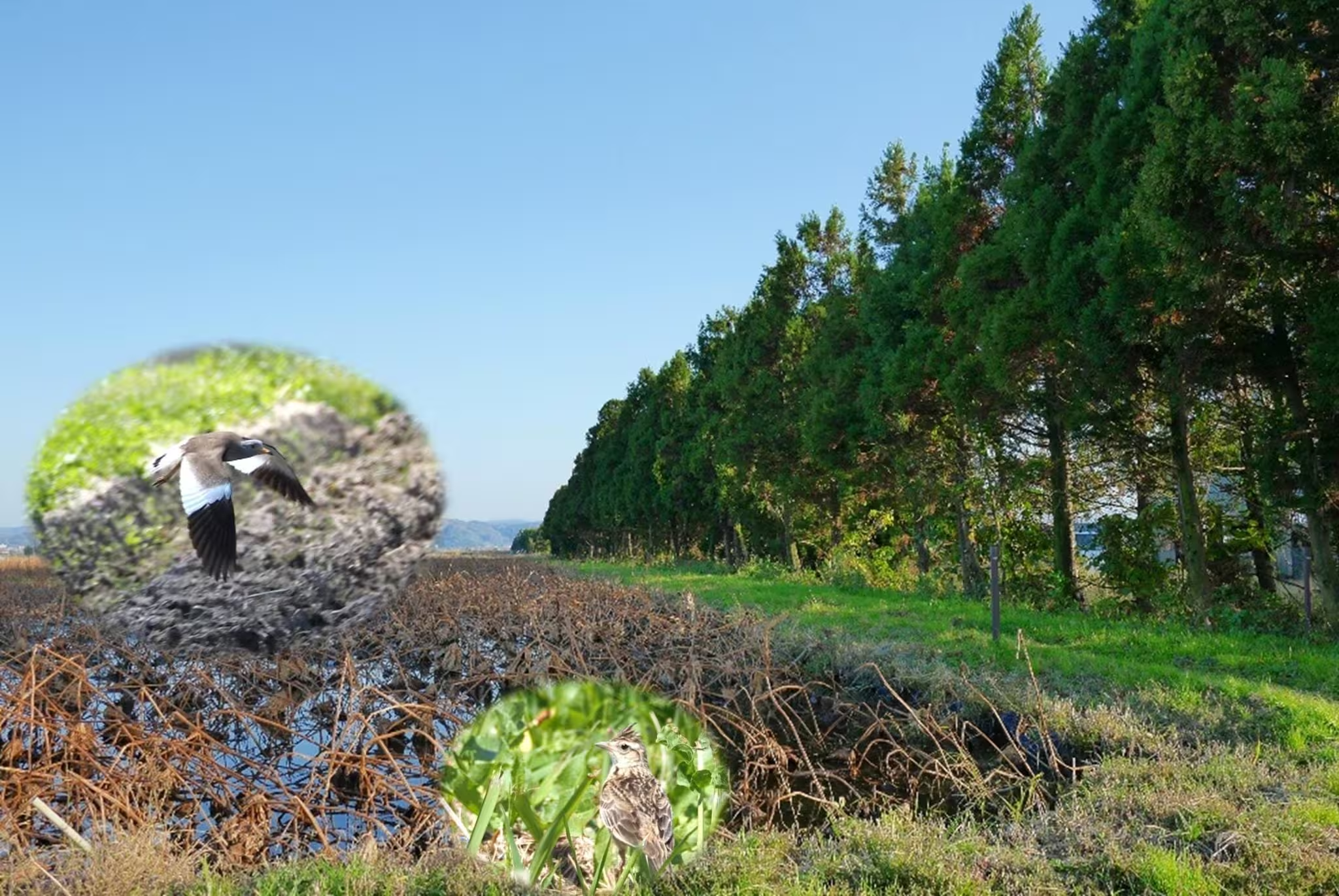
Image shows shelterbelt research site. Birds have been digitally added to the image for illustrative purposes.
Why open space matters
Open wet farmland—rice paddies, lotus fields, and seasonally flooded pastures—acts like a substitute wetland for many species in Asia. These agricultural wetlands are vital stopover and wintering areas for migrants along the East Asian-Australasian Flyway and support breeding birds in summer. But when rows of trees are introduced, the landscape’s character changes. Thin, linear woody features provide perches, nesting niches, and shelter for some species. For ground-nesting and foraging birds that rely on wide, unobstructed views and continuous open ground, those same trees become barriers.
The Japanese team surveyed birds using point-count methods in February and March 2021 and again in June 2023, mapping presence and abundance at sites adjacent to shelterbelts and at open control sites roughly one kilometer away. Their analysis, published in the Journal of Environmental Management, shows a consistent pattern: edge-associated species concentrate near the shelterbelts while grassland-associated species become scarce.
“We found that the abundance of grassland birds was more than 70 percent lower at sites next to shelterbelts compared with open sites located about one kilometer away,” said Masumi Hisano, assistant professor at Hiroshima University’s Graduate School of Advanced Science and Engineering and the study’s corresponding author. “Shelterbelts act like ecological walls.”
The mechanisms are intuitive. Trees increase perch availability for raptors and corvids, raise predator visibility, and fragment continuous open habitat into smaller patches. For birds that need large, open expanses to detect predators and find food, those shifts reduce usable habitat and can increase predation risk.
Design over dogma

The most important takeaway is not a blanket judgment for or against tree planting. Rather, it is about spatial design: where trees are placed, how wide they are, and how they intersect with remaining open habitats. Policies that promote hedgerow restoration or afforestation on the assumption that more trees always equal more biodiversity risk unintended trade-offs in wet-farmed landscapes.
“We should stop asking whether woody vegetation is simply ‘good’ or ‘bad,’” Hisano adds. “The question is how to integrate structural complexity with the needs of open-habitat species—especially in places where wetlands have already been heavily modified by humans.”
In practical terms, that might mean prioritizing tree planting along field margins that do not bisect large open paddies, maintaining wide corridors of open water and fallow fields, or designing shelterbelts with gaps and lower perching opportunities to reduce predator pressure. The team emphasizes variables such as shelterbelt width, spacing, height, and tree composition as actionable design levers that deserve experimental testing across seasons and regions.
Implications for conservation and policy
Agri-environmental schemes in Europe and North America have built much of the evidence base for hedgerows and woody features benefiting farmland biodiversity, but those systems differ from Asia’s wet agricultural mosaics. Rice paddies behave ecologically more like shallow wetlands than dry grasslands, and their bird communities reflect that. Applying one-size-fits-all prescriptions—from a farmer incentive program to a global conservation plan—without local ecological evaluation risks creating conservation trade-offs rather than resolving them.
The stakes are high. Agricultural wetlands produce food and also sustain migratory and wetland-dependent species. Where these habitats are already scarce, every small landscape change reverberates across species ranges and migratory networks. Evidence-based landscape planning can reconcile productive agriculture with biodiversity goals, but it must begin with data-driven spatial design rather than well-intentioned but blunt interventions.
Expert Insight
“Design matters, and it often matters more than simply planting,” says Dr. Emily Carter, an avian ecologist at the University of Cambridge who was not involved in the study. “In agricultural wetlands, the trade-offs are pronounced because many species depend on uninterrupted open water or flooded fields. Shelterbelts can be engineered to reduce harm—by lowering perching opportunities, placing trees away from key foraging areas, or combining tree rows with managed fallow strips that keep open-habitat habitat intact.”
Dr. Carter’s point underscores a broader message: adaptive, site-specific management will outperform universal prescriptions. Field experiments testing different shelterbelt geometries, tree species mixes, and spacing regimes—combined with predator monitoring—are the next logical steps.
For policymakers, the study is a reminder to fund local trials and to measure community-level responses, not just single-species outcomes. For land managers and farmers, it suggests modest design changes can produce markedly different ecological results. And for the public, it offers a cautionary tale: conservation interventions can have winners and losers, even when intentions are good.

Small tweaks. Big consequences. The challenge now is to design agricultural landscapes that keep both people fed and open-habitat birds in the skies.












Leave a Comment
Comments (2)
makes sense tbh, but are raptors/corvids the main cause or is it habitat fragmentation+edge effects? needs multi-season trials, not a snapshot
Wow, didn't expect that. Trees help some birds but wipe out open-habitat species? 70% drop is brutal. Design really matters, not just planting.