
4 Minutes
Imagine a simple tone, played at 40 cycles per second, nudging sticky brain proteins to move where doctors can reach them. The idea sounds almost poetic. Yet a recent primate study suggests that a brief course of rhythmic sound might do just that: shift beta-amyloid out of brain tissue and into cerebrospinal fluid, a sign often taken as improved clearance.
Could this be a low-cost, non-invasive complement to existing Alzheimer’s treatments? Researchers at the Kunming Institute of Zoology (Chinese Academy of Sciences) set out to test exactly that in animals whose brains age much like ours.
Could a low-cost sound-based therapy offer a safer alternative to current Alzheimer’s treatments? In aged monkeys that naturally develop Alzheimer’s-like pathology, scientists found that 40-Hz auditory stimulation produced long-lasting biological effects linked to amyloid dynamics.
What the study did and why it matters
The team led by Dr. Xintian Hu worked with nine elderly rhesus macaques, aged 26–31, animals that develop widespread amyloid plaques akin to those in human Alzheimer’s disease. The experiment was straightforward in design but precise in execution: animals in the treatment group received one hour per day of 40-Hz auditory stimulation — a 1-kHz pure tone modulated at 40 cycles per second — for seven consecutive days. Samples of cerebrospinal fluid (CSF) were collected before treatment, immediately after, and again 35 days later to track biochemical changes.
Results were striking. Levels of two key beta-amyloid peptides, Aβ42 and Aβ40, rose sharply in CSF after the week of stimulation — increases greater than 200% compared with baseline. Even more surprising: those elevated concentrations persisted more than five weeks after stimulation stopped. This kind of durable response has not been reported in mouse models.
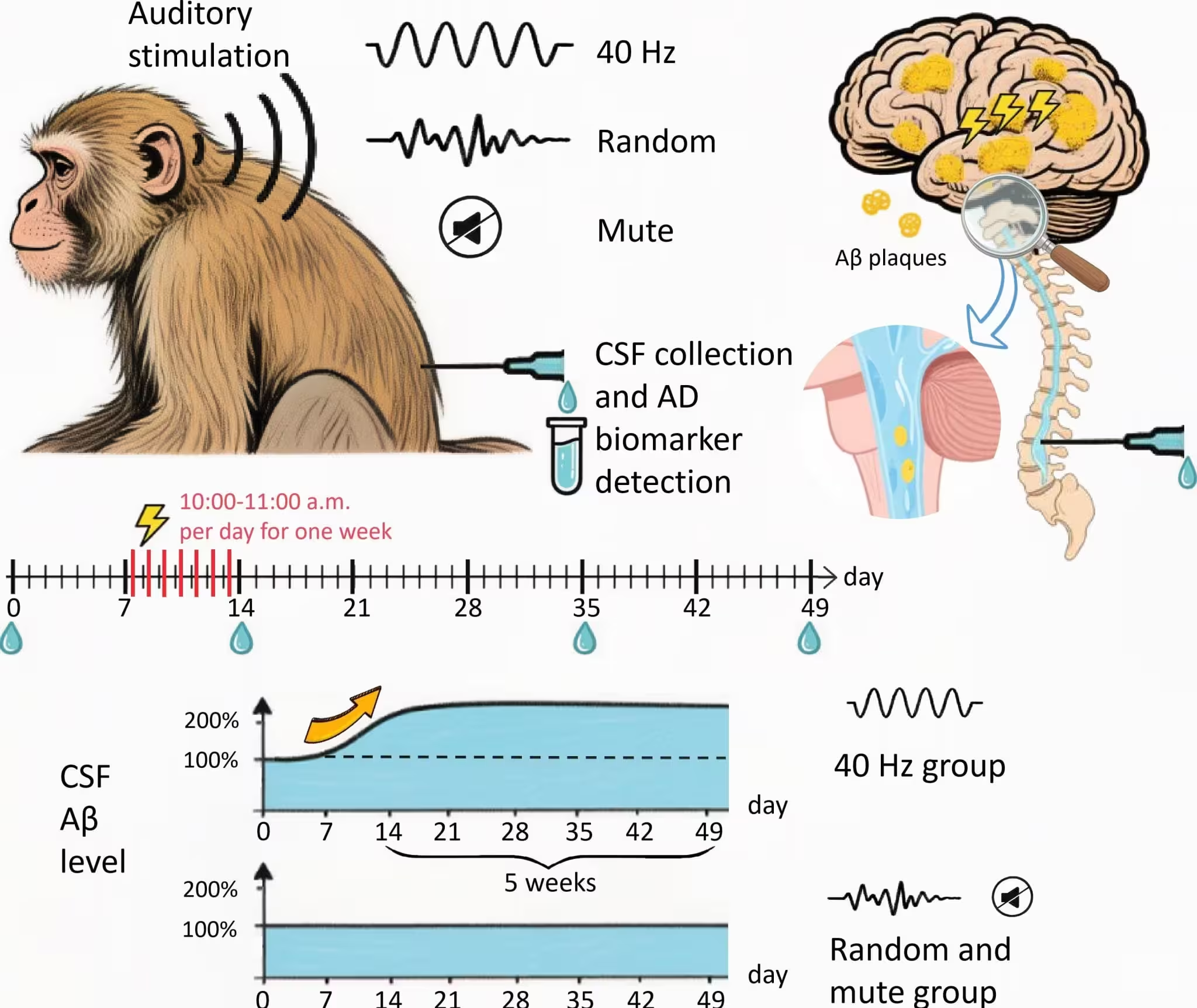
40Hz auditory stimulation specifically caused a significant increase of over 200% in Aβ42 and Aβ40 protein levels in the CSF of aged monkeys, which persisted for more than 5 weeks.

Why does a spike in CSF amyloid matter? In many experimental contexts, higher soluble Aβ in CSF is interpreted as a shift of peptide burden from insoluble deposits in brain tissue into a compartment where clearance mechanisms can act. In other words: movement, not more production. The researchers argue that 40-Hz entrainment may enhance pathways that mobilize and remove aggregated protein.
How this fits into Alzheimer’s research and clinical needs
Current anti-amyloid therapies — notably monoclonal antibodies — have shown promise in slowing decline but come with real risks: cerebral swelling and bleeding among them. A non-pharmacological approach that nudges the brain’s own clearance systems could reduce side effects, lower costs, and broaden access if efficacy translates to humans.
There’s another advantage: primate brains are closer to human brains than rodents in structure, lifespan, and the natural pattern of amyloid accumulation. Observing a robust, long-lasting effect in aged rhesus macaques strengthens the argument for cautious, well-designed human trials.
Still, gaps remain. The mechanism behind the sustained CSF increases is not fully resolved. Are microglial cells activated? Does vascular clearance improve? Or does rhythmic stimulation alter neuronal network activity to favor amyloid solubilization? The study opens each question rather than closing them.
Expert Insight
"The persistence of elevated CSF amyloid weeks after a short course of 40‑Hz stimulation was unexpected," says Dr. Liwen Chen, a neurologist not involved in the study. "If replicated, this suggests modulation of durable clearance pathways rather than a transient redistribution. That has practical implications for dosing, safety, and integration with other therapies."
Translational steps will require careful safety testing, optimized stimulation protocols, and biomarkers that predict clinical benefit. Still, the idea of using sound — inexpensive, non-invasive, and scalable — to assist the brain in clearing toxic proteins is compelling. It invites a new kind of intervention: one that listens as much as it treats.
As researchers plan next steps, human feasibility trials will need to balance rigor with urgency, and to answer a simple but crucial question: can rhythmic sound improve cognition or slow decline when paired with biomarkers that show meaningful changes?
The work does not promise a cure. It offers a different tool, one that might sit alongside drugs, lifestyle changes, and other neuromodulation approaches to reshape how we manage neurodegeneration.

Leave a Comment
Comments (2)
Is this even true? 7 days of tones, then 200% rise in CSF, could be redistribution not cure. Need trials tho
Wow, 40Hz sound moving amyloid? Sounds poetic and kinda hopeful... but I'm wary. Could it actually help ppl?