

4 Minutes
Imagine an engine designed to replace its worn parts continuously, keeping a machine humming for decades. Now picture that engine stuttering, its supply of spare parts dwindling. That is the unsettling image emerging from a new analysis of global biodiversity data: the natural turnover of species in local communities is slowing, not accelerating, even as the planet warms.
What scientists found and why it matters
Researchers drawing on an extensive, century-spanning collection of biodiversity surveys—covering marine floors, freshwater habitats and terrestrial sites—expected to see faster change as temperatures rose. Warmer climates push species ranges poleward and upslope, they reasoned, and so communities should be reshuffled more quickly. Instead, after comparing rates of species replacement before and after the rapid warming that began in the 1970s, the team found something counterintuitive: turnover across many ecosystems has slowed by roughly one third over typical 1–5 year intervals.
That trend appears across very different life forms and settings, from seabed communities to bird assemblages on land. The pattern was strong enough to prompt careful re-examination of how ecosystems operate. If change were only a direct response to shifting climates, we would expect a livelier exchange of species. The data show the opposite.
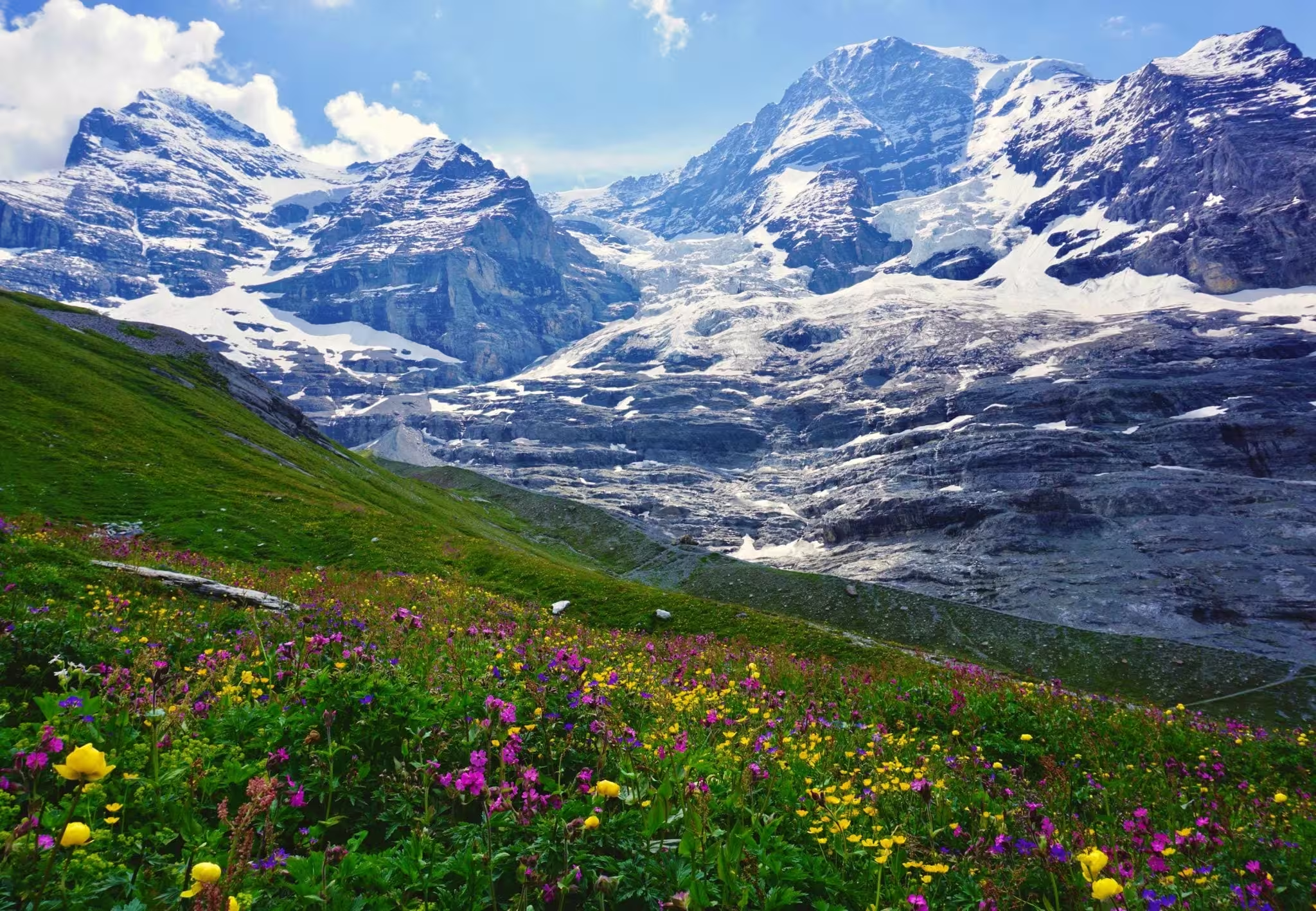
Internal dynamics, depleted pools
To explain the slowdown, the authors explored the idea that community dynamics are not governed solely by external forces like temperature. Instead, many biological communities behave as if in a "Multiple Attractors" phase—a theoretical regime in which species continually replace each other because of internal interactions: competition, predation, and shifting niches. Think of it as an ecological round-robin: no one species holds the field for long because the network of interactions keeps things moving.
But internal motion requires a stream of potential newcomers. That stream comes from the regional species pool: the larger set of species that can colonize a local site. As habitats degrade and biodiversity is lost regionally, fewer species are available to fill gaps. With a thinner pool of colonizers, the internal engine of replacement grinds slower. In short, a landscape that looks locally stable may mask a decline in the wider biological supply chain.

Lead researcher Dr. Emmanuel Nwankwo framed it this way: ecosystems once had a steady turnover because there were ample species to test new niches and exploit opportunities. But with human-driven habitat loss and declines in regional diversity, that turnover is losing momentum. Professor Axel Rossberg, a co-author, emphasized the magnitude of the shift: many locations now show turnover rates roughly a third lower than before the era of rapid warming.
Implications for resilience and conservation
A slower rate of species replacement is not an inherently good sign. Resilience—the ability of ecosystems to recover from disturbance—depends in part on dynamism and on a wide pool of species with varied traits. If local communities stop changing because they lack new entrants, they can become fragile: a single disturbance or disease may have outsized consequences when redundancies and functional alternatives are gone.
Practically speaking, the findings point to the limits of viewing a static species list as an indicator of health. Conservation that focuses narrowly on preserving local composition without addressing regional connectivity and overall diversity may miss the deeper problem: the erosion of the processes that sustain ecosystems.
Responding will require policies that go beyond protecting isolated parcels. Restoring habitat corridors, halting habitat fragmentation, and rebuilding regional species pools through targeted rewilding and translocation could help renew the flow of colonizers. Monitoring programs must also track not just species presence but rates of turnover and the breadth of regional pools.
Expert Insight
"It's tempting to read a calm species list as a victory," says Dr. Lila Chen, a conservation ecologist not involved with the study. "But calm can be a warning sign. We need to restore the ecological supply lines—the sources that replenish local communities—if we want ecosystems to remain adaptive in a changing climate."

The research changes how we think about biodiversity under climate stress. Faster warming does not automatically mean faster ecological change at every scale. Sometimes the bottleneck is internal: the network of life running out of options. In that case, protecting species means more than preserving what remains locally; it means reviving the regional lifelines that keep nature moving.

Leave a Comment
Comments (2)
Is the slowdown really from fewer colonizers, or biased sampling? if that's real then... more tests needed, or different metrics?
Wow that engine metaphor hit hard. Calm = not ok. If regional pools die, whole systems frag. we need corridors, fast