
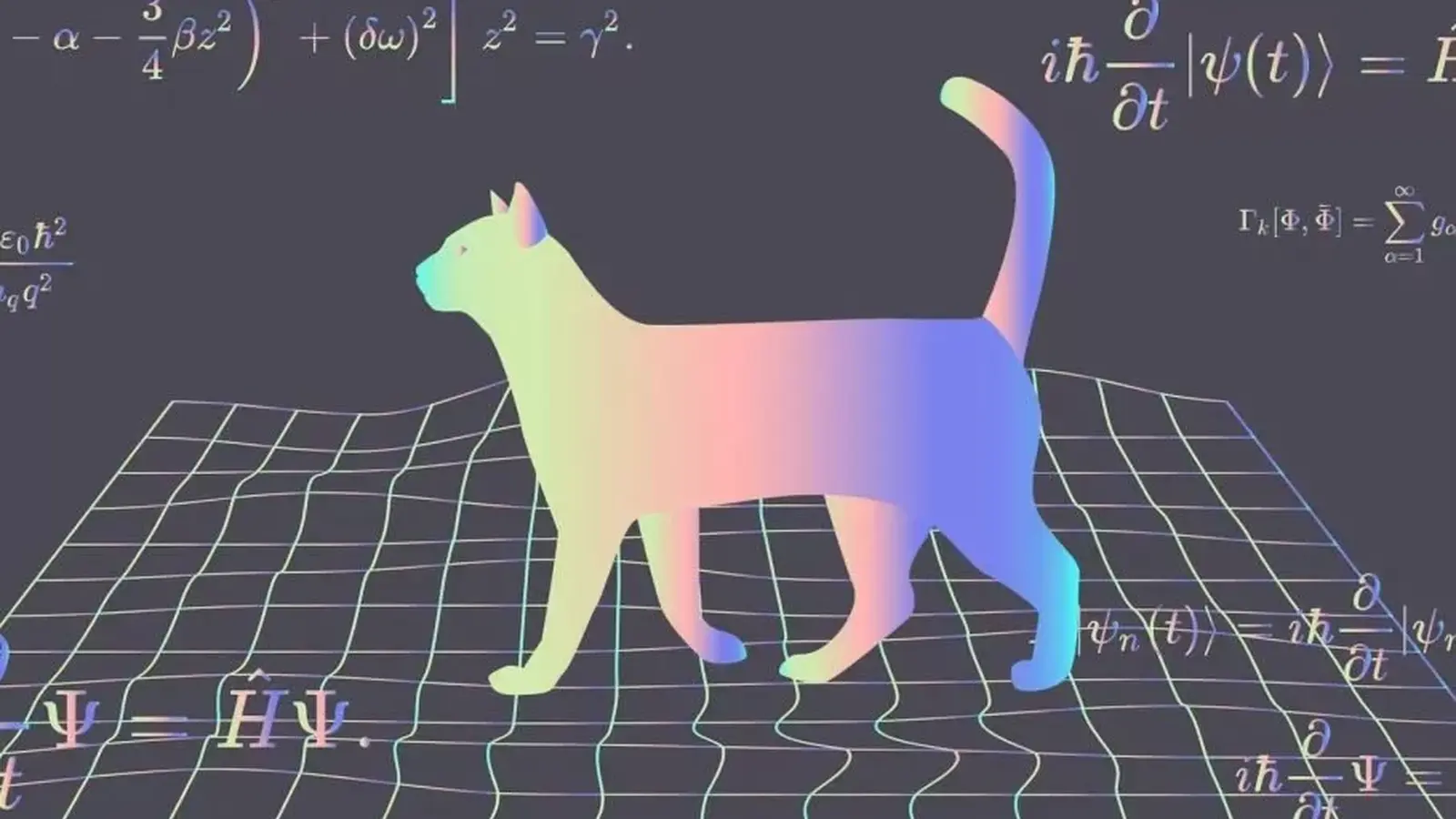
Imagine a cat that refuses to be pinned down by ordinary rules. It doesn’t just sit between alive and dead; it’s built from parts that are themselves stubbornly weird. That is the image emerging from an Oxford team that has pushed Schrödinger’s famous thought experiment into a new, stranger territory.
The original idea — a particle sitting in two mutually exclusive states at once — is textbook quantum strangeness. Erwin Schrödinger sketched it in 1935 as a provocation. Real labs have long since turned the provocation into experiments, putting atoms and photons into superpositions. The Oxford group went a step further: they chose building blocks that are not classical at all, but profoundly quantum, and then entangled those blocks to make a brand-new family of cat-like states.
How did they do it? The team trapped a single strontium-88 ion in an optical well and used two different degrees of freedom inside the same particle. One degree — the ion’s internal electronic state — acted like a qubit. The other — the ion’s motion, its tiny oscillation back and forth — behaved like a quantum oscillator. By engineering interactions between the two and inserting a carefully timed measurement mid-process, the researchers shaped the oscillator’s motion into exotic geometries that resemble a quantum ‘cat’, but with much more structure.

Sebastian Saner, the paper’s lead author, describes the technique as a kind of sculpting: the qubit and the oscillator are kneaded together, then the qubit’s readout freezes the oscillator into the precise pattern the team wants. Short sentence. Big control. The result is not merely a particle in two states, but components that are themselves in nonclassical, and sometimes surprising, configurations.
Why should anyone care? Because these richer states carry information differently. Ordinary qubits are fragile — a whisper of noise scrambles them. Oscillator-based cat states can encode data more robustly, spreading information across a pattern of motion that is harder to corrupt. That resilience translates into potentially simpler and more powerful error-correction strategies for quantum computers and more sensitive, noise-resistant quantum sensors.
Think of it as switching from a single fragile thread to a braided rope. The braid can fray in places and still hold. By using motional oscillators instead of bare two-level qubits, engineers gain new handles over how information is stored and recovered, and they open pathways to architectures that tolerate the messy reality of experimental noise.

The work, published in Physical Review X, is experimental and deliberate. The team demonstrates that with precise control and mid-sequence measurements you can conjure nearly arbitrary, geometrically shaped quantum states in an oscillator. That flexibility is a toolbox for designers: they can tailor states to specific error models or sensing tasks rather than shoehorning requirements into simple qubits.
There are practical hurdles, of course. Oscillators bring their own sensitivities and complexity. But by expanding the repertoire of what counts as a usable quantum state, the Oxford experiment rewrites part of the playbook for quantum information. It’s no longer only about keeping tiny things isolated; it’s about engineering complexity that resists the world.
Creating cat states from already-quantum parts gives researchers new ways to store and protect quantum information, advancing both computing and sensing technologies.
The experiment doesn’t end the debate over quantum foundations, and it certainly doesn’t put a real pet in a box. What it does do is show us how much more there is to explore when we use the universe’s oddest ingredients to build new devices — and ask whether our next-generation quantum machines might come from designs that embrace, rather than hide, the weirdness.


Leave a Comment
Comments
No comments yet. Be the first.