
3 Minutes
Pay $200 a month and you might think you’re getting a premium bot. But under the hood, that monthly fee can balloon into a much larger bill for the company running the model. SemiAnalysis tested heavy use cases across OpenAI's and Anthropic’s paid tiers and the numbers are... striking.
Imagine an advanced user running long-running coding tasks and agent-driven workflows until weekly limits are exhausted. Short prompt? Small cost. Orchestrated agents that iterate, call tools, and re-prompt? The token count explodes. SemiAnalysis estimates that a fully loaded ChatGPT Pro 20x subscription, priced at $200 per month, could translate to roughly $14,000 in API-level token costs for OpenAI. For Anthropic, Claude Max 20x at the same sticker price could cost about $8,000.
Those figures make one thing clear: headline subscription prices say almost nothing about the underlying economics. How quickly a provider reaches profitability depends less on the dollar amount a user pays and more on how efficiently that user consumes compute and tokens.

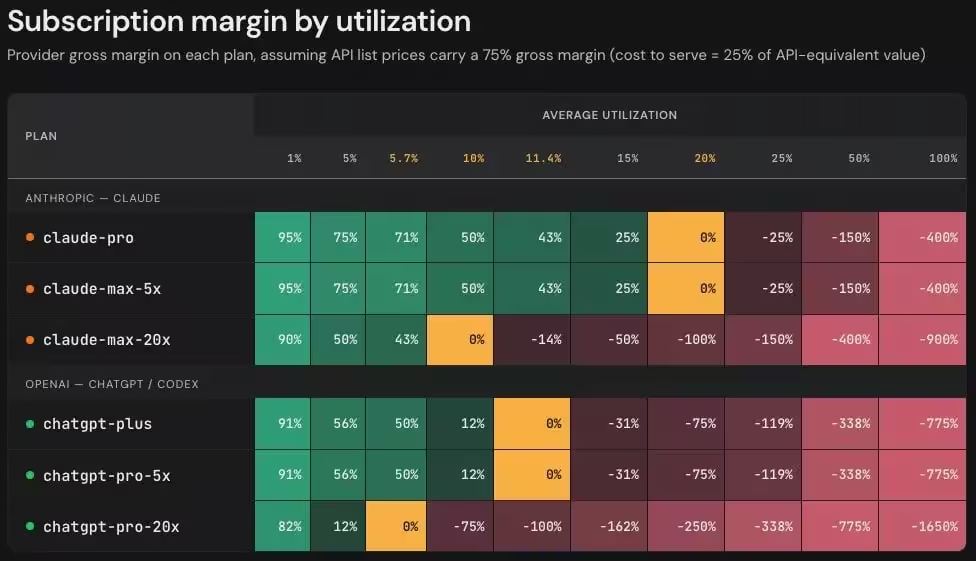
Break-even points arrive sooner than you might think. SemiAnalysis’ modeling suggests Anthropic’s Claude Pro and Claude Max 5x plans only turn a profit if typical user efficiency sits around 20 percent. OpenAI faces even tighter margins: ChatGPT Plus and ChatGPT Pro 5x can slip into loss territory once user utilization rises above roughly 11.4 percent. And on the highest tiers the story gets uglier—Anthropic hits zero gross margin near a 10 percent utilization rate, while OpenAI crosses into negative territory past about 5.7 percent.
In plain language: you don’t need an army of power users to make a subscription unprofitable. Sophisticated agent workflows, heavy code debugging sessions, or enterprise automation routines can push consumption into that danger zone quite quickly.
A $200 per month plan can generate up to $14,000 in token costs for the provider under worst-case heavy use.
That financial squeeze is already reshaping internal enterprise behavior. Token consumption is rising fast—agent-style systems can demand up to 1,000 times the tokens of a single prompt. Companies that once encouraged broad internal experimentation are reining access back in. Microsoft, Meta and Amazon have tightened internal programs after bill shock from enthusiastic staff who treated large language models like free research tools.
There’s a policy tension here. Flat-rate subscriptions have been an accelerator for user growth and mainstream adoption. They lower the barrier to entry and make the value proposition simple. But they also obscure marginal costs, and when a handful of high-consumption users emerge, they can rapidly overwhelm the economics that sustained the pricing model.
SemiAnalysis does offer a path to relief: as infrastructure and model efficiency improve, mid-range models could become far cheaper to operate, possibly translating into consumer-priced tiers around $20 per month. The catch is the top-tier models. The most capable next-generation systems will likely remain expensive to run and may be shifted off subscription shelves into API-only access with pay-as-you-go billing for heavy consumers.
For businesses and power users, that hints at a future split: affordable subscriptions for everyday tasks, and metered API access for high-volume automation and advanced agent work. For vendors, the challenge is more political than technical—how to tighten access or raise prices without throttling growth and alienating a user base still getting used to this technology.
Either way, the math is catching up with the hype. Subscriptions were a growth engine. Now they’re forcing companies to reckon with where the real costs sit—and who ultimately pays the bill.


Leave a Comment
Comments
No comments yet. Be the first.