
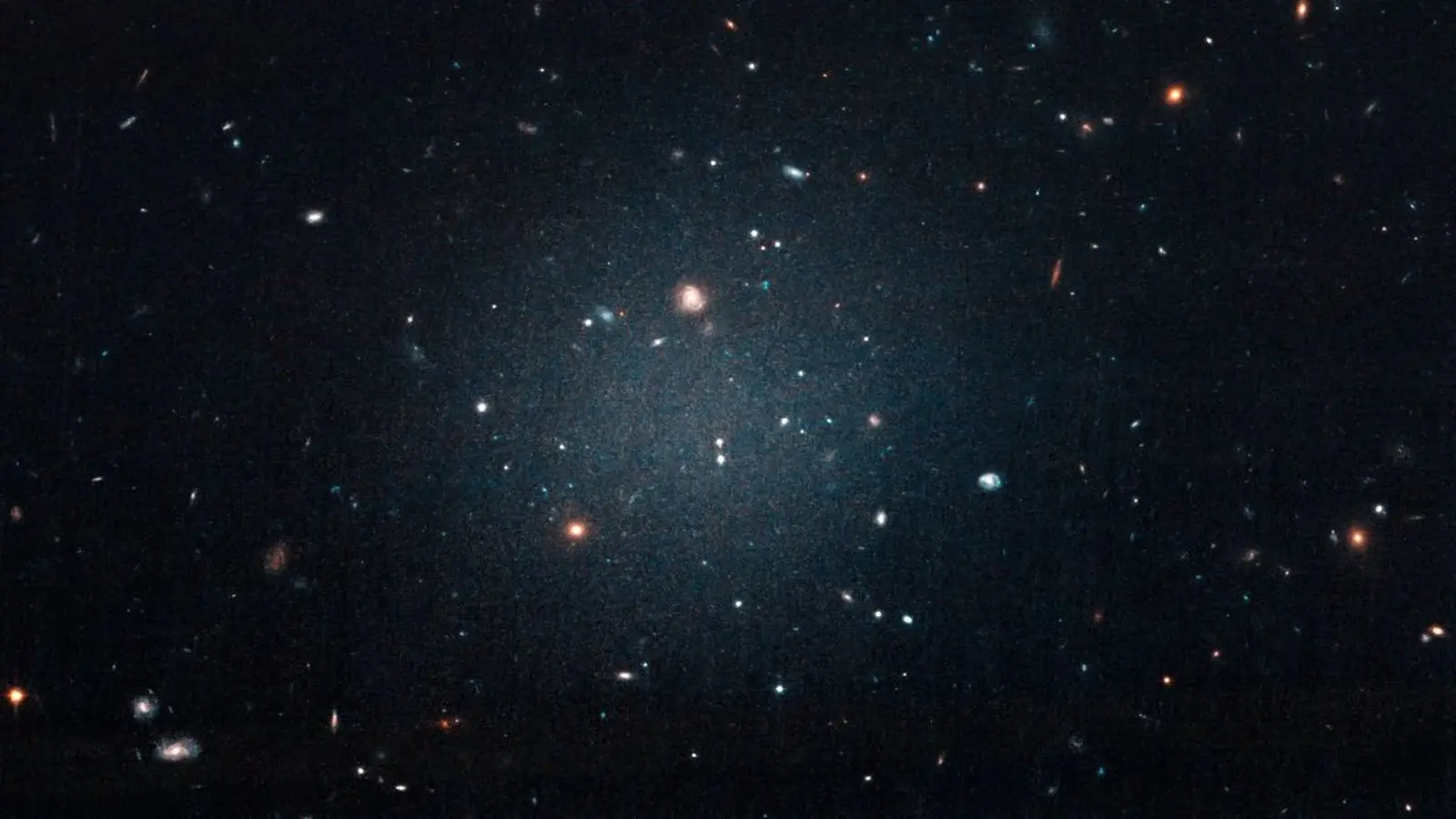
Imagine a string of faint galaxies laid out like a necklace in the dark—except the beads lack the invisible glue we've long thought holds galaxies together. Strange. Defiant. Intriguing.
NGC 1052-DF9 is the latest member of that odd procession, about 67 million light-years away, and it joins DF2 and DF4 as a galaxy whose internal motions can be explained without invoking dark matter. That small statement upends a large expectation: almost every galaxy we study seems to live inside a massive halo of unseen mass that outweighs ordinary matter by roughly five to one.
How do three neighbors all end up apparently stripped of their dark scaffolding? The pattern is too tight to shrug off as coincidence. DF2 first surprised astronomers in 2018, and DF4 followed in 2019—both sitting in the same narrow region of space. Subsequent work revealed that those objects are part of a linear chain of dwarf galaxies trailing the larger NGC 1052 system, and that the chain’s members move together as if choreographed.

NGC 1052-DF9, the third galaxy whose motions can be explained without dark matter.
DF9 looked like the most promising additional test: similar size, similar luminosity, and a comparable system of star clusters. When researchers led by Michael Keim and Pieter van Dokkum turned telescopes and spectra toward it, the outcome echoed the earlier anomalies. The stars in DF9 simply don’t orbit as if embedded within a massive dark halo.
This string of dark-matter-poor dwarfs is a rare natural laboratory for testing dark matter's behavior.
One hypothesis gaining traction is vivid and violent: the so-called bullet-dwarf scenario. Picture two small galaxies on a head-on collision course. Most stars pass by each other—the distances between them are vast—so stellar orbits largely continue uninterrupted. Dark matter, in most particle-physics models, behaves similarly and streams through. Gas, however, is collisional. Clouds slam together, dissipate energy, and come to rest.
.avif "DIY Sprinter Camper Van: Maximum Space, Off-Grid Comfort, and a Perfect Fit for Tall Adventurers")
That leftover gas, shut down relative to the passing dark halos, can cool and fragment into new stars. Over time those gas-rich remnants may condense into tiny galaxies that are relatively bereft of dark matter because the dark halos sailed on. Simulations show this process can produce compact, dim systems like DF2, DF4, and now DF9. It’s an elegant solution—if the initial collisions and conditions line up just right.

The strange trail of faint galaxies, and the three studied to date: DF2, DF4, and DF9. A close-up Hubble image of DF9 is shown beneath a wider view of the surrounding NGC 1052 region, with the red box indicating the region where data were collected.
Beyond being a clever origin story, the chain has broader implications. If these dwarfs truly formed after an extreme collision, the evidence favors dark matter that behaves like a physical substance—particles or fields that move independently of baryonic gas—over alternative gravity theories that try to eliminate the need for dark matter. In other words, these exceptions might reinforce the rule.
Still, questions multiply faster than answers. What drove the initial collisions? How common are such chains? Could observational biases be skewing our picture? The team’s kinematic studies, combining deep imaging from DECaLS and Hubble with precision spectroscopy, have tightened the constraints, but they haven’t yet revealed a smoking gun.
For observational cosmology the stakes are tangible. If more dark-matter-deficient dwarfs are found in the same structure, and if simulations can reproduce both their arrangement and motions, we gain a controlled setting to probe dark matter’s non-gravitational behavior—or to corner it further if it refuses to match the data. For theorists, the objects are a rare touchstone: small, simple systems where messy baryonic physics is limited and dark matter’s fingerprints, or absence thereof, are easier to read.
The new DF9 results were published in The Astrophysical Journal and come on the heels of a string of papers that gradually transformed this corner of the sky from a curiosity into a testing ground. Astronomers will continue to scour the NGC 1052 region for more candidates and run higher-resolution simulations to check whether bullet-dwarf collisions—or some other exotic mechanism—can consistently produce a linear string of dark-matter-poor galaxies.
So what now? Keep watching. The universe has a way of offering up its secrets one peculiar case at a time, and this faint chain of renegade dwarfs may be telling us more about the invisible architecture of the cosmos than a thousand typical galaxies ever could.


Leave a Comment
Comments (2)
this is wild! If dark matter can be stripped like that, huge implications. But could observational quirks be fooling us? curious.
Wait, so 3 galaxies in a row lack dark matter? Is this even real or just a selection/measurement fluke... Bullet-dwarf sounds wild, but how likely is that chain? Need more sims and obs, tbh