

Imagine spotting a new clue not on the brain's surface, but in the thin, clear fluid that cushions it. Small discoveries like that can rewrite how we chase a disease. Researchers in Spain report that the active form of an enzyme called meprin-β rises in both brain tissue and cerebrospinal fluid from people with Alzheimer's, pushing the enzyme into the spotlight as a potential marker of disease progression.
The study, led by Javier Sáez Valero at the Institute for Neurosciences (a partnership between Miguel Hernández University of Elche and the Spanish National Research Council), paints a nuanced picture. Meprin-β exists in two states: an immature, inactive precursor and a mature, active enzyme. By measuring each form separately, the team could see where changes actually occur — and when.
Short answer: the active enzyme shows up later. When the researchers screened frontal cortex samples and classified them by Braak stage, the jump in active meprin-β appeared at intermediate and advanced stages of Alzheimer’s. Early-stage samples did not show this increase. At the same time, messenger RNA from MEP1B, the gene that makes meprin-β, was elevated in those later stages, suggesting production ramps up as pathology advances.
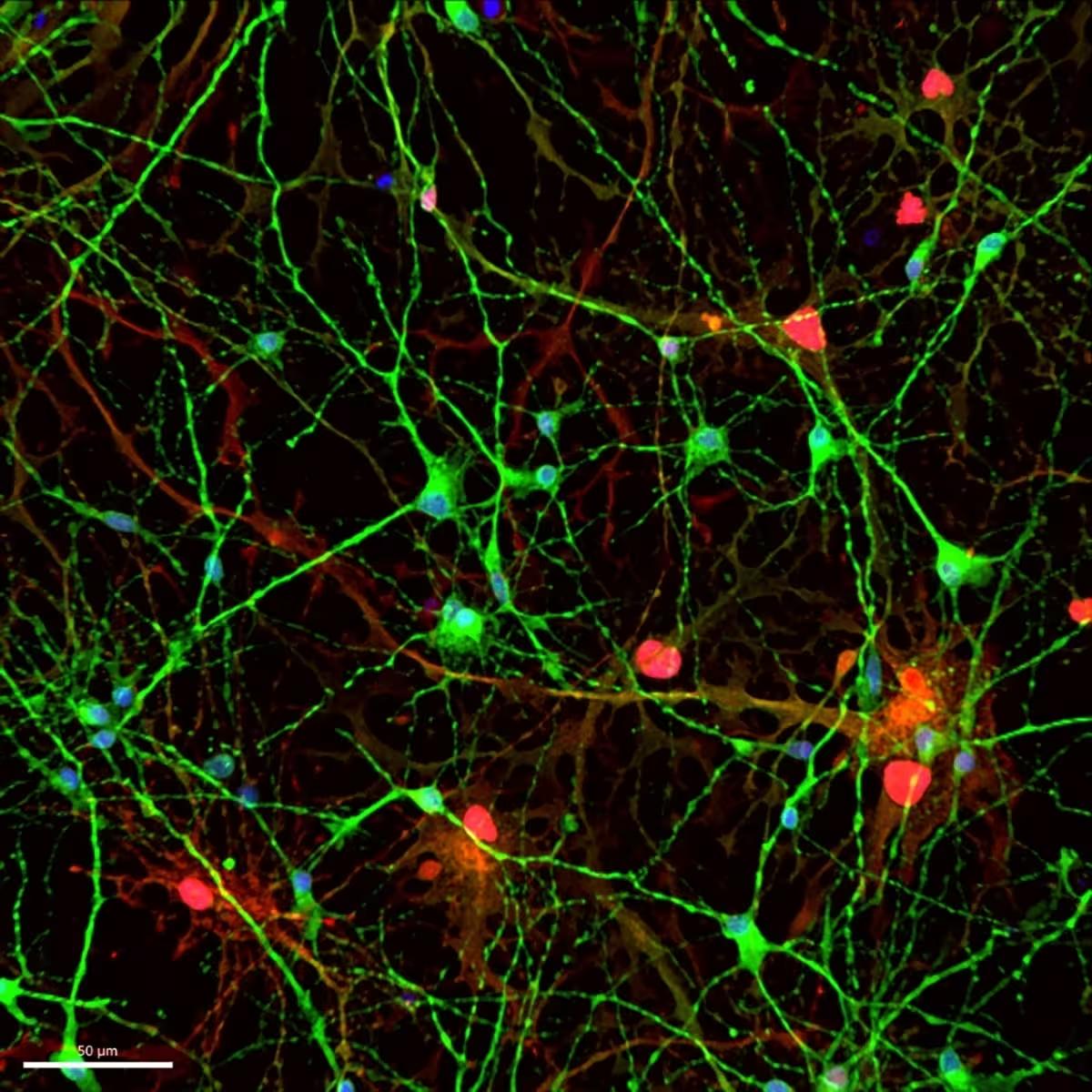
Cell culture of induced pluripotent stem cells (iPSCs). Neurons are shown in green and astrocytes in red.
Why does that matter? Because meprin-β, like the well-known enzyme BACE1, can act as a β-secretase — one of the molecular scissors that cleave amyloid precursor protein (APP) to generate beta-amyloid fragments. Beta-amyloid accumulation is a hallmark of Alzheimer’s. But BACE1 has long dominated the discussion. This work nudges meprin-β into the conversation as another player that might shape how APP is processed in diseased brains.
Association is one thing. Cause is another. To probe whether beta-amyloid itself could trigger changes in meprin-β, the team turned to experiments. They exposed human neurons grown from induced pluripotent stem cells (iPSCs) to Aβ42, a toxic form of beta-amyloid. The result was clear: neurons increased their levels of the active enzyme. Short and striking. Exposure led to upregulation.

Animal models added a parallel line of evidence. Rats engineered to accumulate amyloid-related pathology had higher concentrations of active meprin-β in their cerebrospinal fluid. Taken together — patient tissue, cultured human neurons, and rodent CSF — the findings suggest a link between amyloid buildup and a rise in the enzyme's active form. The mechanism remains to be nailed down, but the pattern is consistent.
Here’s the practical angle. Cerebrospinal fluid can be sampled via lumbar puncture, and clinicians already test it for Alzheimer's-related proteins. If active meprin-β reliably tracks with disease stage or progression, it could join that testing panel as a biomarker. That possibility excites researchers, but caution is warranted: larger, longitudinal studies will be needed to know whether meprin-β levels predict clinical decline, reflect downstream consequences, or simply mirror advanced pathology.

Team from the Altered Molecular Mechanism in Alzheimer’s Disease and Dementia laboratory at IN UMH-CSIC.
There are also therapeutic questions. If meprin-β contributes to APP processing in a way that increases harmful beta-amyloid species, then modulating its activity could be considered. But first scientists must untangle whether the enzyme is a driver, a passenger, or part of a feedback loop that amplifies damage once amyloid accumulates.
Sergio Escamilla, the study's first author, notes that the experimental rise in meprin-β after Aβ42 exposure provides a mechanistic bridge between hallmark pathology and the alteration observed in patients. Sáez Valero adds that finding the active form of the enzyme in cerebrospinal fluid "raises new questions about its relationship with the changes that occur during the disease and its potential use as an indicator." The questions are open. The route forward is clear: more samples, more time points, and studies that link enzyme dynamics to cognition and clinical outcomes.
In a field where every credible biomarker is a rare prize, meprin-β is now a candidate worth following — not as an answer, but as a thread that could lead to one.


Leave a Comment
Comments
No comments yet. Be the first.