
2 Minutes
Benchmarks that pretend to be real-world tests are finally getting an honest update. Primate Labs has shipped Geekbench 7, and it feels less like a numbers contest and more like a mirror held up to everyday device use.
The app remains cross-platform — Android, iOS, Windows, macOS, and Linux — so comparisons still span phones, laptops, and desktops. But the workloads have been retuned. On the CPU side, Geekbench 7 introduces media-focused tests for audio and video encoding, decoding, and processing. Translation: tasks like video calls, screen sharing, streaming, and casual content playback are now better represented in scores.
 |  |  |
Game testing gets a pragmatic nudge too. A new Game Physics workload runs on the Jolt Physics engine, aiming to reflect the physics overhead modern mobile titles actually pay. Photo editing scenarios were expanded as well; the Photo Editor workload now applies a richer set of real-world edits, and the Photo Library test adds support for JPEG XL and DNG imports and processing — nods to how users capture, store, and edit images today.
Perhaps the most consequential change is how multi-core testing is handled. Geekbench 7 will only invoke multi-core runs when the measured task truly benefits from parallelism. No more artificially pumped scores from tests that never use every core. That change also meant removing the HTML5 browser test from multi-core measurements, a move intended to keep multi-core results honest and grounded.
The GPU suite shifts emphasis away from raw 3D rendering and toward content creation and machine learning workloads. Expect tests that simulate face-filter modeling for social apps, image upscaling powered by ML, and virtual background processing used in video conferencing. These are the GPU loads that increasingly matter to everyday users and developers alike.
 | 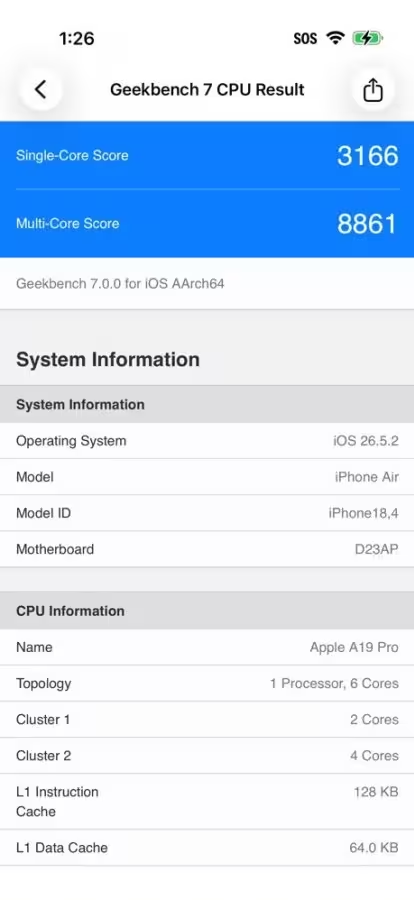 |  |
For reviewers and OEMs this is a practical pivot. Benchmarks will now reward balanced silicon that accelerates real desktop and mobile tasks rather than chips tuned to win synthetic scenarios. For app developers, the new tests offer a clearer signal about how hardware variations affect media pipelines and ML inference on device.
Geekbench 7 remains free for personal use, which should make it easy for enthusiasts to rerun their favorite devices and see how scores change when tests match real workloads. Want to know what your phone actually does when you start a video call or slap on a face filter? Run it and judge for yourself.

Leave a Comment
Comments
No comments yet. Be the first.