
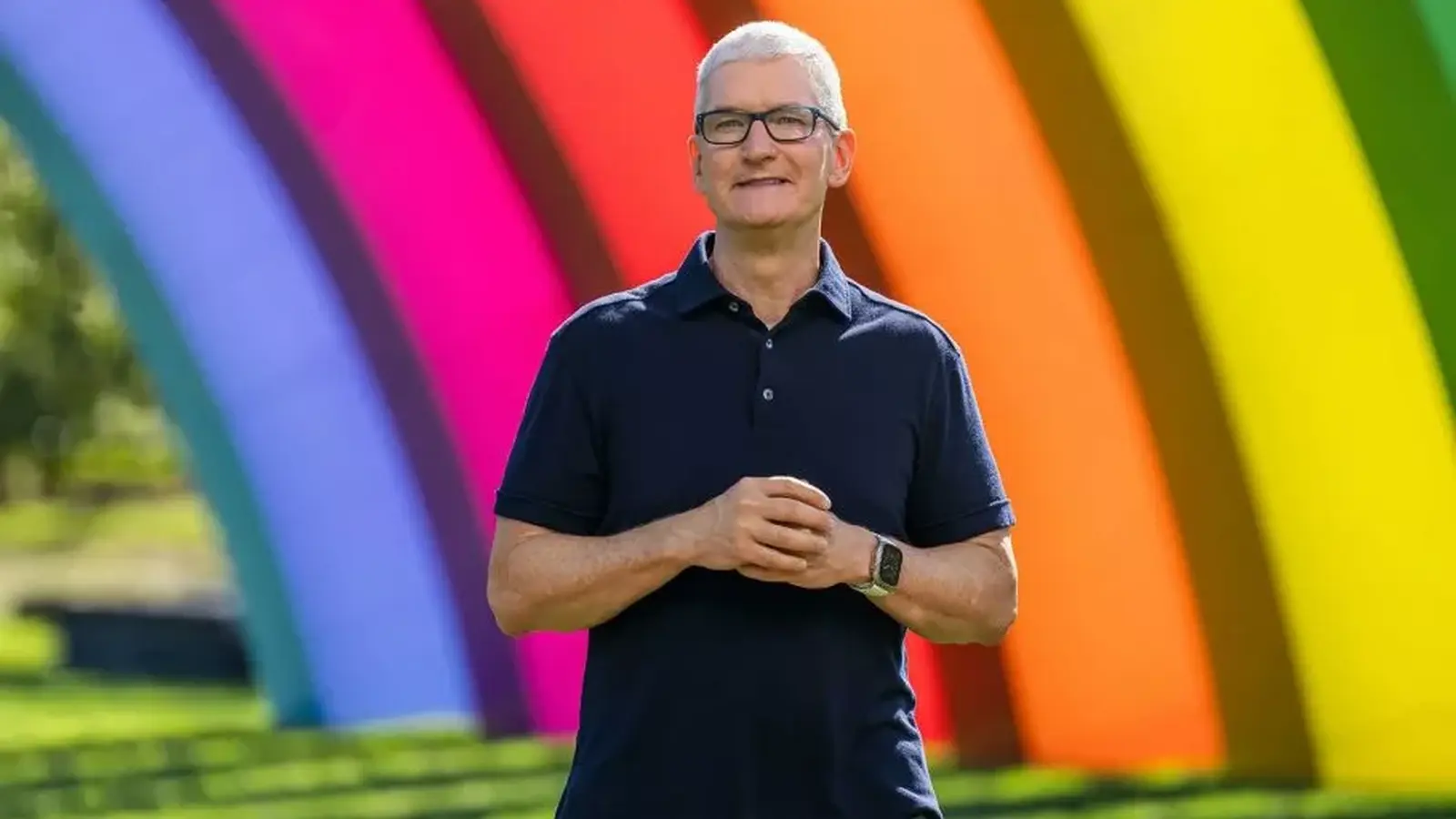
He closed his final quarterly earnings call as CEO this week, and the numbers that followed read like the plot of a company that rewrote its own future.
When Tim Cook took the helm of Apple in 2011, the company’s annual revenue was about $108 billion. Fast forward to Q3 2026: Apple posted $109.4 billion in a single quarter. That’s not a footnote. It’s a flash of how the business accelerated—what used to take a year now arrives in three months.
Annual revenue tells a similar story. Apple’s fiscal 2025 haul reached roughly $416 billion. iPhones, once the clear lion of the herd, have only gotten louder: iPhone sales brought in about $47 billion for the whole of 2011, compared with $54.3 billion in just the recent quarter alone.

Market value, too, has followed a steep climb. Under Cook, Apple hit a string of improbable milestones on Wall Street: the first company to reach $1 trillion (2018), then $2 trillion (2020), $3 trillion (2022) and $4 trillion (2025), and later joined the race toward the $5 trillion mark. All told, the market cap sits near $4.5 trillion as Apple trades blows with rivals like Nvidia for the title of the world’s most valuable public company.
Stock performance captures the human drama. A day after Cook became CEO in August 2011, Apple’s share price was about $13.35. Today a share trades near $304.8—a roughly 23-fold increase. Simple math. Massive impact.
Devices in the wild add texture to the tally. Apple now reports more than 2.5 billion active devices worldwide. The company didn’t disclose that figure until it crossed the 1 billion mark in 2016. What follows from scale is often subtle but powerful: a larger installed base begets stickier ecosystems and predictable revenue streams.
That’s where services changed the equation. In 2011, Apple’s services arm—think iTunes, App Store and AppleCare—generated roughly $9.4 billion for the full year. In Q3 2026 alone, services revenue reached $30.7 billion; fiscal 2025 services revenue was around $109 billion. Subscriptions? Apple now counts more than 1.5 billion active subscriptions across its offerings. This is the pivot from one-time hardware sales to recurring, high-margin income.
Under Cook, the services roster expanded dramatically. Apple introduced payments and banking with Apple Pay and Apple Card, broadened entertainment with Apple Music and Apple TV+, launched Apple Arcade and Apple Fitness+, and layered new conveniences for users worldwide. Together, these services knit hardware into a persistent business model.

Hardware didn’t stall while services rose. Cook’s era delivered category-defining products: the Apple Watch turned wearables mainstream; AirPods rewrote the rules for wireless audio; Apple Silicon shifted the chip landscape with in-house performance and efficiency gains; and Vision Pro pushed the company into spatial computing. The iPhone X’s design overhaul was another inflection point—proof that Apple could still surprise after the Steve Jobs era.
Fifteen years of leadership turned Apple from a brilliant device maker into an integrated hardware-and-services empire.
The handoff is already scheduled. John Ternus will be CEO starting September 1, stepping in before Apple’s major iPhone announcement later this year. Tim Cook won’t disappear—he’ll move to executive chair of the board, where he says his focus will shift toward government relations and helping Apple navigate regulatory and antitrust pressures around the globe.
Change of guard, same high-stakes game. Apple’s next chapter will be about sustaining growth at scale, and about whether new leaders can keep the company nimble while it manages scrutiny, supply-chain limits and the ever-rising bar of user expectations.

Leave a Comment
Comments
No comments yet. Be the first.