
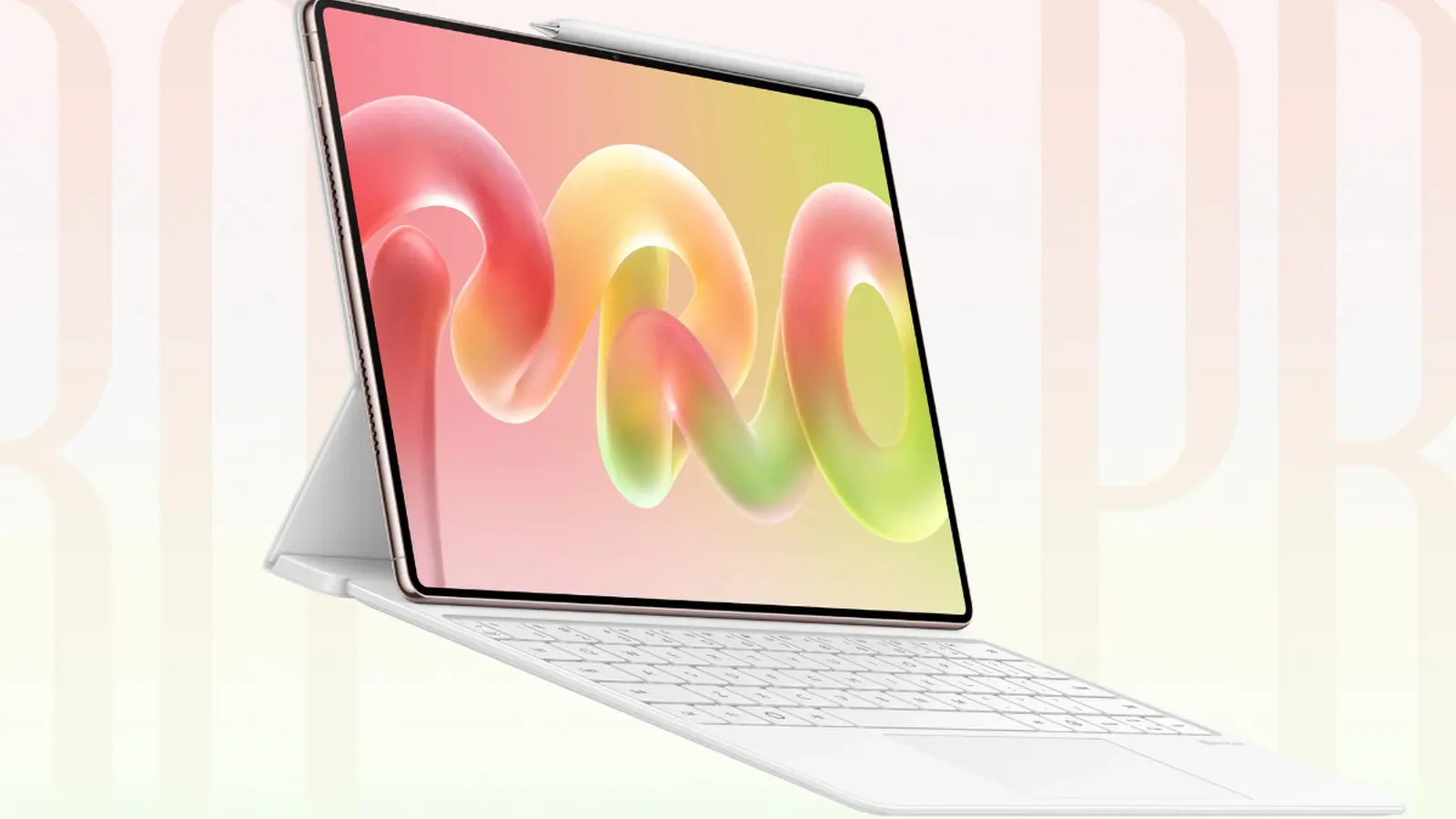
Thin as a whisper. Heavy on features. Huawei’s MatePad Pro 2026 arrives with a headline-grabbing 4.7mm metal unibody and a 12-inch flexible OLED that feels like the future in your hands.
Can a tablet that slim still deliver flagship performance? Huawei says yes. The 12-inch panel runs at 144Hz, bears a 3:2 aspect ratio and a 3036 x 1952 resolution, and can spike to 1,600 nits for bright-room legibility. An optional Soft Light Edition dials down reflections with nano-etching, useful for artists and anyone who hates glare.

Under the skin sits Huawei’s new Kirin T93 chipset; a more budget-friendly Enjoy Edition swaps in a T93A. Huawei claims roughly a 25% uplift versus the prior generation. Memory tops out at 12GB of RAM and storage reaches 512GB, while a 7.2W central stereo cooling system tames thermals when workloads spike.
The MatePad Pro 2026 balances thinness and endurance—surprising, given its 10,400mAh battery. You still get 66W fast charging that Huawei says can refill the pack in about 53 minutes. And when your phone runs dry, the tablet can act as a 40W reverse wired power bank.
Huawei continues to push HarmonyOS forward. The tablet debuts Dual Desktop, a fluid toggle between tablet and desktop interfaces activated by a four-finger swipe. That UX supports more than 200 PC-class applications, making the device a more plausible laptop replacement for creators and road warriors.

For content capture and conferencing, there’s a 50MP rear camera with autofocus capable of 1080p video, and a 12MP front camera for calls. Software extras include panorama, time-lapse, beauty modes, and 2D face unlock—basic but serviceable for a productivity-first slate.
Audio gets attention too. A quad-speaker Huawei Sound setup with spatial audio aims to fill the room, and the tablet pairs best with Huawei’s FreeClip earbuds for an enriched listening profile when watching movies or editing audio.
Connectivity is modern: Wi‑Fi 7+ and Bluetooth 6.0. But there’s a caveat—no cellular or satellite options were announced, so tethering remains the fallback for mobile data.
Huawei is positioning this tablet squarely at creators. The GoPaint app receives new brushes and deeper integration with the TourBox creative controller, and the slim chassis, large screen, and high refresh rate make sketching and digital painting feel more precise.
Cosmetics include five finishes—Cherry Pink Gold, Condensed Light Blue, Floating White, Deep Space Gray, and Bright Moon Silver—designed to appeal to both fashion-forward buyers and professional users.

Pricing in China starts at 5,999 yuan (about $889) for the 12GB + 256GB model. The Soft Light Edition and higher-capacity bundles push the price into higher tiers: the 12GB + 256GB Soft Light Edition is 7,199 yuan (~$1,067), while the top 12GB + 512GB with keyboard bundle checks in at 8,399 yuan (~$1,244). Enjoy Edition variants are slightly cheaper across similar configurations.
Huawei also quietly launched a 12,000mAh 100W power bank with offline tracking not long ago—an accessory that complements the new tablet’s fast-charge credentials and reverse charging abilities.
Whether the MatePad Pro 2026 will convince people to choose a tablet over a laptop depends on how seriously they value thinness without sacrificing battery life or performance. It’s a bold attempt to square that circle, and one worth testing in person if you prize portability as much as power.

Leave a Comment
Comments
No comments yet. Be the first.