
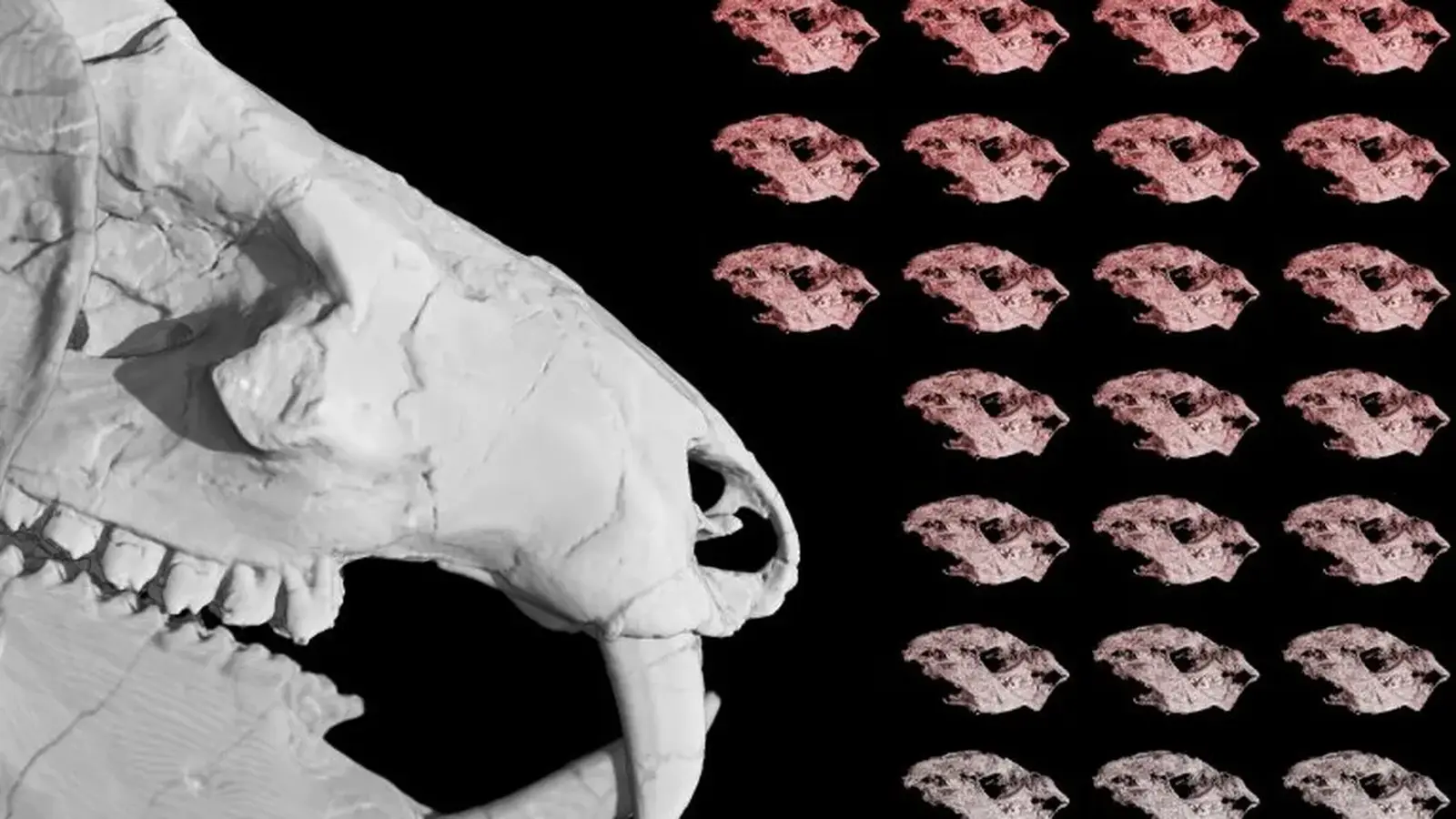
A rabbit-sized skeleton poking from the Gobi sand has just upended a decades-old guess about early mammals. The nearly intact fossil, named Tamirkhan balcarceli, shows that a group long thought to be close kin of modern placental mammals were actually on a very different branch of the mammal family tree.
Unearthed in 2004 during an American Museum of Natural History expedition and described in Nature by researchers from AMNH, Stony Brook, the University of Arizona, and Arcadia University, the specimen is the most complete zhelestid ever found. For nearly 40 years zhelestids were known mostly from isolated teeth. Those low, rounded teeth made paleontologists imagine small, plant-eating, hoof-like mammals. The rest of the anatomy, it turns out, tells another story.
So what did the whole skeleton reveal? Tamirkhan keeps the characteristic rounded molars, yes. But its skull and postcranial bones carry the signature of zalambdalestoids, a separate group of small, shrew-like mammals. Long, ever-growing incisors. A skull with features inconsistent with placentals. Hind limbs built for agility, with slender bones and distinctive ankle joints. Piece by piece, the animal looks less like an early placental and more like a zalambdalestoid relative.

Short sentence. Big implication. If zhelestids are nested within zalambdalestoids, then those rounded, plant-crushing teeth evolved independently in different lineages. Convergent evolution at work. Two unrelated mammals, similar diets, similar tooth shapes. The teeth misled scientists about relationships because function can mimic ancestry.
There is a larger context here. Molecular clock studies have often suggested that placental mammals originated deep in the Cretaceous. Those models use DNA from living species to estimate timings. But fossils provide the hard evidence to place those molecules into real anatomy and time. As coauthor Paul Velazco notes, molecular predictions are powerful, but fossils test those predictions.
Tamirkhan was small — only six to seven inches from nose to tail — but its hind limbs are relatively long, giving it a rabbit-like silhouette that earned zhelestids their informal nickname, Cretaceous rabbits. Look closer and differences emerge. The long incisors and the ankle morphology align Tamirkhan with zalambdalestoids rather than with modern rabbits or true placentals. The study’s comparative analysis used MorphoBank, a growing anatomical database, to test evolutionary positions across a broad set of early mammals. The result consistently placed zhelestids apart from placentals.

Why does this matter? Because for centuries paleontologists have sometimes treated teeth as tiny roadmaps to whole animals. Georges Cuvier famously claimed a single tooth could let you reconstruct an entire creature. Teeth are incredibly informative, but they are not infallible. Tamirkhan is a reminder that incomplete fossils can hide deep surprises, and that a more complete skeleton can rewrite a family tree.
The find also highlights the scientific riches of the Gobi Desert. Alongside sites in Kazakhstan, Kyrgyzstan, and Uzbekistan, the Gobi routinely yields unusually complete Cretaceous mammals. Those fossils preserve anatomy that isolated teeth cannot, and they continue to reshape ideas about how mammals diversified while dinosaurs still ruled.
This specimen shows why fieldwork remains essential and why a single tooth should never have the final word on evolution.
When the next surprising skeleton turns up, paleontology will be waiting, ready to rethink another tidy story about life deep in Earth’s past.

Leave a Comment
Comments
No comments yet. Be the first.