

Imagine a robot that walks into an unfamiliar home, listens to a brief instruction and completes most tasks without detailed training. Sounds like science fiction? Not according to Unitree's founder.
Wang Xingxing used a big stage at a robotics conference in Beijing to argue that embodied AI—the fusion of advanced perception, world modeling and physical control inside robots—is approaching what he called a 'ChatGPT moment.' After Unitree's recent Shanghai listing, his words landed with extra weight: IPOs tend to sharpen plans into roadmaps.
He painted a practical milestone. A production humanoid should be able to enter an unknown environment and successfully perform roughly 80 percent of routine tasks using only simple voice or text prompts. Hit that threshold, and adoption could accelerate rapidly. Short sentence. Big impact.
Unitree is not a minor player. Industry data places the company as the world's largest maker of robot dogs and the second-largest sender of humanoid robots by shipment volume. Its machines became a social-media phenomenon thanks to videos—dancing bots, kung-fu moves, high-speed agility. Most of Unitree's early customers were universities and research centers, but the roadmap clearly targets consumer and industrial use at scale.
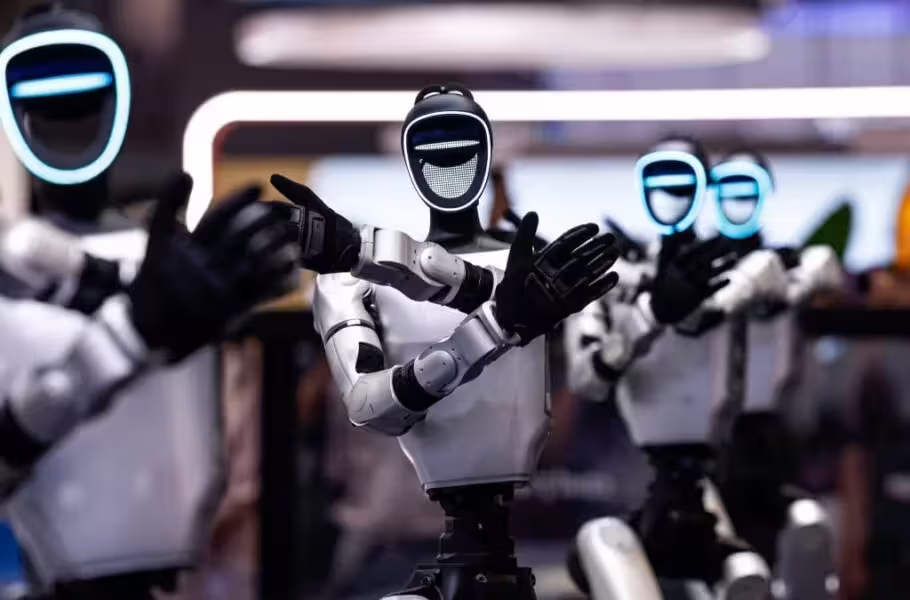
Still, the CEO was careful to separate optimism from hype. He told the audience that a software breakthrough of the kind he envisions could plausibly arrive within two to three years under a favorable scenario, while a more conservative horizon stretches to five to ten years. Other founders in the Chinese robotics scene echo similar timetables. Wang He, founder of Galbot, projects a pivotal year near 2028 when robots will perform 70–80 percent of everyday tasks without specialized training.
Why the wait? Unitree is investing heavily in so-called World Models—internal physical simulators that let a robot anticipate consequences and plan actions in messy, real-world settings. According to Wang, decision-making models remain the industry's tightest bottleneck. Perception is advancing fast. Locomotion is solid. But translating sensory data into safe, generalizable action plans is still an unsolved engineering puzzle.
Unitree says most of its current R&D and hiring is concentrated on those World Models, acknowledging they’re behind the ideal targets for real-world deployment.
The backdrop is geopolitical as much as technical. China shipped more than 40,000 humanoid robots in the first half of this year and accounted for about 97 percent of global shipment share, driven by government encouragement to deploy machines in repetitive or hazardous roles as a response to demographic decline. That commercial momentum is colliding with national-security concerns abroad: U.S. regulators recently moved to restrict imports of certain foreign robots on security grounds, turning humanoids into another theater of Sino-American technological rivalry.
So what happens if Wang’s timeline holds? Industry dynamics could shift from incremental lab wins to a wave of practical, serviceable robots in retail, logistics, eldercare and home assistance. Investors will lean in. Supply chains will scale. And everyday users will start to treat humanoid robots as tools rather than curiosities. What happens if the timeline slips instead? Researchers will keep chipping away at decision-making and sim-to-real transfer, and commercial deployments will advance more slowly—but steady progress will continue.
Either way, the conversation has moved beyond purely mechanical breakthroughs. The real battleground now is software that lets a machine form a working understanding of a messy, three-dimensional world and act on it reliably. Expect the next few years to be noisy, experimental and occasionally spectacular as teams race to deliver that elusive ChatGPT-like inflection point for embodied intelligence.

Leave a Comment
Comments
No comments yet. Be the first.