

4 Minutes
A planet just left its fingerprint on the radio sky, and astronomers can finally say they know where the sound came from.
Using South Africa’s MeerKAT radio array, a team from the Center for Astrophysics — Harvard & Smithsonian and the University of Oregon picked up short, repeating radio bursts that point back to Beta Pictoris b, a massive world roughly 63.4 light-years away. The bursts were not only brief and recurring; their radio waves were strongly circularly polarized — the telltale signature of auroral emission produced when charged particles meet a magnetic field.
This is the first clear radio signal traced to an exoplanet, and it gives us a direct measurement of that planet’s magnetic strength.
The observations, carried out across four sessions in 2025 and 2026, covered frequencies between 0.85 and 3.5 GHz. That band revealed both transient, highly polarized bursts and weaker, persistent radio emission. To be certain the signal really came from the planet and not the much brighter host star, the team used distant quasars as astrometric anchors — fixed beacons to map the sky with precision. The result: the emission lines up with Beta Pictoris b, not the early-type star it orbits.
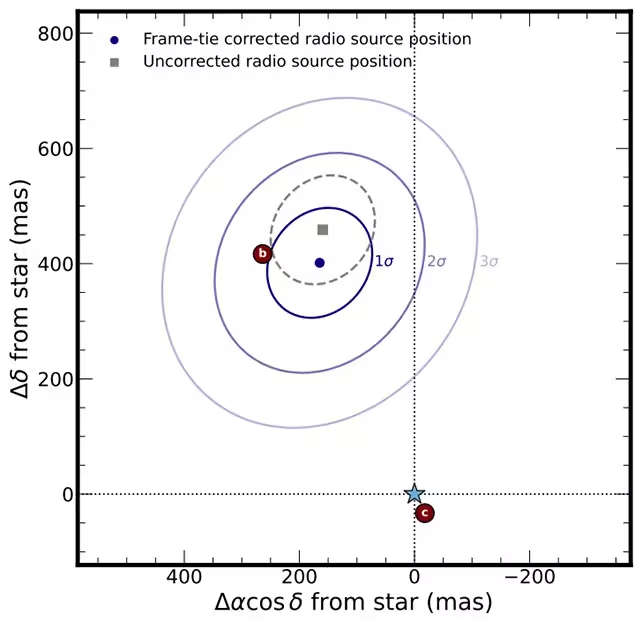
Planet b is one of three known planets around Beta Pictoris (the third planet isn't included in this diagram).
Why does that matter? Early-type stars like Beta Pictoris are hotter and structurally unlike our Sun, and none of the known mechanisms for radio emission from such stars fit the observed pattern. On the other hand, the radio bursts match what we expect from an Electron Cyclotron Maser Instability (ECMI) — the same engine that drives auroral radio bursts at Earth and Jupiter. In short: this is planetary aurora, transmitted across light-years.

Beta Pictoris b is no shrinking violet. Discovered in 2008, the gas giant is about ten times the mass of Jupiter and rotates rapidly, completing a spin in roughly eight to nine hours. Those fast rotations and a turbulent interior dynamo help explain a magnetic field the team estimates to be thousands of times stronger than Earth's. Such an intense magnetosphere would naturally produce bright auroral radio emission under the right conditions.
The detection does more than put a new checkmark on a discovery list. Magnetic fields shape a planet’s atmospheric escape, particle environment, and even potential habitability for moons. Directly measuring an exoplanet’s magnetic strength — even for a young, massive gas giant — gives theorists a real number to test their dynamo models against. The radio bursts, with their polarization and repetition, are like a raw data stream from a planetary engine room.
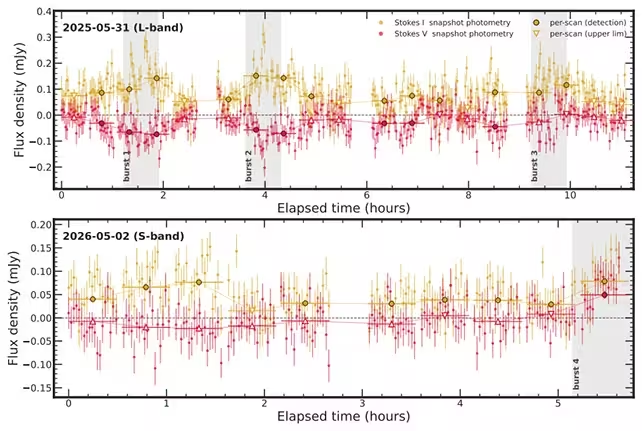
Short, repeated radio bursts were detected from planet b.
The work is currently available on the preprint server arXiv and has not yet passed peer review. Still, the methodology is conservative and convincing: precise localization using quasars, repeated detections over multiple observing runs, and emission properties that map cleanly onto ECMI physics. The authors stress that no known process from an early-type star can reproduce what was seen.
Now the team is turning their sights outward. Seven other known giant exoplanets in five nearby systems sit within reach of the same technique, if sensitivity improves. The researchers estimate that next-generation radio observatories delivering roughly five- to seven-fold gains in sensitivity will bring those worlds into view, opening a new channel for studying exoplanet magnetospheres across a range of masses and ages.
So what does a planet’s radio voice tell us, in the end? It reveals an invisible shield — the magnetic field — and the processes inside a world that would otherwise be hidden from sight. We have long studied exoplanets by starlight and shadows. Now we’re learning to hear them.

Leave a Comment
Comments (1)
Whoa a planet literally singing in radio! That polarization detail is wild, gives chills. If true this rewrites how we probe exoplanets. Hope peer review confirms, but love the method, clever use of quasars lol