
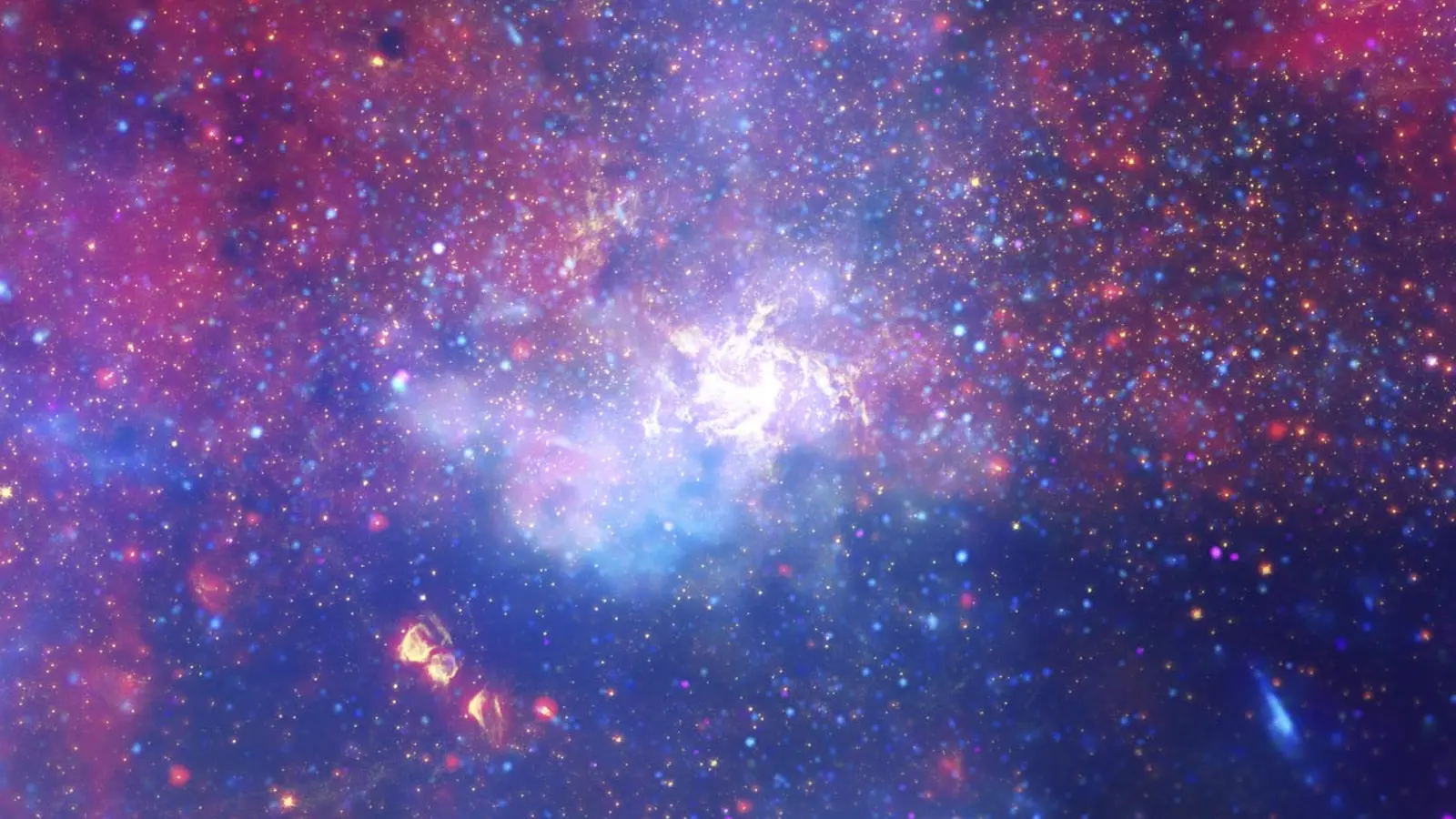
Something unexpected is spiraling at the heart of our galaxy. Close to the supermassive black hole known as Sagittarius A*, astronomers have found a swirl of gas unusually rich in heavy elements — the cosmic metals forged inside stars and tossed into space by their violent deaths.
That finding comes from a team at McGill University’s Trottier Space Institute, using the James Webb Space Telescope’s infrared eyes. Webb can tease apart the heat fingerprints of multiple gas clouds at once, giving an unprecedented look at the chemical makeup of material orbiting only light-hours from Sgr A*. The results show the gas contains high abundances of elements beyond hydrogen and helium — what astronomers call “metals,” from carbon and oxygen to iron and beyond.
Why does that matter? Because composition shapes behavior. Metals help gas cool, and cooling governs how readily clouds collapse or slide inward toward a black hole. In this case, the metal-rich signature resembles the composition of many stars that circle Sgr A*, suggesting that the gas and those stars may share a common origin — born from the same enriched environment or fed by the same generations of stellar explosions.
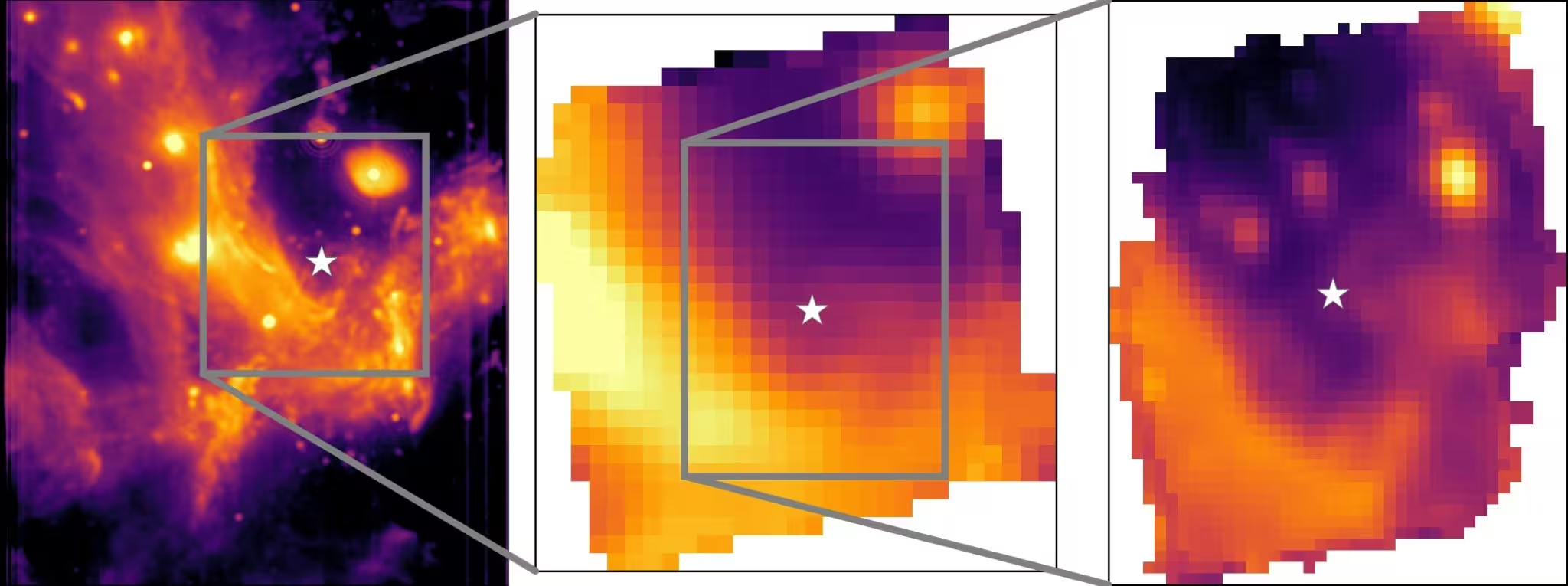
Three views of the center of our Galaxy in infrared light, with the location of the black hole Sagittarius A* marked by a white star. From left to right, the images zoom in and show the region at different wavelengths.
There’s a puzzle here. Sgr A* is a picky eater. For a supermassive black hole, it’s slow and sparse when it comes to guzzling material, far less voracious than its counterparts in many other galaxies. Could the chemical recipe of its neighborhood be part of the reason? “To understand why it’s eating so little, we have to study the properties of the available material,” says Nicole Ford, lead author of the study and a PhD student in Professor Daryl Haggard’s group. Composition, dust content and local dynamics all play a role.
Observations like these also force us to reassess how we read the environment around a black hole. A recent complementary study led by Mayura Balakrishnan examined whether the surrounding gas preserves a record of past energetic outbursts from Sgr A*. The answer was messy: local conditions — density, temperature, and the gas’s own chemistry — sculpt the light we see, masking clear signatures of ancient flares. In short, the gas does not keep a simple, reliable diary of the black hole’s past tantrums.

Gas swirling around the center of our Galaxy. The animation shows the gas at different infrared wavelengths, demonstrating how it moves around the black hole Sagittarius A*, marked by a white star icon.
Putting the pieces together will require more than snapshots. Webb gives remarkable, high-fidelity measurements over short stretches of time. To map how this metal-rich material behaves over millennia, researchers must fold these observations into long-term simulations of gas dynamics near a black hole. Only then can we test whether the stellar fireworks of the past seeded the circumnuclear gas we observe today, and whether that enrichment explains Sgr A*’s modest appetite.
Beyond feeding questions, there’s a broader implication: if nearby supermassive black holes inherit chemically enriched gas from surrounding stellar populations, that process could influence how elements are mixed and distributed across galaxies — and ultimately how planets like ours acquired the raw materials for rocky worlds and life.
This metallic swirl at our galaxy’s center is a reminder that black holes don’t exist in isolation; they are embedded in a complex, evolving ecosystem whose chemistry tells a story we are only beginning to read.


Leave a Comment
Comments
No comments yet. Be the first.