

Something roughly the size of a small country has been lurking past Pluto—quiet, slow, and almost invisible against a glittering wall of Milky Way stars. Astronomers now think this distant world, given the provisional name 2026 ED138, might qualify as the solar system's sixth dwarf planet.
Spotted in images from the Simonyi Survey Telescope at the Vera C. Rubin Observatory, ED138 first stood out not because it flashed bright but because it moved. It sits about 46 astronomical units from the Sun, a realm of dim sunlight and frigid ice where trans-Neptunian objects, or TNOs, wander in elongated orbits. Early estimates place its diameter somewhere between about 600 and 1,500 kilometers, large enough that gravity may have rounded it into a spheroid—the key physical test for dwarf planet status.
The finders are an experienced pair. Matthew Holman, a senior astrophysicist at the Harvard & Smithsonian Center for Astrophysics, flagged the object while running search code he developed with colleague Kevin Napier. Mario Jurić, who leads Rubin's solar system team at the University of Washington, confirmed more observations and helped nail down the orbit. Their combined work shows that ED138 is not a fleeting artifact but a real body whose motion can be traced back more than a decade.

2026 ED138 orbital arc (with annotations)
Why was something this big overlooked until now? The answer is crowding. ED138 lies close to the plane of our galaxy, where millions of background stars swamp telescopic images. Even a sizable icy world can vanish into that stellar haze unless a telescope repeatedly images the same patch of sky and software is tuned to pick out slow, systematic motion from a torrent of points of light. Rubin does both—scanning the southern sky at depth and speed—and its pipelines compare billions of detections to assemble tracks of moving objects.
Holman and Jurić didn’t just find fresh frames. They went back in time. Rubin images from March through July 2026 yielded a string of recent detections, and the team also identified ED138 in archival survey data dating to 2016. Those precovery observations extend the orbital arc to more than ten years, letting astronomers constrain the path and velocity far better than a handful of new exposures alone could

Mosaic of 2026 ED138 discovery images

That matters. The sizes, orbital shapes, and compositions of TNOs are fossils of the solar system's youth. Each newly characterized object refines models of how the giant planets migrated and how smaller bodies were shuffled into the Kuiper Belt and beyond. A nearly spherical body about 1,000 kilometers across is not a mere catalog entry; it's a probe into primordial conditions and dynamical history.
ED138 would slot alongside the five dwarf planets recognized by the International Astronomical Union: Pluto, Ceres, Eris, Haumea, and Makemake. If it is confirmed, it will be the largest trans-Neptunian object discovered in roughly two decades—an infrequent prize that Rubin unearthed while the observatory was still commissioning the Simonyi Survey Telescope.

This image from the NSF–DOE Vera C. Rubin Observatory shows the area of sky where the newly discovered dwarf planet candidate 2026 ED138 (ED138) was found. This image is a composite of multiple images captured by Rubin between 4 March and 11 July 2026.
The discovery also highlights a shifting paradigm in observational astronomy. Rubin is not simply taking deeper pictures. It is delivering a combination of cadence, sensitivity, and computational filtering that lets teams discover a moving object and then hunt through months or years of archived images to reconstruct its history. That capability, often called precovery, turns what used to be a slow chase into a rapid, retrospective detective story.
Finding ED138 required patient, meticulous work: code to link faint detections across many nights, archival trawls that revealed a decade-long arc, and careful photometry to estimate brightness and surface reflectivity. Those brightness and albedo assumptions translate into the wide size range for now. More observations across different wavelengths, and perhaps even stellar occultation campaigns, will narrow the uncertainty and determine whether ED138 truly meets the IAU's shape criterion.
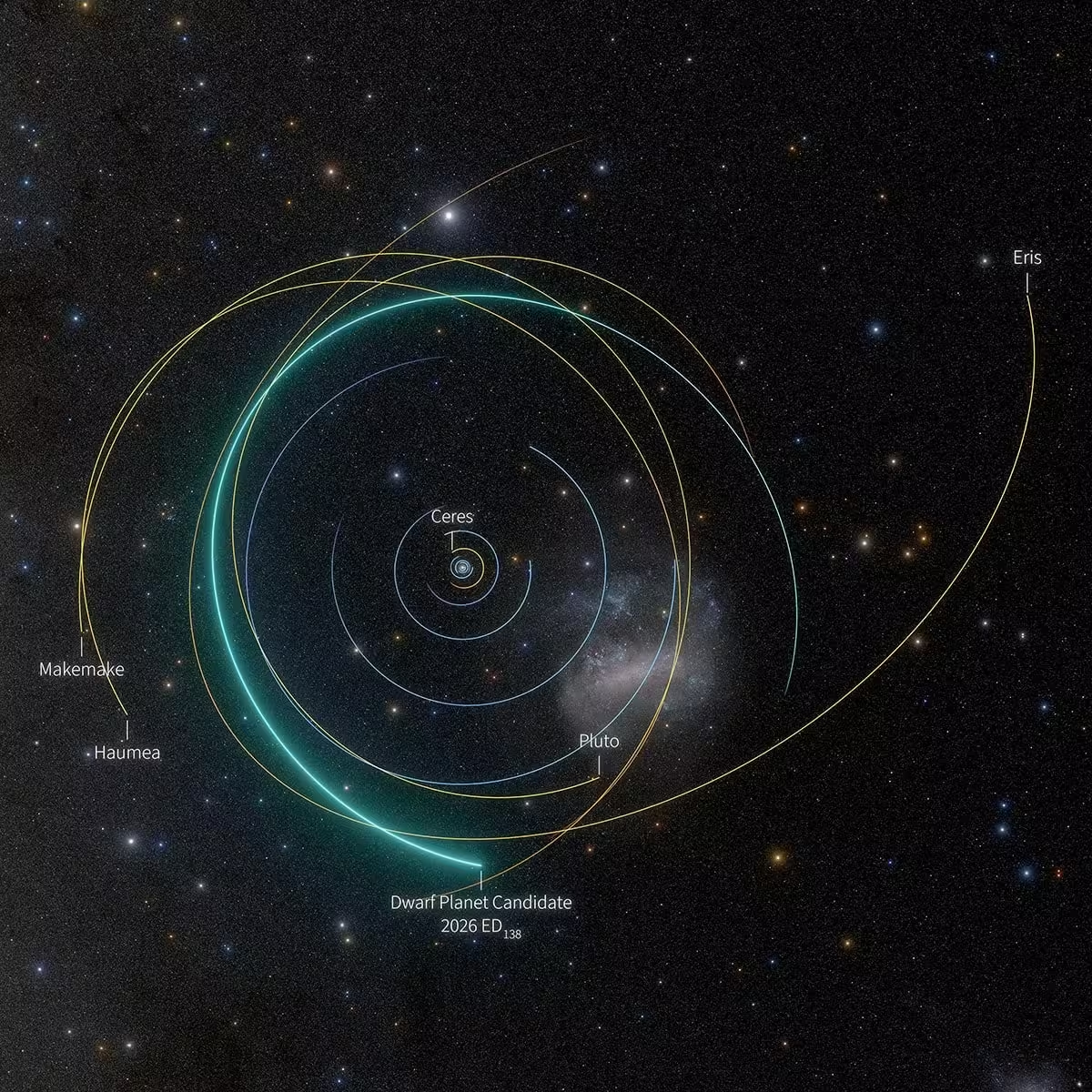
Top-down view of 2026 ED138 orbit (with dwarf planets)
For planetary scientists, the excitement is twofold. One: a rare, large TNO to study up close in data. Two: proof that objects hiding in crowded starfields or in slices of sky overlooked by past surveys are now within reach. Rubin’s Legacy Survey of Space and Time will repeatedly image the whole southern sky for a decade, so other hidden giants might soon step out of the stellar crowd.

We are watching a new chapter of the outer solar system open, told one slow-moving point of light at a time. Keep an eye on the deep-sky catalogs; the next discovery might already be waiting in images taken years ago.

Leave a Comment
Comments
No comments yet. Be the first.