

Major retroactive grants approved as ZEC consolidates
Zcash coinholders voted to approve $8.39 million in retroactive grants during the Q3 2026 Coinholder-Directed Retroactive Grants round. Seventeen of 37 proposals received funding, covering security research, protocol development and emergency responses tied to this year’s critical vulnerabilities. The largest single voting block involved roughly 2.18 million ZEC — about 10.4% of Zcash’s fixed 21 million coin supply — underscoring strong participation for a governance model that routes funding decisions directly to coinholders.
How the coinholder vote played out
What was approved and how much
Coinholders authorized $8.39 million in payments to teams and researchers whose work was already completed. That sum represents about 93.1% of the $9.01 million originally requested in the round. The program finances retroactive grants from the Coinholder-Controlled Fund, a multisig pool created under Zcash’s network funding framework.
Under the protocol’s current rules, a proposal vote must see at least 420,000 ZEC participating to qualify. A simple majority of votes cast (excluding abstentions) is sufficient to approve funding. Shielded Labs and the Zcash Foundation act as two of three keyholders in the fund’s 2-of-3 multisignature arrangement; they execute approved payments but their veto powers are limited to specified legal grounds.
Participation spike and governance implications
Participation surged this quarter. OpenZcash shows the largest Q3 vote at ~2.18 million ZEC, a sharp increase from roughly 500,608 ZEC in Q1. Several proposals were pushed into Q3 after Q2 voting was postponed during Zcash’s emergency response to the Orchard vulnerability. Zcash co-founder Zooko Wilcox characterized the round as proof of coinholder-directed funding and a sign of the network’s capture resistance — an interpretation of the outcome rather than a strict, quantifiable property of the governance model.
Zcash just gave away more than $8m in retroactive grants, including millions of dollars of retroactive grants to a lot of people who selflessly worked to protect all users during the AI bug crisis this year.
Orchard vulnerability and the $1.5M award
Discovery and disclosure
One of the highest-profile approvals was a $1.5 million award for Taylor Hornby, the researcher credited with uncovering a critical counterfeiting vulnerability in Orchard. Shielded Labs disclosed that Hornby identified the flaw on May 29 while auditing Orchard with traditional security methods and Anthropic’s Opus 4.8 model during an AI-assisted review.

The vulnerability impacted the zero-knowledge proof circuit underpinning Orchard, potentially allowing an attacker to mint ZEC within the shielded pool in a way that left little on-chain evidence. Hornby reported the issue promptly to Zcash Open Development Lab (ZODL) engineers, enabling an emergency operational response that involved developers, miners, exchanges and infrastructure providers.
Network response and mitigation
The Zcash Foundation noted that Orchard transactions were temporarily disabled while teams implemented NU6.2 with a corrected circuit. Their analysis found no clear evidence of unauthorized value creation, and the network’s turnstile accounting showed total supply remained intact. The $1.5 million represents retroactive compensation for the security research and remediation tasks completed by Hornby and his nominators. Larger grants must still pass compliance checks and administrative review — payments above $50,000 undergo additional scrutiny before keyholders coordinate disbursements.
Security and protocol development received the lion’s share
Much of the funded budget prioritized audits, protocol upgrades and formal verification — work tied to the network’s resilience after a turbulent security episode.
Among the other major approvals were:
- $1.95 million for ZODL’s Q1 and Q2 core protocol development work
- $1.203 million for ValarGroup’s Ironwood contributions
- $738,942 for formal verification of the Ironwood zk-SNARK circuit
- $599,000 to cover external audits
- $425,000 addressing five critical Zebra consensus-divergence vulnerabilities
- $400,000 tied to a temporary detectable unlimited-mint-and-sell exploit
- $150,000 in Zebra vulnerability bounties
Ironwood followed the Orchard incident as the network continued to iterate on shielded pool design. In July, the Zcash Foundation released Zebra 6.0.0 with NU6.3 Ironwood support. Ironwood introduced a new shielded pool using Orchard’s Action layout and the Halo2 proving system while keeping discrete accounting records for transparency and safety.
Not every proposal passed. Twenty submissions were rejected or failed to secure funding, but most dollars flowed to the largest, security-focused requests — demonstrating coinholders’ prioritization of resilience and protocol integrity.
Market reaction: ZEC price and technical indicators
Price action after the vote
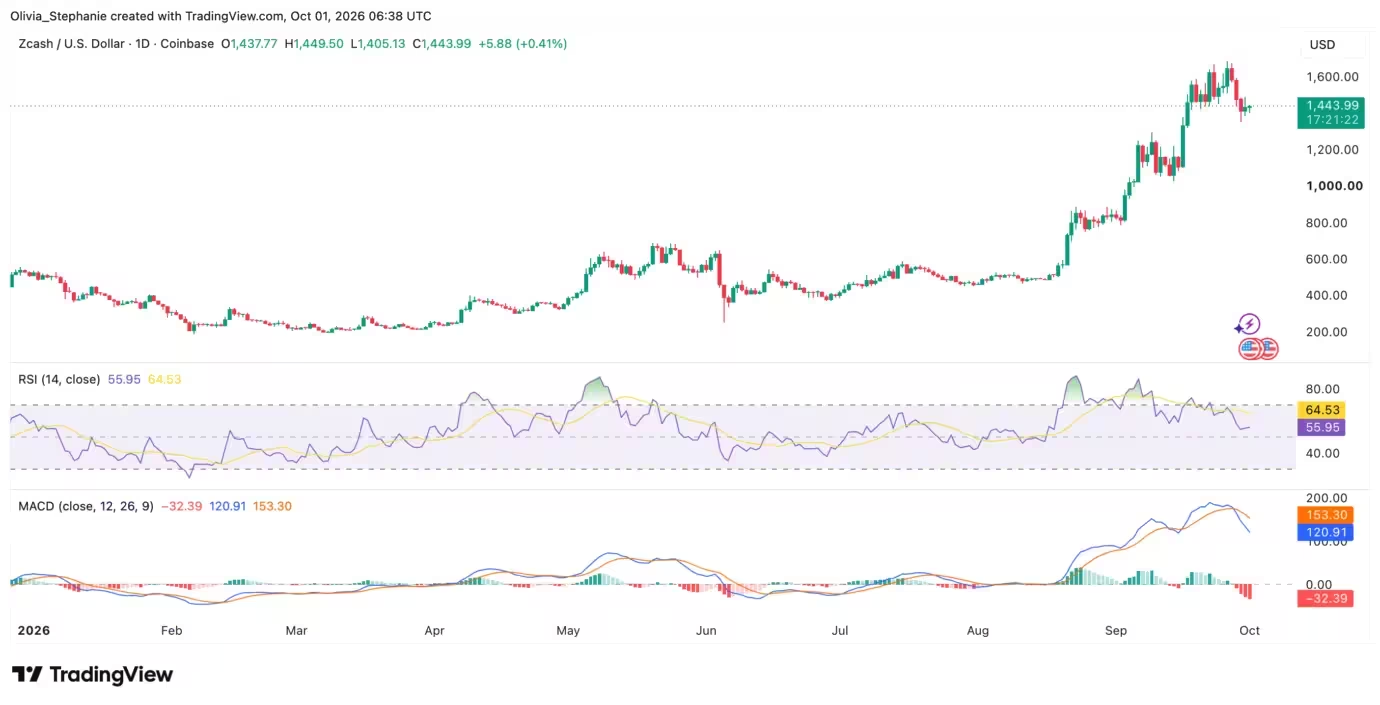
At the time of reporting, Zcash (ZEC) traded near $1,407. CoinGecko’s 24-hour range showed roughly $1,382 to $1,458. That price sits below the $1,600–$1,700 zone reached during September’s rally but remains far above pre-breakout levels.
The daily technical picture shows momentum cooling from the overbought conditions seen during the rally. The 14-day Relative Strength Index (RSI) is around 55.45, down from a moving average near 64.49, indicating the short-term buying pressure has eased but is still above neutral.
Zcash (ZEC) price chart
Momentum metrics and possible near-term levels
The MACD configuration reflects similarly diminished short-term bullishness: the MACD line sits near 120.13 against a signal line around 153.14, leaving a negative histogram in the -33 area. These readings point to fading momentum as ZEC consolidates beneath September highs.
Traders monitoring moving averages note the daily 21-day EMA recently tested for the first time since August, according to market commentator that1618guy. A deeper correction could move attention toward the 55-day EMA, near $1,100 at the time of analysis. Immediate support in the market sits around $1,400, while a recovery into the $1,500–$1,600 zone would revisit the area where sellers pressured price last month.
On-chain flows and a whale accumulation
Exchange withdrawals and large-wallet activity
On-chain trackers logged a notable withdrawal: a whale moved 2,000 ZEC (about $2.82 million at the time) off Binance across two addresses, then consolidated the funds into a primary accumulation wallet. That main address now holds roughly $66.19 million worth of ZEC.
Exchange withdrawals alone don’t confirm long-term intentions — coins moved on-chain can be held in cold storage, redeployed into trading, or used for staking, custody, or other on-chain activities. Still, large transfers during a price consolidation often draw attention from market participants and analysts tracking supply concentration and potential selling pressure.
What this means for Zcash and the wider crypto ecosystem
The grant approvals underline several broader themes relevant to privacy-focused blockchains and crypto governance: - Coinholder-directed funding can rapidly channel resources to security and protocol work after a crisis, rewarding researchers and teams whose contributions protect network users. - Retroactive grants create incentives for disclosure and remediation by compensating work after successful completion rather than paying only up-front bounties. - Technical upgrades — from zk-SNARK formal verification to consensus-level patches in Zebra — remain essential for maintaining trust in privacy coins where zero-knowledge proofs and shielded transactions are central.
For traders and investors, continued monitoring of on-chain metrics, derivatives open interest, and technical indicators (RSI, MACD, EMAs) will be important to gauge whether ZEC’s recent rally marks a durable trend or a correction phase.
Looking ahead: the next grant window and governance timeline
The next retroactive grant cycle will accept proposals from Oct. 30 through Nov. 13. That will be followed by a review period and voting from Dec. 17 through Dec. 29. Given the Q3 surge in participation and the heightened focus on security funding, upcoming rounds could again prioritize audits, formal verification and protocol work aimed at strengthening shielded pools and the underlying zero-knowledge systems.
Final takeaways
Zcash’s recent coinholder vote redistributed more than $8 million to contributors who helped secure the network during a high-profile vulnerability episode. The mix of large security awards, increased voter participation and active on-chain accumulation highlights an ecosystem balancing governance, protocol risk management and market dynamics. For privacy-focused blockchains that rely on advanced cryptography like zk-SNARKs and Halo2, transparent funding and rapid-response coordination between researchers, foundations and operators remain critical to long-term resilience.

Leave a Comment
Comments (1)
Wow 1.5M for the Orchard finder?? Huge. Coinholders actually put money where mouth is, but who nominated Hornby and how clean was the split, curious...