

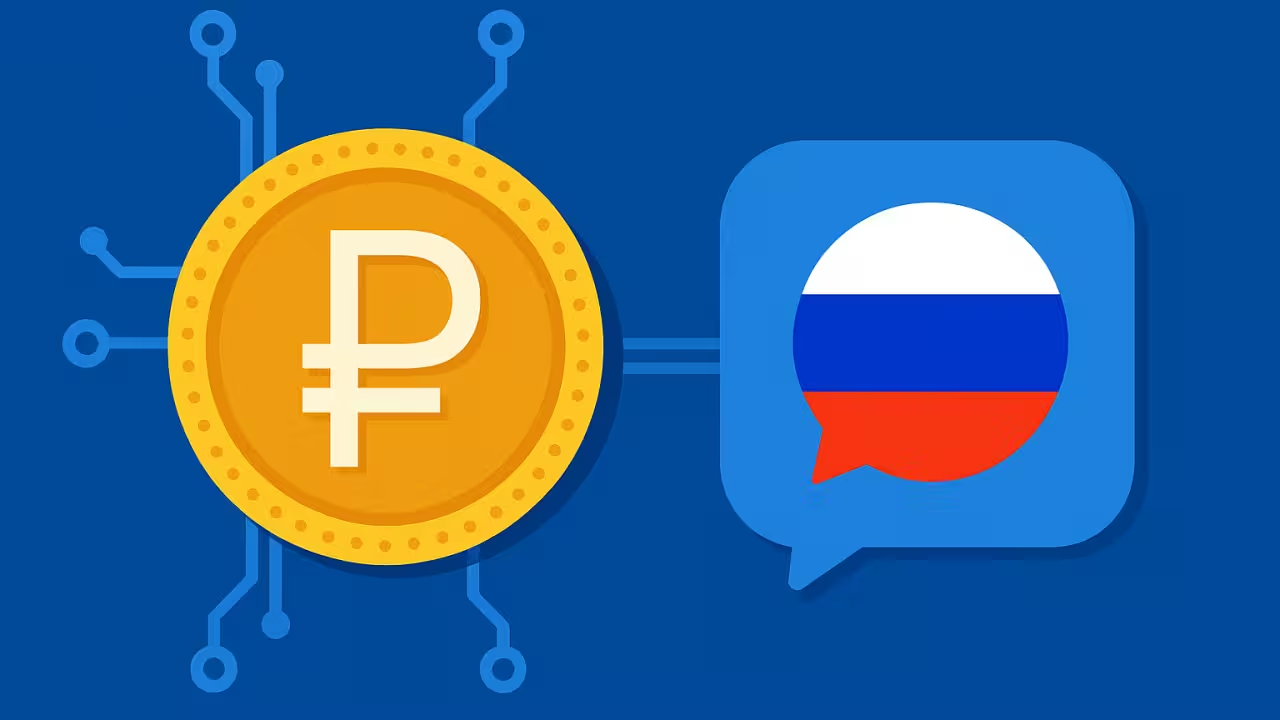
Russia pays wages in digital rubles for the first time
On October 1, Russia’s Finance Ministry processed salary payments using the central bank digital currency (CBDC) known as the digital ruble, marking the first time Moscow moved the CBDC into routine government payroll operations. The ministry said participating staff opened digital ruble accounts on the Bank of Russia’s platform before receiving wages, but it did not disclose how many employees were involved or the total value of the transfers.
Voluntary adoption and account setup
Receiving salary in digital rubles remains optional for employees. Workers can continue to receive pay through existing methods — bank transfers or cash — while those who opt for the CBDC must open an account on the Bank of Russia’s platform. Commercial banks act as the user interface: individuals create a digital ruble wallet through a participating bank’s mobile app, but the actual account is held on the central bank’s infrastructure.
Background: pilot trials and budget testing
The Oct. 1 payroll payments build on earlier pilots. During 2025 the Finance Ministry and Federal Treasury conducted digital-budget trials that moved nearly 16 million rubles in digital currency across selected salary payments, stipends and contract disbursements. Those trials were designed to test the Bank of Russia’s backend and to ensure public-spending processes could run smoothly on the CBDC platform before broader use in government accounting.
Functions tested in 2025
The Bank of Russia said its 2025 pilot covered a range of operations, including core transfers between individuals and businesses, standard budget payments and several programmable or smart-contract-like transactions. Testing aimed to validate both throughput and operational rules before extending digital-ruble functionality more widely to state institutions.
How the Bank of Russia prepared payroll functionality
The central bank adapted platform tariffs and operational rules to support payroll transfers. On June 19, the Bank of Russia approved a board decision that introduced specific tariffs for digital-ruble transfers from companies to individuals, covering salaries and employment-related payments. To encourage early uptake, payroll transfers will carry a zero platform fee through the end of 2026.

Fees and future tariff schedule
From Jan. 1, 2027, the Bank of Russia’s published tariff schedule foresees compensation equal to 67 kopecks per completed payroll instruction for participating institutions, subject to a minimum per payment register. The initial zero-fee window is meant to lower barriers for employers and institutions integrating the CBDC into payroll and human-resources systems.
Wider retail access: banks and merchants onboarded
The Finance Ministry’s payroll rollout followed the first large-scale stage of the digital-ruble rollout on Sept. 1, when major banks, telecom payment services and large retailers began offering digital-ruble services nationwide. Major banks and large merchants were required to prepare systems that allow customers to open digital ruble accounts and process CBDC payments via familiar mobile apps and point-of-sale services.
Limits and fees for consumers and businesses
Individuals are allowed to transfer up to 300,000 rubles per month from ordinary bank accounts into their digital ruble wallets; businesses do not face this top-up limit. Digital-ruble person-to-person payments and consumer transactions currently carry no platform fee. Merchant charges have a temporary zero-fee period through Dec. 31, 2026; standard merchant fees are scheduled to apply in 2027.
Phased rollout through 2028
The Bank of Russia outlined a multi-year phased rollout. The Sept. 1 requirement initially covered the largest banks and qualifying large merchants — typically businesses with annual revenue above 120 million rubles that meet specific banking conditions. From Sept. 1, 2027, the mandate will extend to banks with universal licenses and merchants with revenue above 30 million rubles. A further stage in September 2028 will bring banks with basic licenses and additional merchants into scope.
Exemptions and consumer choice
Small retail outlets are partially exempt. Stores with annual revenue below 5 million rubles and businesses operating without reliable internet access are not required to accept the CBDC. Bank of Russia Governor Elvira Nabiullina has emphasized that personal use is optional — an "option and not a requirement" — while confirming customers of major banks would gain access from September 2026.

Technology use cases: programmable payments and public finance
Beyond consumer payments, the Bank of Russia has been testing programmable or conditional budget transactions in collaboration with the Finance Ministry, Federal Treasury and regional authorities. These programmable payments allow conditions to be attached so funds are released only when pre-set criteria are met — a feature that could improve transparency and automation in public finance and targeted spending.
Smart contracts and government disbursements
Programmable transactions expand the CBDC’s utility for conditional disbursements such as stipends, grants or contract milestones. Pilot implementations have focused on whether payment rules can be reliably enforced on the central bank platform, how reporting integrates with government accounting, and what operational safeguards are needed to prevent misuse.
Cross-border settlement prospects and geopolitical constraints
The Bank of Russia has signaled that cross-border settlement is a potential long-term use case for the digital ruble. Officials in Moscow and New Delhi have discussed whether CBDCs could support bilateral trade settlement, although no operational Russia-India CBDC settlement network has been announced. Cross-border use remains an exploratory track while the domestic rollout focuses on payments, transfers and government transactions.
Sanctions and international limitations
Russia’s CBDC program faces international constraints. In April, the Council of the European Union included a ban on EU support for developing the digital ruble as part of a 20th sanctions package related to the war in Ukraine. The measures also targeted Russian crypto platforms and certain RUBx transactions. Despite these restrictions, the Bank of Russia maintained its domestic rollout timetable, proceeding with preparations and the Sept. 1 launch for major banks and merchants.
Digital ruble vs. regulated cryptocurrencies
Russia’s digital-ruble expansion coincided with a new regulated cryptocurrency framework that took effect in September 2026. The two systems are legally and operationally distinct. The digital ruble is central bank money issued and controlled by the Bank of Russia, while Bitcoin, Ether and other cryptocurrencies operate under separate domestic digital-asset regulations. That separation means CBDC adoption is not a replacement for regulated crypto markets but rather a parallel development in Russia’s payments landscape.

As the Finance Ministry’s Oct. 1 payroll experiment shows, Russia is moving from pilots toward practical public-sector adoption of the digital ruble. Key questions going forward include the pace of private-sector uptake, how programmable features are governed, the impact of tariff changes after 2026, and whether cross-border CBDC arrangements will materialize amid geopolitical headwinds. For crypto observers and payment industry participants, Russia’s phased approach offers a live case study of how a major economy integrates a central bank digital currency into wage payments, retail commerce and public finance.

Leave a Comment
Comments (1)
digital ruble payroll? sounds handy but uh who controls access and freezes accounts? if true, privacy worries me..