

Large Lubin-Linked Transfer Sparks Market Attention
A wallet associated with Ethereum co-founder Joseph Lubin moved 133,298 ETH — roughly $356 million at the time of transfer — to a new address, raising fresh questions about potential selling pressure and short-term implications for ETH price action. The on-chain tracker Lookonchain flagged the transaction around five hours after it occurred. Crucially, the funds were not sent to a known centralized exchange, which reduces the immediate probability of an instant market sell-off but keeps traders and analysts on alert.
Why the destination matters: exchange vs private wallet
On-chain movements of large ETH balances get attention for a reason: transfers into centralized exchanges typically increase liquid supply available for trading, which can translate into short-term downward pressure on price if those tokens are sold. By contrast, transfers between private or cold wallets do not automatically increase circulating sell-side liquidity. Because the Lubin-linked transfer did not, at the time of reporting, hit a known exchange wallet, the move currently appears to be a repositioning rather than an outright liquidation.
That said, the receiving address remains a focal point. A subsequent shift of those 133,298 ETH to an exchange would materially change the market implications and could accelerate volatility.
Price reaction: ETH holds the $2,700 line
Ethereum showed limited immediate price reaction and was trading near $2,715 at the time of the report, keeping price above the closely watched $2,700 level. This area has repeatedly acted as a near-term battleground during ETH’s recent recovery from earlier drawdowns. Buyers have defended the $2,636–$2,700 band several times, but the $2,800 region has proven to be stiff resistance.
Institutional demand through U.S. spot Ethereum ETFs helped underpin the recent rally, but inflows have cooled after a strong run. Between early September and Sept. 25, roughly $690 million flowed into spot ETH ETFs across five straight sessions, with BlackRock’s ETHA and Fidelity’s FETH accounting for sizable portions of that demand.
Staking and supply dynamics
Staking demand continues to absorb liquid ETH supply. As of Sept. 28, about 43.5 million ETH — roughly 35.66% of total supply — was staked, with an additional 1.61 million ETH queued to enter staking versus about 161,000 ETH waiting to exit. That imbalance left the validator entry queue nearly 10 times larger than the exit queue at that snapshot. While staked ETH is not immediately liquid, staking alone does not dictate price direction; it does, however, reduce available circulating supply and can provide support if demand persists.

Technical outlook: buyers still hold the edge
Ethereum’s daily chart remains constructive overall despite the uncertainty from the large wallet movement. The Directional Movement Index (DMI) shows the positive directional indicator (+DI) comfortably above the negative directional indicator (-DI), signaling buyers retain a directional advantage. ADX sits above the 25 threshold commonly used to confirm a meaningful trend, indicating the prevailing move still has strength even though ADX has eased from its September peak.
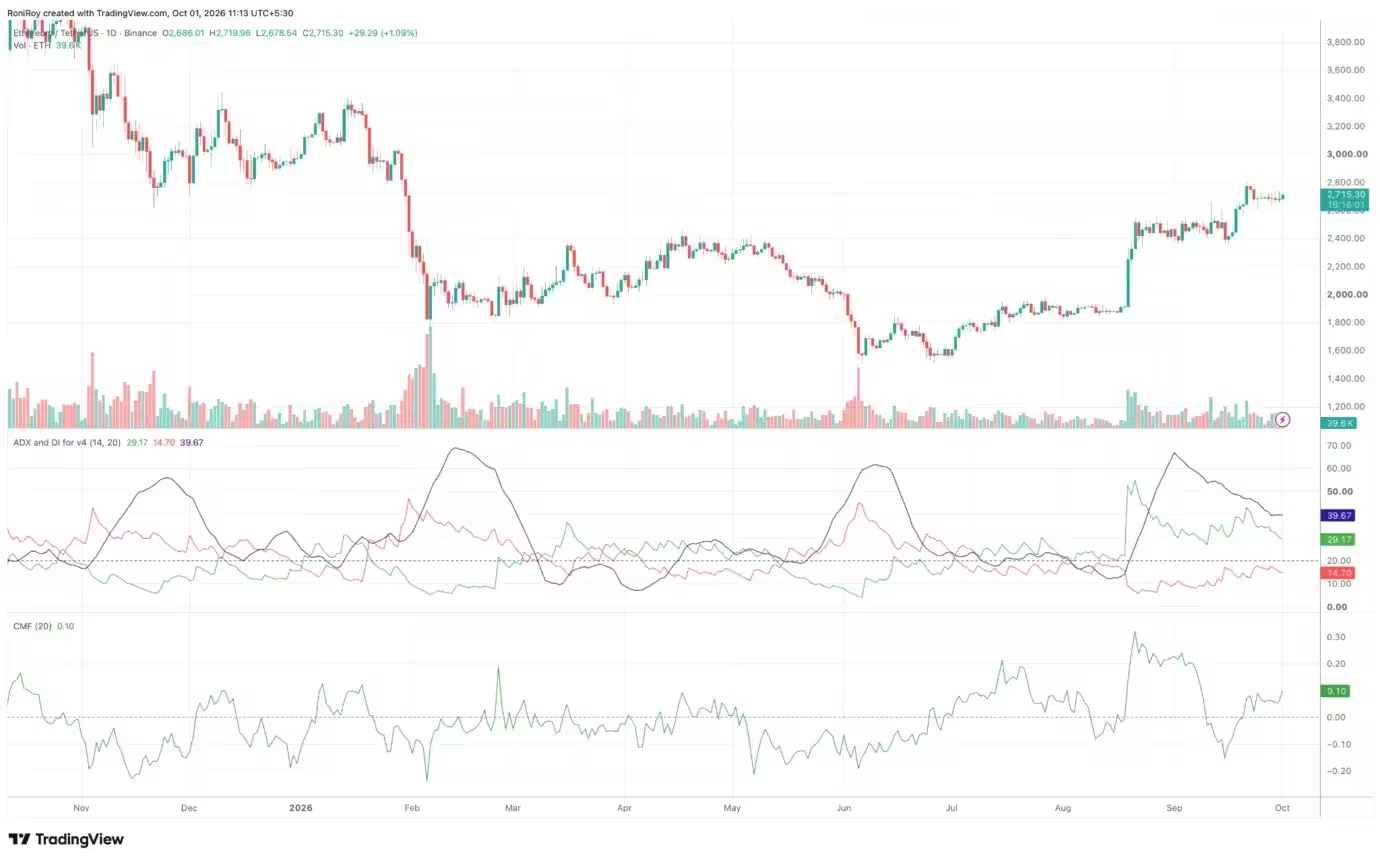
ETH/USDT 1-day price chart
A positive 20-day Chaikin Money Flow (CMF) around 0.10 also supports the view that buying pressure remains stronger on a volume-weighted basis. Importantly, CMF has not signaled sustained distribution following the 133,298 ETH transfer, suggesting the movement has not yet translated into decisive selling pressure from capital flows.
Key levels and breakout scenarios
On the upside, the immediate resistance cluster lies in the $2,749–$2,800 region. A clean daily and intraday break above roughly $2,749, ideally accompanied by expanding momentum readings, would reopen $2,800 as the next target. If buyers follow through, $2,900 and then the psychological $3,000 level would come into focus as potential objectives for a sustained rally.
On the downside, the lower Donchian boundary near $2,635–$2,636 is the key short-term floor. A decisive break below $2,636, especially if matched by a negative swing in short-term momentum and a CMF dip below zero, would weaken the short-term setup and increase the odds of a deeper pullback.
Short-term momentum: watch the Donchian channel and ROC
On the four-hour chart, Ethereum is trading in the upper half of its 20-period Donchian Channel. The upper boundary sits around $2,748.60, the midpoint near $2,692.15 and the lower boundary about $2,635.69. Price has yet to confirm a breakout above the upper channel boundary, keeping intraday traders cautious.

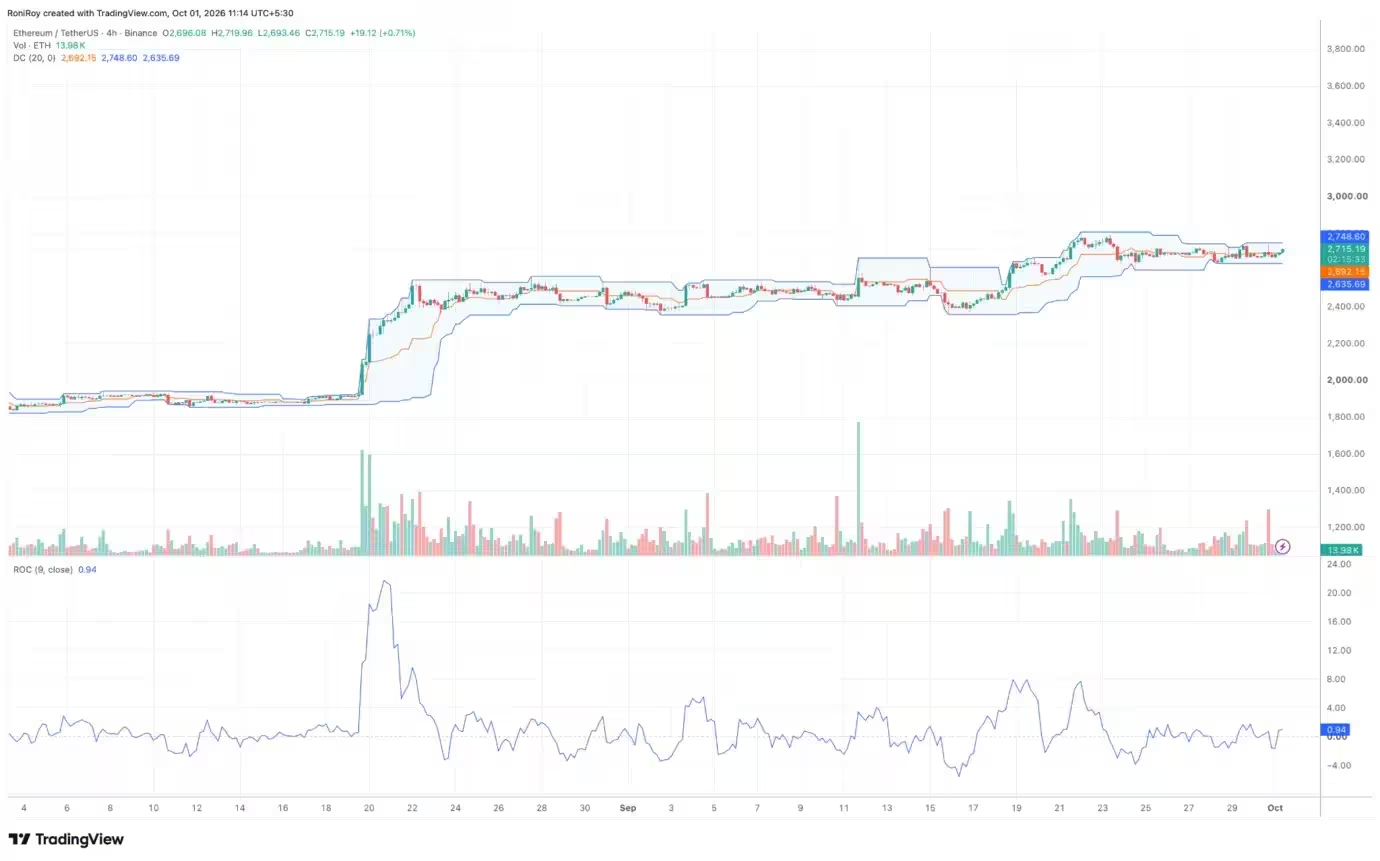
ETH/USDT 4-hour price chart
The nine-period Rate of Change (ROC) is positive but muted at 0.94, indicating short-term momentum favors buyers but lacks aggressive acceleration. A four-hour close above $2,749 tied to an expanding ROC would strengthen the case for retesting $2,800 and potentially advancing toward the $2,900–$3,000 zone.
Conversely, failure to break the upper Donchian range would keep $2,692 as the first support, with the more significant short-term support at $2,636. A move below those levels accompanied by rising -DI, falling +DI and a CMF below zero would point to a deterioration of buying conviction.
ETF flows, whale activity and risk management
Spot ETH ETF inflows were an important source of demand in recent weeks, with BlackRock’s ETHA and Fidelity’s FETH among the most prominent products. ETF demand helped cushion ETH during failed breakout attempts around $2,800, but inflows have moderated. Market participants will be watching ETF flows for signs of renewed institutional appetite or waning demand.
Whale movements, such as the Lubin-linked transfer, are inherently ambiguous until direction is confirmed — are these transfers long-term custody reallocations, cold storage moves, or prelude to sell-side activity? Because the transfer did not route to known exchange wallets, the immediate market implication is limited. Still, traders should be prepared for volatility if the recipient address later funnels large balances into exchange on-ramps.
Trading implications and scenarios to watch
- Bull case: ETH sustains a breakout above $2,749–$2,800 with rising volume and momentum; ETFs resume inflows and CMF remains positive. Targets: $2,900 then $3,000.
- Bear case: Recipient address pushes material ETH to centralized exchanges, or price falls below $2,636 with negative momentum and CMF flipping below zero. That would open the door to deeper corrective action.
- Neutral / range case: ETH remains confined between $2,636 and $2,800 as market participants assess on-chain signals, ETF flow data, and macro catalysts.
Conclusion: on-chain move notable but not yet decisive
The 133,298 ETH transfer from a wallet linked to Joseph Lubin is significant in size and merits attention, but it has not yet translated into a clear supply shock or immediate bearish outcome because the tokens did not land on a known exchange. Ethereum’s technical indicators — including a positive DMI alignment, ADX above trend thresholds, and a positive Chaikin Money Flow — suggest buyers retain the upper hand in the near term.
Key levels to monitor remain $2,749–$2,800 on the upside and $2,636 on the downside. Traders should watch the receiving address closely for any sign of further transfers to centralized exchanges, ETF flow updates, and changes in short-term momentum readings like ROC and CMF. Until a confirmed exchange deposit or a decisive break of technical floors occurs, the market’s reaction to the Lubin-linked move looks more like cautious watchfulness than immediate panic.


Leave a Comment
Comments
No comments yet. Be the first.