

Pi Network schedules first Ecosystem Summit as PI trades near $0.08
Pi Network has confirmed its inaugural three-day Ecosystem Summit, set to run online from November 17–19, 2026. The announcement arrives as PI continues to trade under $0.08, reflecting sustained selling pressure after a nearly 14% monthly decline. The summit aims to showcase developer tools, application demos and the platform's roadmap for increasing real-world utility, but it does not include confirmed launches or guaranteed liquidity improvements.
What to expect from the November Ecosystem Summit
Pi Network says the online event will gather the core team, third-party developers and app operators to demonstrate building blocks for the ecosystem. The program is billed to include:
- Developer demonstrations of Pi App Studio, account authentication and payment integrations.
- Application showcases highlighting Mainnet projects and real use cases for Pioneers.
- Platform updates and previews of new features for builders, including support for AI applications.
- Announcement of an upcoming hackathon, with rules, prizes and registration details to follow during the summit.
The company has not yet published a full agenda or viewing instructions. Organizers stress that this summit differs from Pi Day and Pi2Day events, focusing specifically on tooling, developer adoption and app-level showcases rather than sitewide network activity or celebrations.
Developer reach and ecosystem scale
Pi’s announcement emphasizes the network audience available to builders: more than 60 million engaged Pioneers, over 300 Mainnet applications, roughly 420,000 nodes and 18.1 million KYC-verified users. Those figures underline the distribution potential for new dApps and payment-enabled services, particularly as low-code and AI-assisted development lowers the barrier to building software.
However, Pi has not published a consistent, verifiable breakdown of active users, merchant sales or transaction volumes across its Mainnet applications. Numbers describing app deployments do not necessarily translate into frequent commercial activity or completed purchases, which remains a key adoption metric for developers and merchants evaluating payment functionality in the ecosystem.

Usage and liquidity questions persist
While developers can integrate with Pi’s SDK for account authentication and payments and use app-discovery tools to reach Pioneers, the project hasn’t committed to providing network-wide usage reports. The summit program has not promised new liquidity facilities, exchange listings or secondary-market infrastructure—areas traders and ecosystem participants often watch closely.
That leaves practical questions: how many customers regularly use a given Mainnet app, what are merchant sales volumes, and how frequently do on-chain or off-chain transactions settle? Demonstrations at the summit may show working integrations, but they may not deliver the comprehensive transactional metrics some investors and partners require.
Technical upgrades, AI integration and stablecoin exploration
Pi’s development roadmap has been active alongside summit planning. Recent protocol work included an October 13 deadline for node operators to install Protocol 28 software ahead of an announced Mainnet activation window. Protocol 28 is designed to improve handling of delayed transactions and allow grouped smart contract updates, although the project has not independently confirmed a successful, network-wide activation.

The company is also evolving the platform for AI-first applications. Announced improvements include tighter integration for externally created AI apps into Pi App Studio and upgrades to SoloHost, the self-hosted AI software platform. Enhanced developer documentation is expected to accompany these changes to speed onboarding.
On the payments front, Pi disclosed an exploratory partnership with Open Standard, the team behind the OUSD stablecoin, to evaluate dollar-backed token payments and potential Pioneer rewards. Pi maintains that PI will remain the primary cryptocurrency for the network, while stablecoins could offer predictable fiat-denominated pricing for merchants and customers. No Mainnet launch date for OUSD on Pi has been confirmed, and reward mechanics or user incentives have not been specified.
An independent analysis of OUSD highlights that the stablecoin currently operates on Base, Ethereum, Solana and Tempo; how it will integrate into Pi’s Mainnet remains under development.
Market snapshot: PI price and on-chain indicators
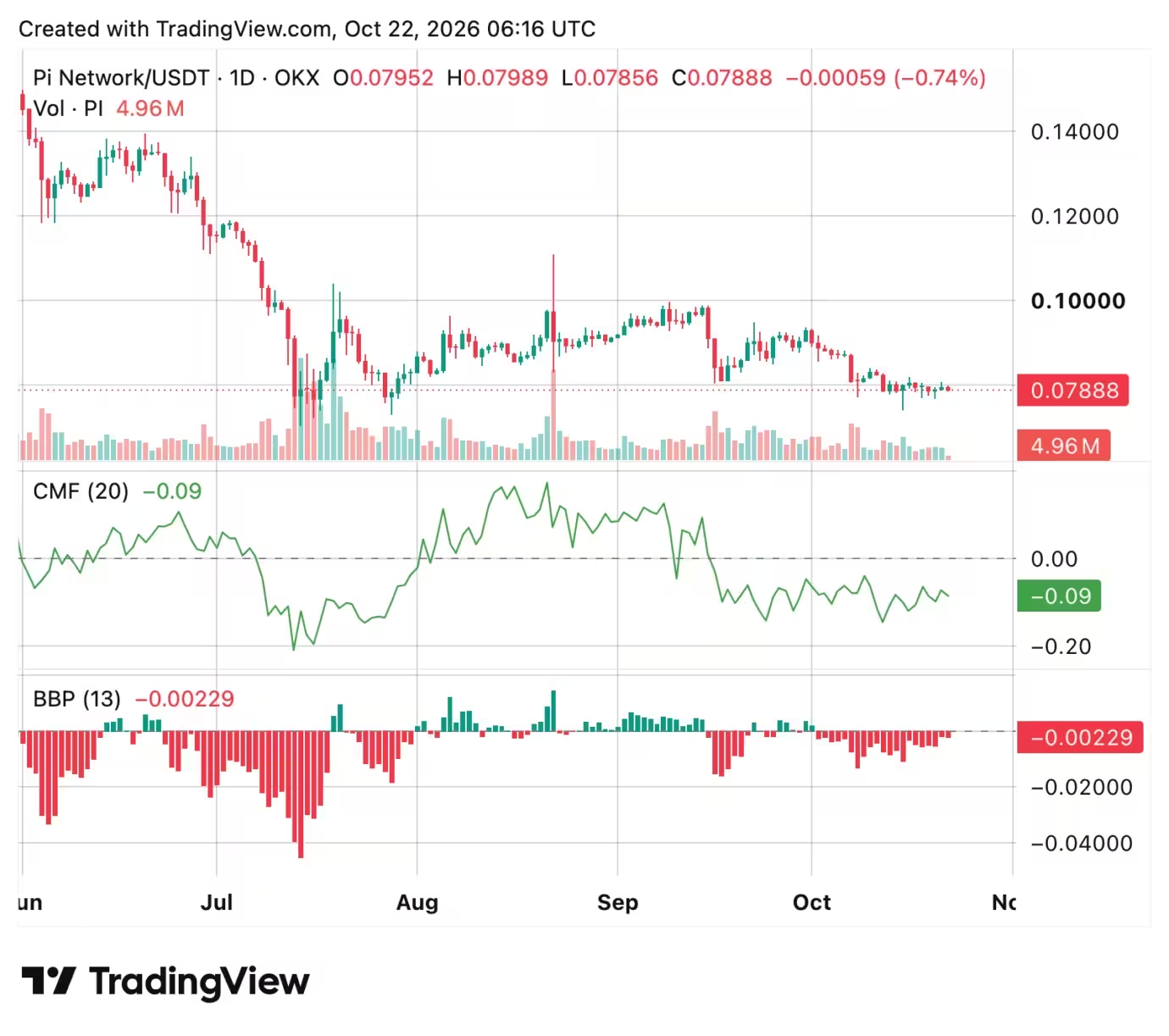
PI traded around $0.0787 on October 22, 2026, down roughly 13.9% over the previous month. Daily volume was approximately $3.23 million, while seven-day performance showed a modest 2% gain. Based on a circulating supply of 11.28 billion PI, the network’s market capitalization was near $888.2 million at the time of reporting.
For perspective, PI’s all-time high occurred in February 2025 at $2.99, while the token’s recent low was $0.070586 in July 2026. Technical indicators pointed to negative net money flow: the Chaikin Money Flow was around -0.09 and Bull Bear Power read -0.00229—figures that indicate selling momentum has been present, although the latter reading suggested marginal easing rather than a confirmed bullish reversal.
PI Network price chart
Support and resistance levels to watch
Traders monitoring PI should note immediate support near $0.078, with a secondary support level around $0.075 should downside momentum accelerate. Key resistance levels sit near $0.082 and $0.090; reclaiming those zones would be required for the token to break out of its recent trading range and reduce short-term volatility.
What the summit could mean for adoption and markets
The November Ecosystem Summit is positioned as a developer- and application-focused event, with practical demos and a hackathon designed to accelerate tooling and real-world integrations. For developers, the event offers exposure to a large Pioneer base; for merchants and service providers, it may clarify payment options and stablecoin planning. For traders and investors, the summit could spark renewed interest if announcements include tangible measures to improve liquidity, merchant settlement or verified usage metrics.
At present, Pi’s public statements emphasize platform capabilities and the promise of scale rather than immediate market-moving releases. Stakeholders should therefore treat summit expectations with measured optimism: demonstrations and developer resources can increase long-term utility, but short-term price catalysts typically require clearer signals on listings, liquidity or measurable transaction growth.
Conclusion
Pi Network’s November summit will be closely watched by builders, merchants and market participants seeking clarity on real-world adoption, developer tooling and payments integration. While the network reports significant user and application counts, meaningful metrics around active usage and transaction volumes remain sparse. The event should reveal more about the project’s technical direction, hackathon plans and developer resources—but investors will likely continue to monitor liquidity, exchange access and on-chain activity before revising price expectations for PI.

Leave a Comment
Comments
No comments yet. Be the first.