
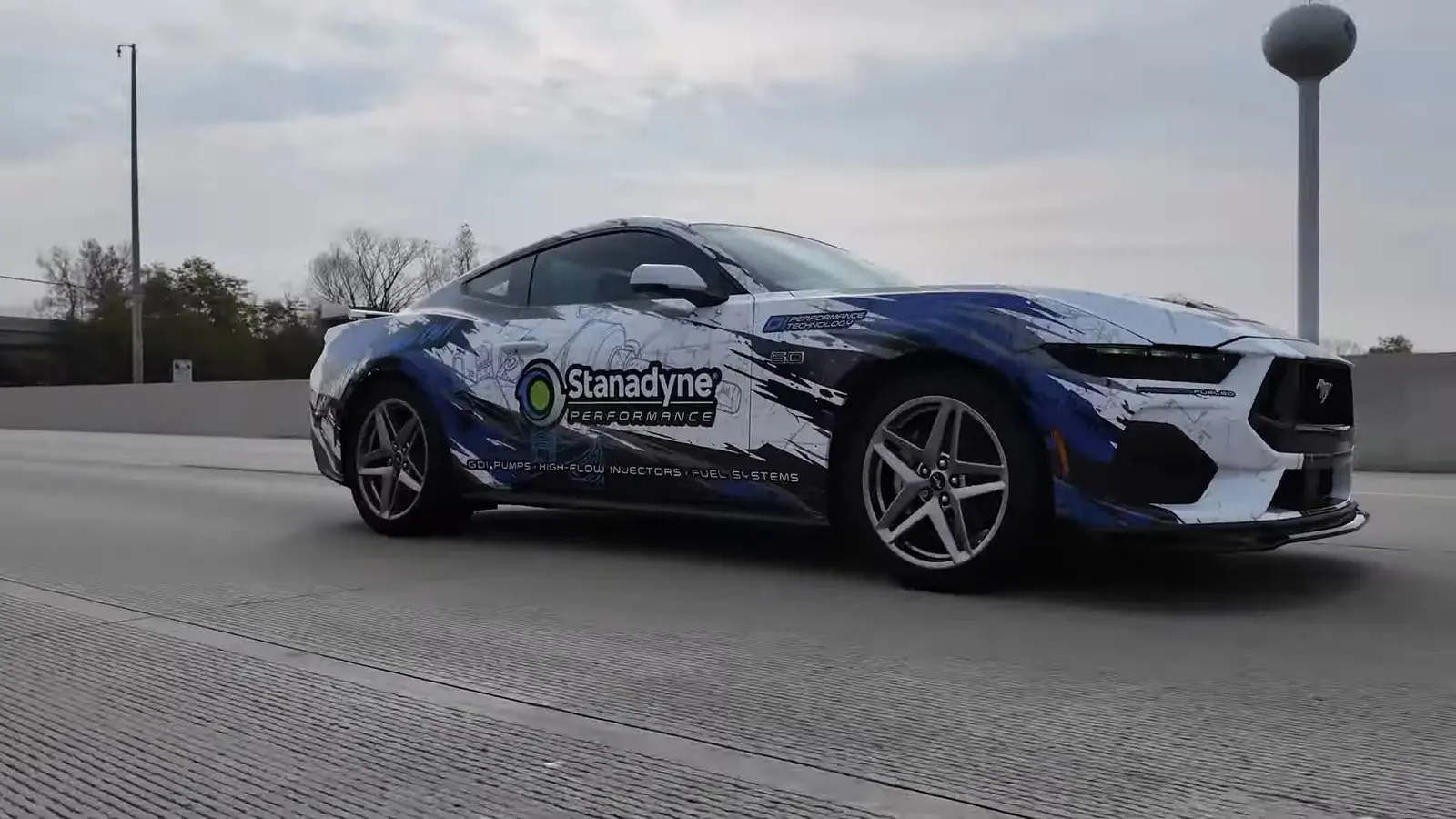
Lingenfelter Performance Engineering has fitted a seventh-generation S650 Ford Mustang GT with an in-house Vortech centrifugal supercharger package that produced 607 hp (615 PS) and 442 lb-ft (600 Nm) to the rear wheels on a Dynojet Research chassis dynamometer at 10 psi (0.69 bar). The prototype was shown at the 2026 SEMA Show and the installation was carried out at Lingenfelter's Wixom, Michigan build facility. Company marketing and media specialist Carter MacEwen revealed the project in a YouTube announcement and said full pricing and specification sheets will follow in the coming months.
Package layout and measured performance
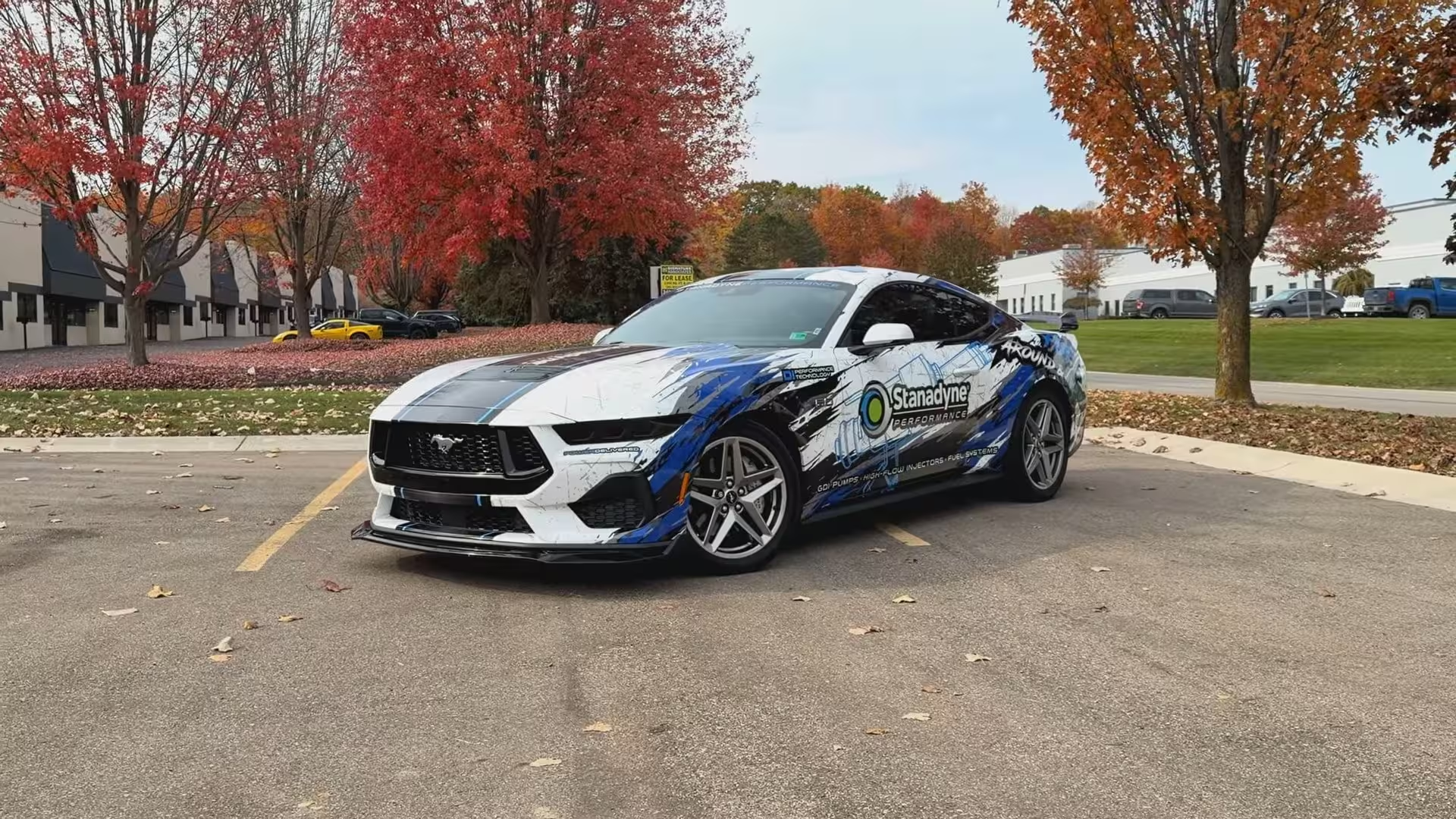
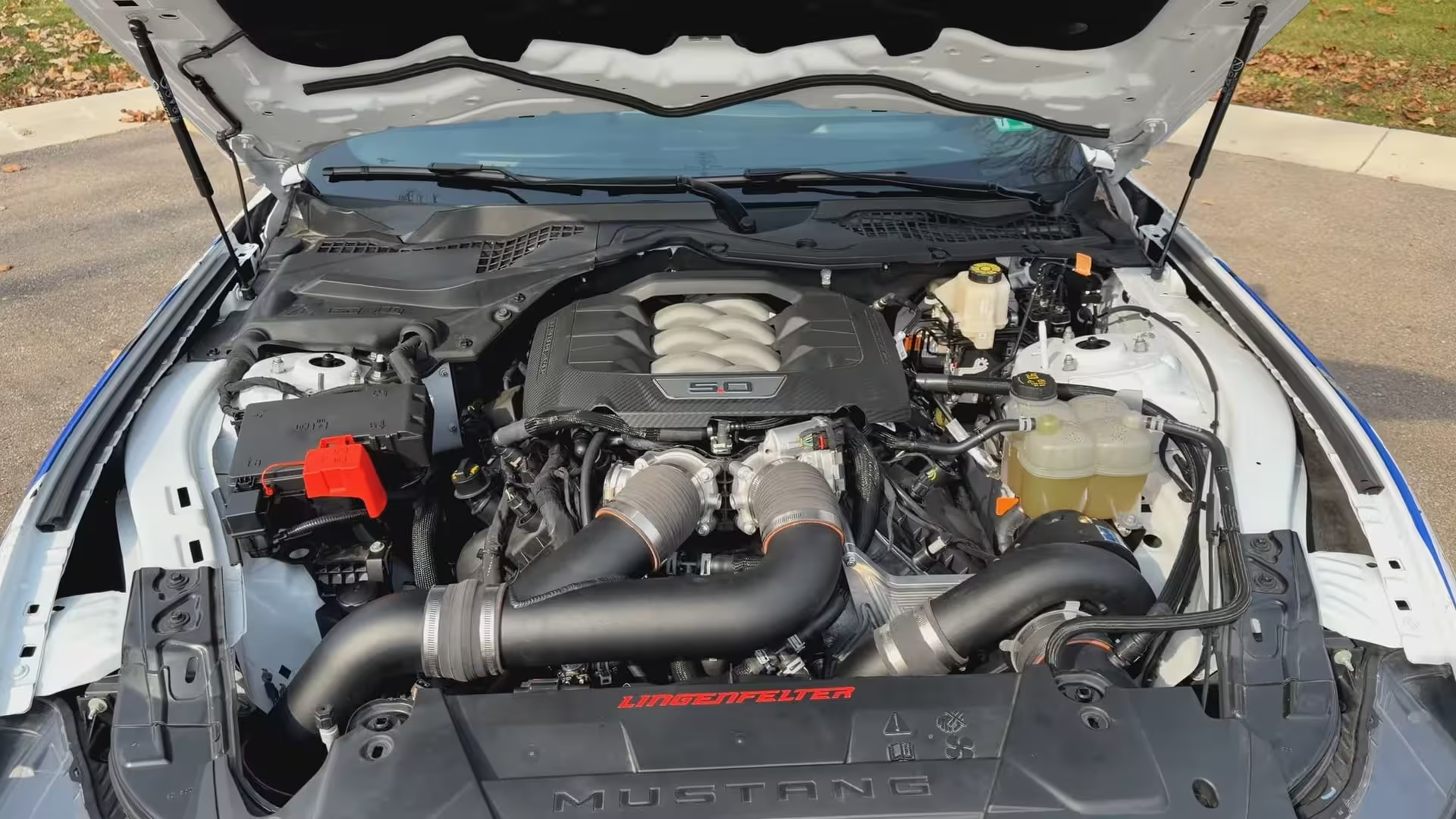
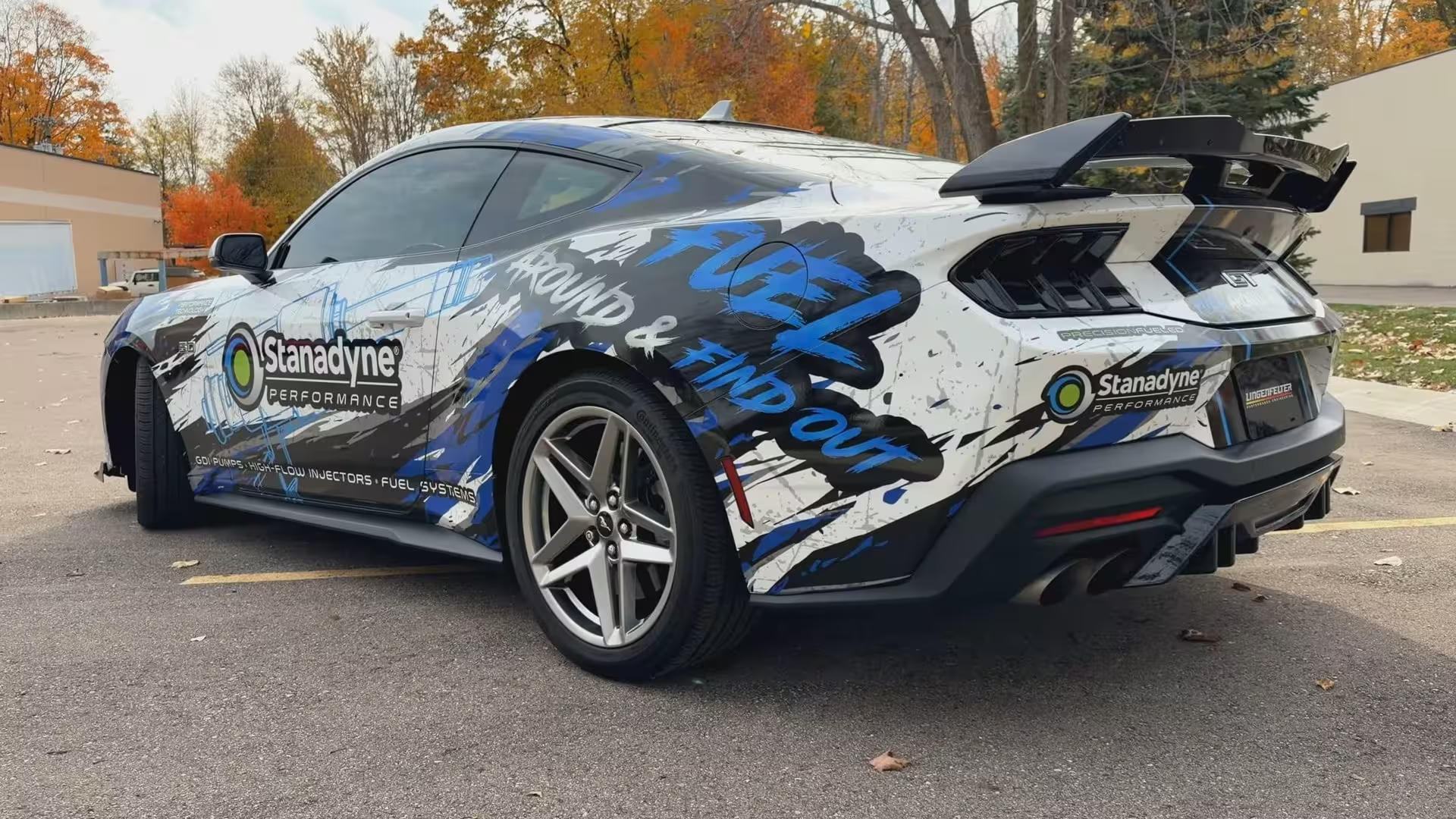
The package uses a Vortech V-3 JT-Trim centrifugal supercharger mounted on the driver side of the engine bay rather than a roots-style blower that sits on top of the intake manifold. Centrifugal units compress air via a high-speed impeller and feed pressurized air through a high-flow air filter into a gear-driven compressor. Lingenfelter routes the boosted air through a large front-mounted air-to-air intercooler behind the lower grille, then through custom mandrel-bent aluminum charge piping. The upper charge tube splits into a Y-pipe with red silicone couplers that feed both of the S650 Mustang GT's factory throttle bodies, allowing the original 5.0-liter intake manifold cover to remain in place. Visual and branding elements include red Lingenfelter lettering on the radiator shroud and a Stanadyne Performance livery on the car.
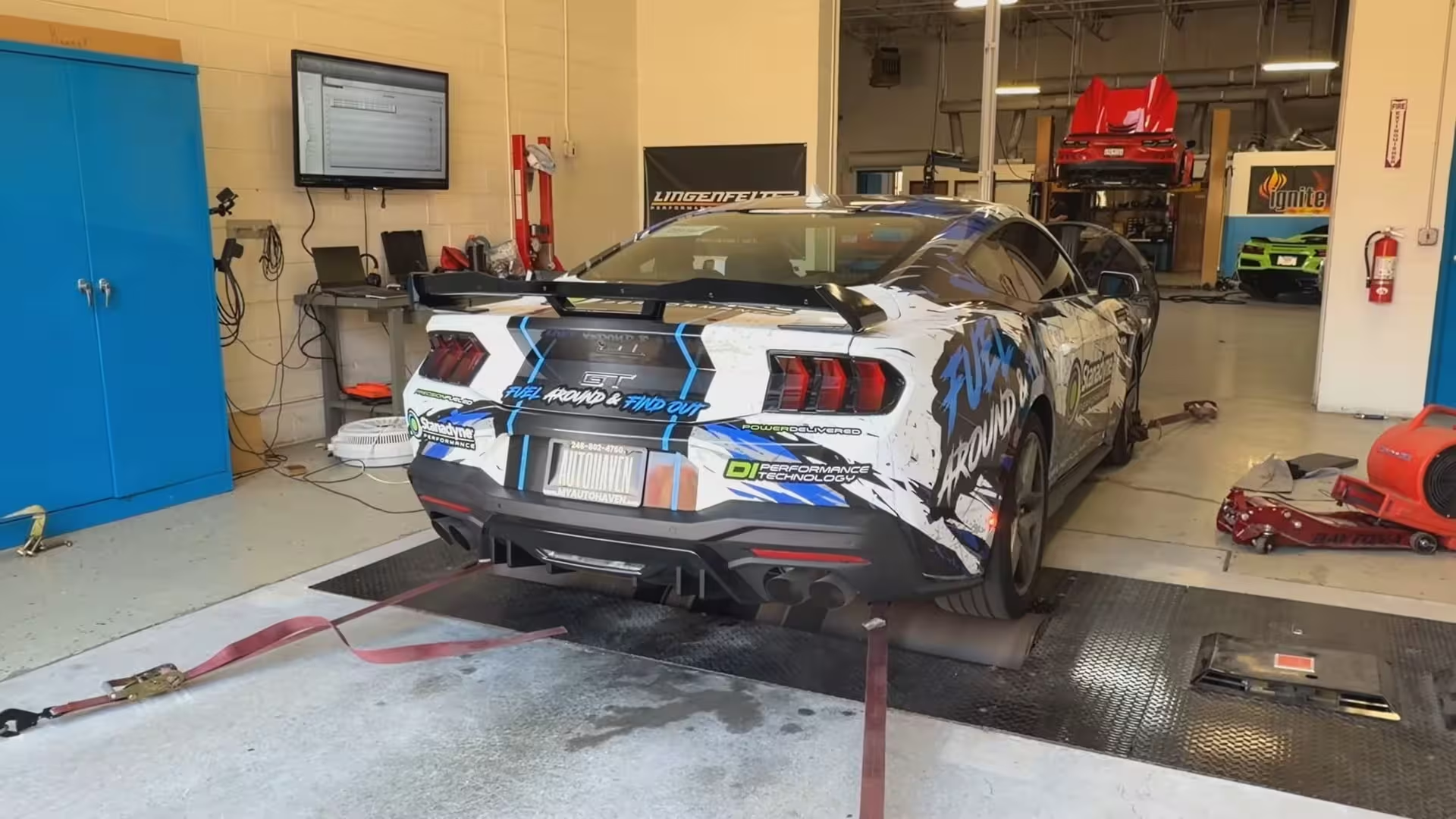
On the Dynojet chassis dynamometer the modified 5.0-liter Coyote V8 made 607 hp (615 PS) at 7,460 rpm and 442 lb-ft (600 Nm) at 7,010 rpm to the rear wheels at 10 psi of boost. Factoring a typical 15 to 18 percent driveline loss translates those rear-wheel figures to roughly 715 to 740 hp (725 to 750 PS) at the crankshaft. Lingenfelter notes that the result represents an increase of nearly 200 hp (203 PS) at the tires compared with a stock 2026 Mustang GT.

For reference, factory 2026 Mustang GT outputs are listed at 480 hp (487 PS) and 415 lb-ft (563 Nm), or 486 hp (493 PS) and 418 lb-ft (567 Nm) with the active exhaust option. Lingenfelter compared the new centrifugal package alongside other forced-induction hardware in its catalog, which already includes the $9,995 Magnuson and Roush TVS2650 kit.
The prototype highlights a technical partnership with Stanadyne. Both the Mustang and a companion C8 Corvette displayed Stanadyne's Fuel Around and Find Out livery, promoting the company's new RGX 12-millimeter (0.47-inch) direct-injection pump. Stanadyne specifies the RGX pump for up to 200-bar (2,901-psi) pressure, 8,000 rpm operation, E85 compatibility, and flow capacity supporting roughly 800 to 1,400 hp (811 to 1,419 PS) across Ford and GM V8 applications. Pairing that fuel delivery capability with the Vortech V-3 JT-Trim, which is rated for up to about 1,000 hp (1,014 PS), establishes the mechanical foundation for higher-output Lingenfelter packages in future iterations.
Lingenfelter announced the hardware and dyno validation at SEMA but has so far listed only the demonstration car and the promise of multiple forthcoming Mustang packages. MacEwen specifically referenced plural Lingenfelter Mustang packages, consistent with the company's history of offering tiered builds that expand initial forced-induction kits with exhaust, suspension, and badging options.

Founded in 1973 in Decatur, Indiana by the late NHRA racer John Lingenfelter, the firm built a reputation within General Motors communities for high-performance engineering. Under owner Ken Lingenfelter the company now operates out of Brighton and Wixom, Michigan. Notable past Lingenfelter projects include supercharged and twin-turbo Corvettes and Camaros, a 2001 twin-turbo 7.0-liter (427-cubic-inch) C5 that put 800 hp (811 PS) to the rear wheels and was tested at 0 to 60 mph in 1.97 seconds by a magazine, and a modified 6.5-liter (396-cubic-inch) Chevrolet Tahoe that ran a 13.8-second quarter mile at 96 mph (154 kph). With Chevrolet having ended Camaro production after 2024, Lingenfelter has expanded its work to include the Mustang platform.

Leave a Comment
Comments
No comments yet. Be the first.