
Zcash has activated the NU7 network upgrade at block 3,543,405, cutting the target block interval from 75 seconds to 25 seconds. The upgrade brings faster confirmations, new limits for shielded transactions, and a fee-reservation mechanism that earmarks 60% of transaction fees for future miner rewards. The change also disables the Sprout privacy transaction format, leaving roughly 12,224 ZEC locked under current consensus rules.
Key changes introduced by NU7
- Activation height: block 3,543,405 (approx. Nov 6 at 02:34 UTC).
- Block interval: target reduced from 75s to 25s.
- Miner fee split: miners receive 40% of transaction fees; 60% is reserved in the Network Sustainability Mechanism for future mining rewards (around Feb 2031).
- Shielded transaction limits: new caps to reduce wallet scanning workload and daily download requirements.
- Sprout disabled: legacy version 4 transactions are retired, rendering funds in that pool unspendable under current rules (approx. 12,224 ZEC).
What the block time reduction means
NU7’s primary performance change is the threefold reduction in the target block interval. In practical terms, this should shorten confirmation times for many on-chain payments and increase aggregate throughput. Zcash’s technical notes estimate Orchard transaction capacity climbing from roughly 2.9 to about 6.6 transactions per second under the new cadence.
However, the network requires time to adapt. In the first hours after activation, blocks averaged closer to 39 seconds as mining difficulty adjusted toward the new target. Node operators were warned in October to upgrade client software ahead of activation so their nodes would follow the new consensus rules.

The protocol preserves the existing daily ZEC issuance. To keep the schedule intact despite faster block production, the per-block reward is reduced; NU7 does not inflate supply even though blocks will be produced more frequently.
Throughput and user experience
End users and custodial services should see lower latency for confirmations, but actual waiting times remain dependent on conditions such as network hash rate, mempool state, and the number of confirmations required by wallets, exchanges or merchants. Faster blocks also mean faster reorganizations in rare events, which can affect how services validate incoming deposits.
Fees, sustainability and miner economics
NU7 revamps how transaction fees are allocated. Miners will now receive 40% of fees while 60% flows into the Network Sustainability Mechanism, a reserve intended to bolster future mining rewards rather than permanently burning value. That pool is planned to be used to supplement rewards starting around February 2031.
Maintaining the 21 million ZEC cap, this design aims to strike a balance between present miner incentives and long-term network sustainability. The change can shift short-term fee economics for miners, while potentially smoothing issuance for future reward schedules.
What miners should consider
Miners will need to reassess fee expectations and block production revenue models. Since the daily issuance is unchanged but distributed across more blocks, individual block rewards decline, and the 60/40 fee split reduces miners’ immediate fee take. Mining pools and solo miners should update profitability models and plan for the transitional period while the network difficulty recalibrates.
Shielded transactions and Sprout retirement
NU7 introduces limits on shielded activity to reduce the load that wallets must handle when scanning the chain. Developers estimate that the worst-case daily wallet download requirement falls from about 271 MB to 169 MB, improving sync times and lowering resource demands for light clients.
The upgrade also disables version 4 (Sprout) transactions, which effectively freezes funds still held in the original privacy pool. Roughly 12,224 ZEC — about $15.3 million at the reported market price — remain in that pool and are not spendable under the current consensus rules.
Zcash co-founder Sean Bowe previously explained that disabling Sprout prevents further spending from the legacy pool. He flagged the possibility of a future recovery mechanism, but no recovery proposal has been approved by consensus at this time. The retirement of Sprout is a modernization step, but it raises questions about user confidence and the handling of legacy balances.
Security and node upgrades

Prior to activation, the supporting software release included several security fixes for Zebra and other client implementations. Network operators were instructed to upgrade to remain compatible with the new consensus rules. Nodes that did not upgrade risked being left on the pre-NU7 chain and out of sync with the network.
Market reaction: price and technical outlook
Despite the protocol improvements, ZEC faced selling pressure alongside the broader crypto market. Following NU7 activation, Zcash traded near $1,250 after a roughly 6% decline in 24 hours, with reported 24-hour volume around $1.33 billion.
Crypto.news market data recorded a 24-hour trading range from $1,217.35 to $1,330.22. ZEC’s seven-day performance was relatively flat (down around 0.78%), and the token had fallen roughly 4.94% over the prior month. Technical indicators point to consolidation after a retreat from late-September peaks near $1,650.
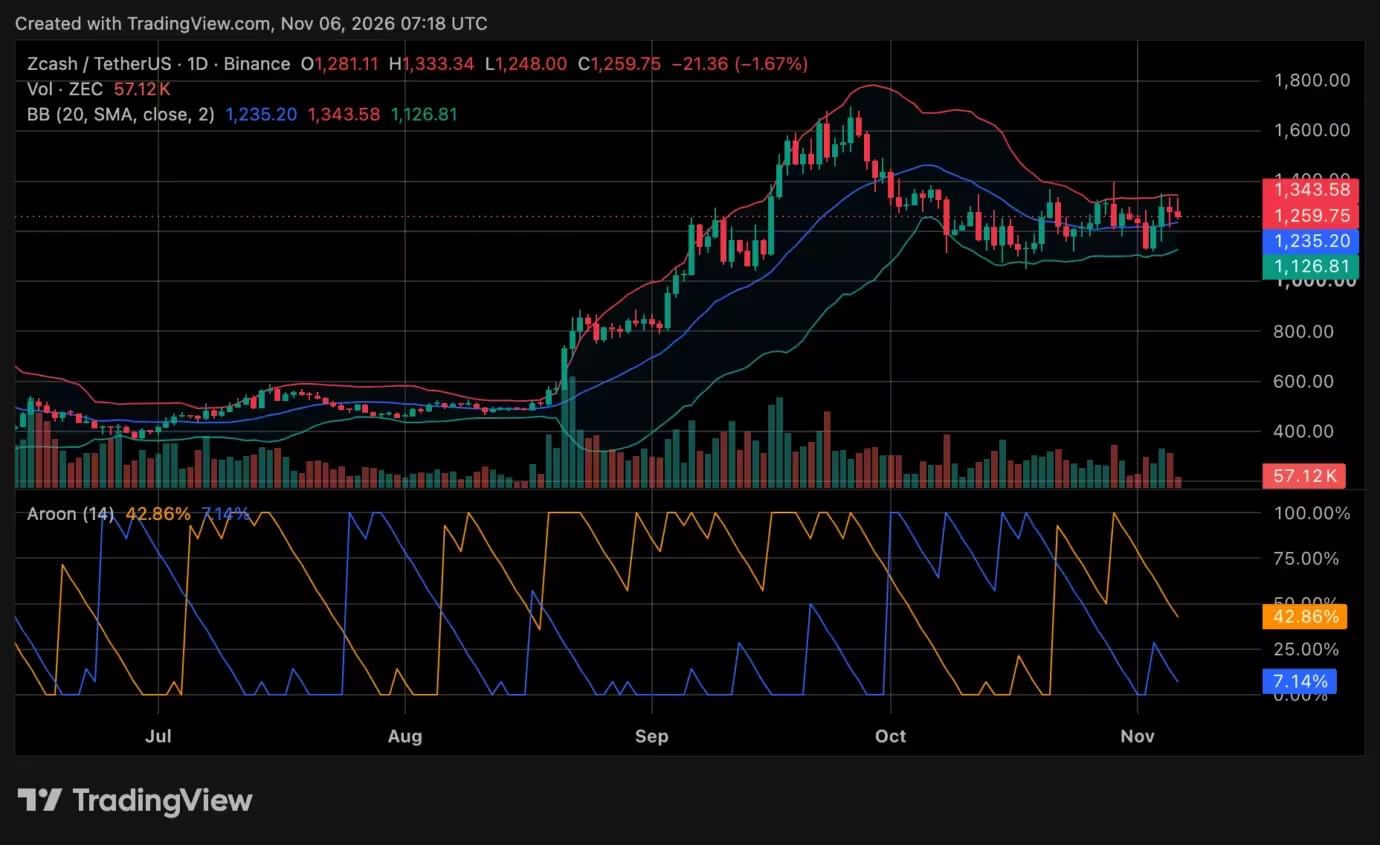
Zcash (ZEC) price chart
Bollinger Bands place the middle band near $1,235.20, providing immediate support. The upper band at $1,343.58 marks the first resistance zone, while the lower band around $1,126.81 identifies a potential downside target if selling pressure increases. The Aroon oscillator shows Aroon Up at 7.14% and Aroon Down at 42.86%, signaling that recent downward momentum has been stronger and that the market lacks a clear bullish trend.
Analysts offered mixed views: some argue the update preserves an ascending channel structure on charts, while others highlighted the Sprout funds as a reputational concern that could affect confidence among legacy holders. A sustained move above $1,343.58 would shift focus to a recovery attempt, whereas a break below $1,235.20 could expose ZEC to further selling toward the $1,126.81 area.
What users, exchanges and developers should do now
- Node operators: ensure you are running NU7-compatible software to follow the upgraded consensus and receive the correct chain history.
- Wallet providers and custodians: confirm shielded transaction limits and update client scanning logic to reduce sync burden.
- Miners: revise fee and reward models to account for the 60/40 fee split and the reduced per-block reward.
- Holders of legacy Sprout funds: monitor community governance and recovery proposals closely; no recovery has been approved at present.
Conclusion
NU7 is a significant modernization step for Zcash: it accelerates block production, reins in shielded-wallet resource requirements, and sets aside transaction fees to support future rewards without altering the 21 million ZEC cap. While these protocol improvements should enhance usability and long-term sustainability, short-term market reaction has been muted, with ZEC trading under pressure. The disabled Sprout pool remains a contentious point for some community members, and miners, operators and service providers must adapt their systems and expectations during the transition.
As the network difficulty stabilizes and node software adoption completes, the real-world effects on confirmation times, fees and on-chain capacity will become clearer. For now, NU7 lays the groundwork for faster, more scalable Zcash operations while raising important governance and user-protection questions about legacy privacy pools.

Leave a Comment
Comments (1)
Wait 12,224 ZEC frozen? and 60% of fees reserved till 2031? Sounds risky. Is there any real recovery plan or just hope?