
An engineering sample of AMD's Zen 6-based Medusa Point has appeared in Geekbench 7, showing a single-core advantage over the Ryzen 9 9950X3D and competitive multi-core performance against several desktop and AI-focused chips.
Geekbench 7 results and comparisons
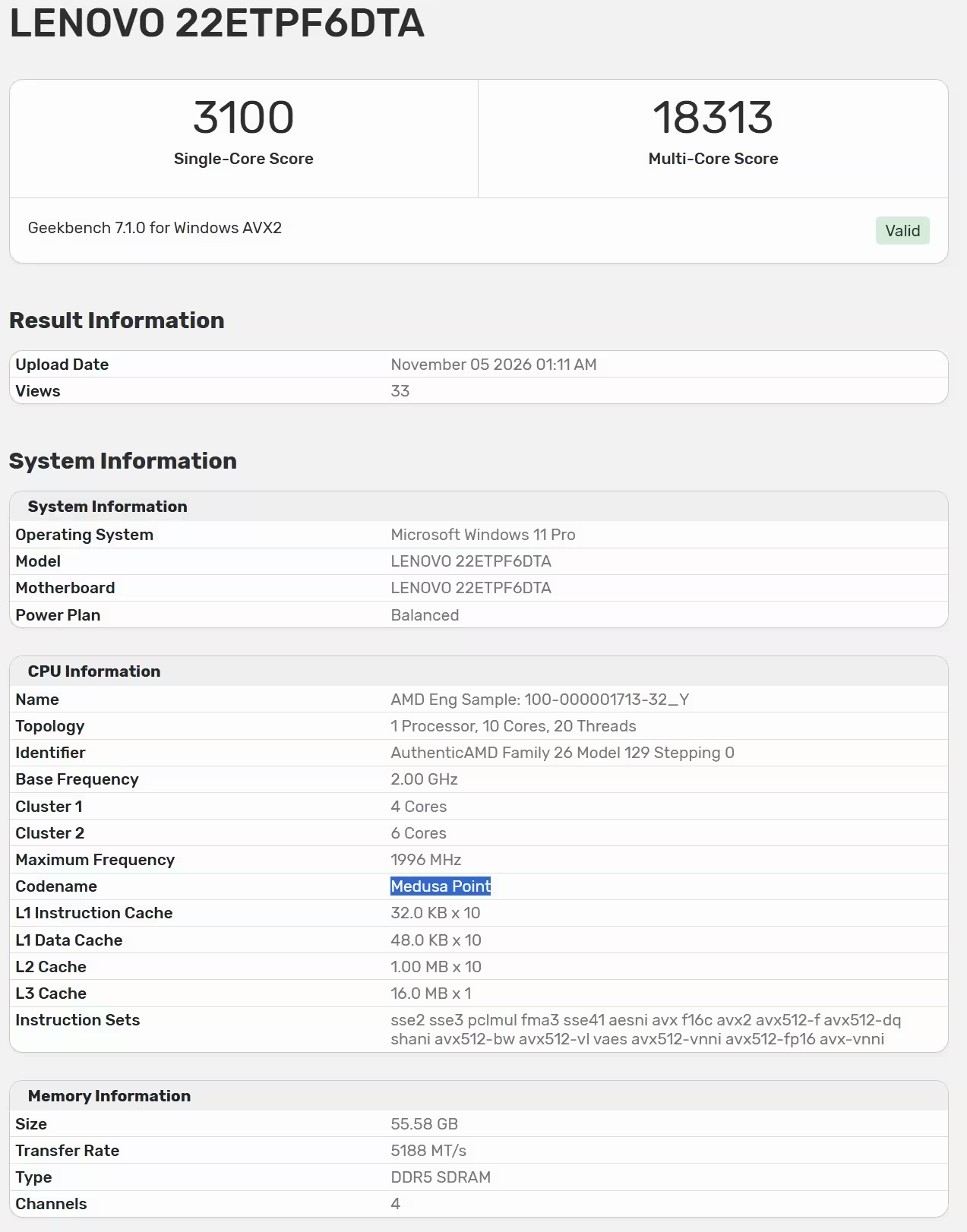
- The engineering sample recorded a single-core score of 3,100 and a multi-core score of 18,313 in Geekbench 7.
- Its single-core score is about 1.6% higher than the reported average 3,051 score for the Ryzen 9 9950X3D, and it also exceeds the Ryzen 9 9950X (3,069) and Ryzen 9 9900X (3,023) while remaining below the Ryzen 7 9850X3D (3,131) and Ryzen 9 9950X3D2 (3,164).
- On multi-core, the sample's 18,313 score is roughly 5.3% faster than the Ryzen AI MAX 390 average of 17,393, sits slightly below the Ryzen AI MAX PRO 390 average of 18,541, and ranks ahead of Intel’s desktop Core i9-14900 and Core i7-13700KF in the reported data.
Reported hardware configuration and vendor disclosure
The benchmark entry lists the chip as 100-000001713-32_Y running on a Lenovo test platform. The sample is reported as a 10-core, 20-thread design arranged in two clusters of four and six cores and is recorded with 16 megabytes of L3 cache.
AMD has not confirmed final specifications, official clock frequencies, or a release date for the Zen 6-based processors.


"Hi, I’m Julia — passionate about all things tech. From emerging startups to the latest AI tools, I love exploring the digital world and sharing the highlights with you."
Leave a Comment
Comments
No comments yet. Be the first.