
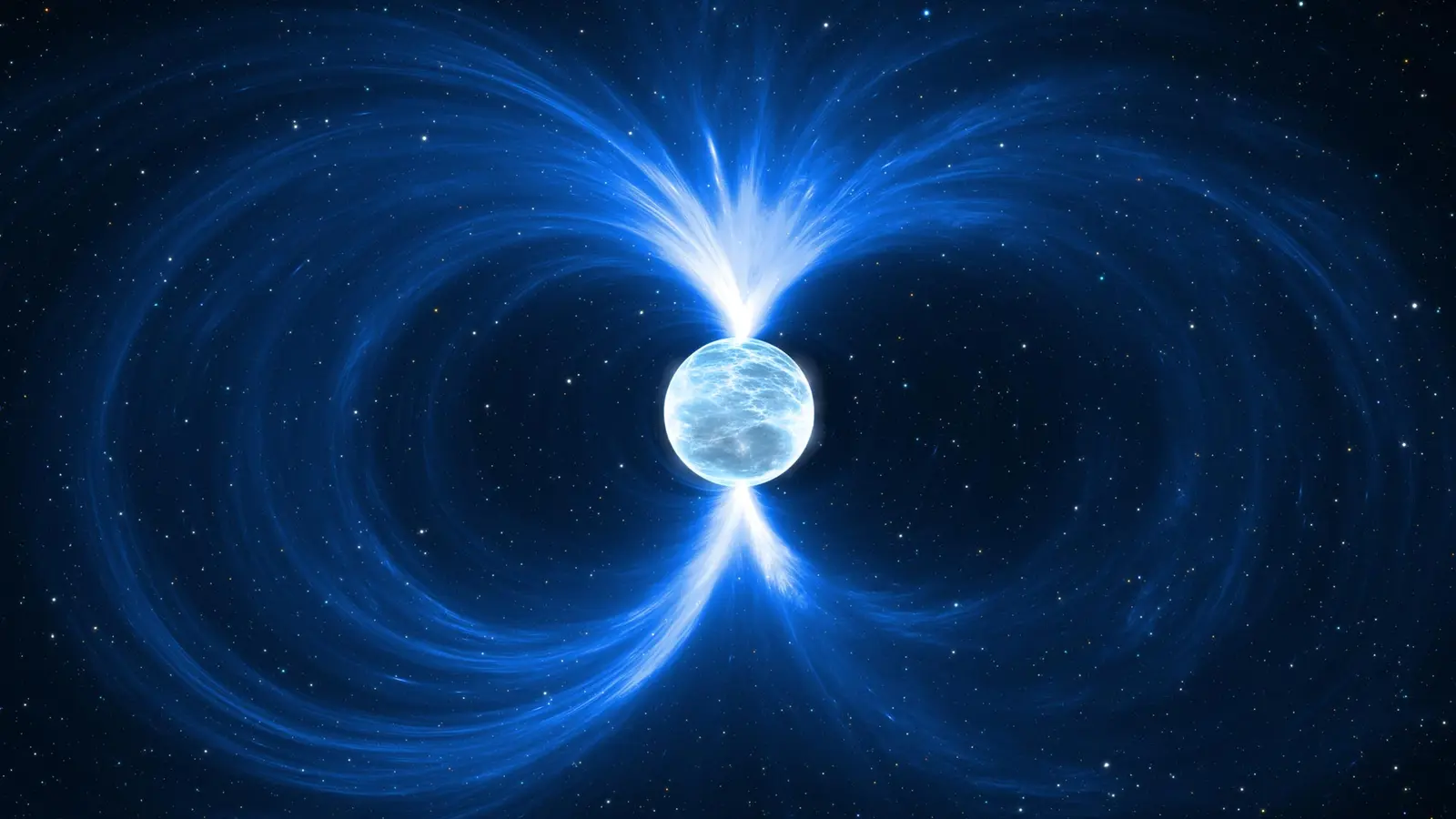
They slam together in a blink — denser than an atomic nucleus, colder than a furnace, and impossibly loud in gravity. Two neutron stars collide and, for a few wild milliseconds, physics is pushed to the brink. What happens next is not always a black hole; sometimes the wreckage becomes something stranger: a magnetar.
Using Japan’s FUGAKU supercomputer, researchers recreated such a crash in painstaking detail. The simulated stars each held 1.35 solar masses. The calculation resolved structures down to 6.25 meters, small enough to catch the turbulent eddies that ordinary simulations wash away. The input magnetic field began around 3.16 trillion gauss — on par with the strongest binary pulsars. Then the turbulence took over.
When the stars touch, shear between layers tears the flow apart. That triggers the Kelvin–Helmholtz instability, a fluid tantrum that stretches and folds magnetic field lines like dough. On sub-meter scales the field explodes in strength, and within milliseconds that chaos cascades upward to affect the whole remnant. Parts of the merged object briefly spike to about 10 quadrillion gauss, while the average stellar-scale field climbs to roughly one quadrillion gauss in about five milliseconds.
In plain terms: a magnetar is born. The team quantifies the amplification: turbulence boosts the stellar-scale magnetic field by at least a factor of 316, and the simulation reaches an electromagnetic saturation energy near 10^50 ergs within roughly 3 ms after merger. Short. Intense. Cataclysmic.
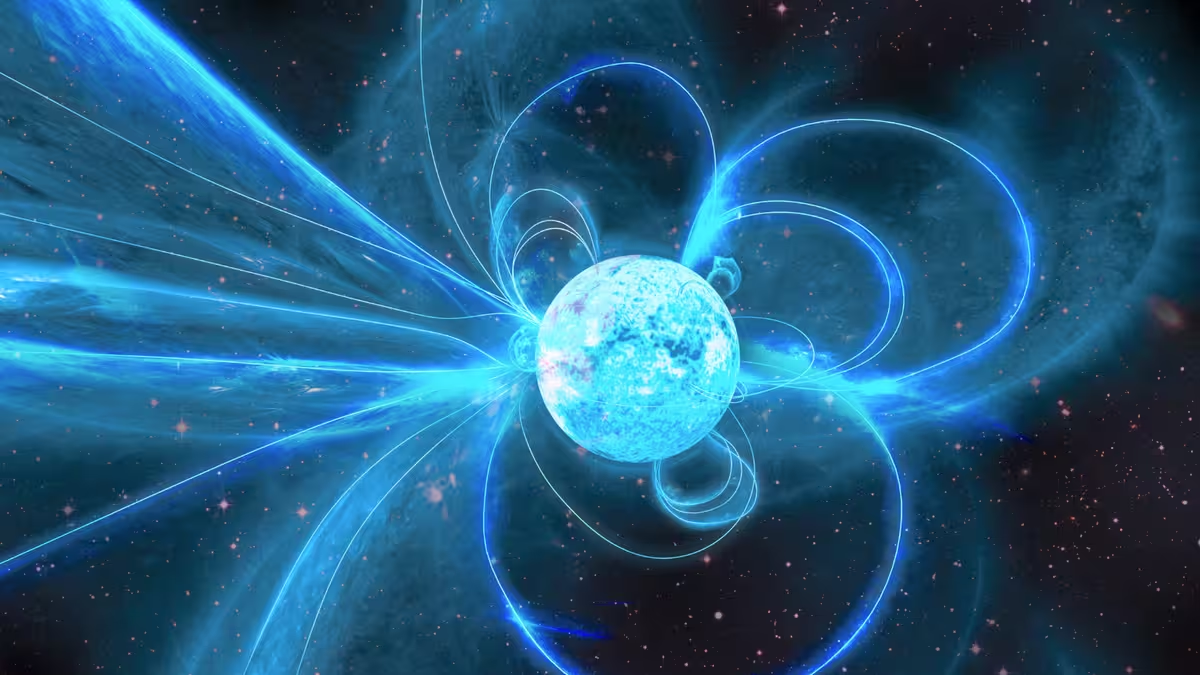
Why does this matter? Magnetars are the heavyweights of magnetism — their fields dwarf ordinary neutron stars by a thousandfold and eclipse Earth’s field by trillions. They power dramatic high-energy flares, and they are candidates for at least some fast radio bursts. Showing that a merger can manufacture such a field on millisecond timescales ties violent binary collisions to some of the most explosive phenomena we see across the sky.
But the story has caveats. Turbulence and microphysical dissipation at the smallest scales remain uncertain. If the simulation’s extrapolations are generous, the stellar-scale field might be overestimated by an order of magnitude — yet even then you still end up with fields around 100 trillion gauss, comfortably in magnetar territory. Another wrinkle: the amplified field in the run stayed concentrated around the equator, not neatly arranged along the poles where it would help launch relativistic jets. Additional processes, like the magnetorotational instability, may be needed to reconfigure the field for jet formation.
These calculations cover only the opening act. The simulation captures the birth throes, not the long life story. Will the newborn magnetar survive or slump into a black hole minutes, hours, or days later? Can those enormous fields drive the gamma-ray and radio fireworks we observe? Longer, more detailed runs — and complementary observations — will be required to answer these questions.
The result is nevertheless striking: under plausible conditions, magnetar-strength fields can grow from binary chaos in less than a blink of an eye. If true, some of the universe’s most magnetic objects owe their existence to a brief, furious ballet of gravity and turbulence — a cosmic forge that lights up the sky and leaves lingering mysteries for observers to chase.

Leave a Comment
Comments
No comments yet. Be the first.