
Imagine a routine blood test revealing more than a tired hormone: it flags a future health threat. That is the unsettling takeaway from a new analysis of long-running studies involving more than 26,000 men across Australia, the United States and Europe.
The review, published in Lancet Healthy Longevity, pooled data measured with mass spectrometry — a more precise way to read hormone levels — and compared men in the lowest fifth of hormone concentrations with those in the highest fifth.
The headline figure is clear. Men in the lowest testosterone quintile had an 18% higher relative risk of dying from cancer than men in the highest quintile, even after adjusting for age and other health factors. Risk began to climb when baseline testosterone fell below roughly 8.6 nmol/L.
Other androgens mattered, too. Men with the lowest dihydrotestosterone (DHT) showed about a 21% greater relative risk of cancer death. Low sex hormone‑binding globulin (SHBG) was tied to a roughly 28% higher relative risk of prostate cancer. And the smallest luteinizing hormone levels correlated with an approximately 45% higher relative risk on similar measures. SHBG ferries testosterone through the bloodstream and affects how much free hormone is available; luteinizing hormone is the pituitary signal that tells testes to make testosterone.
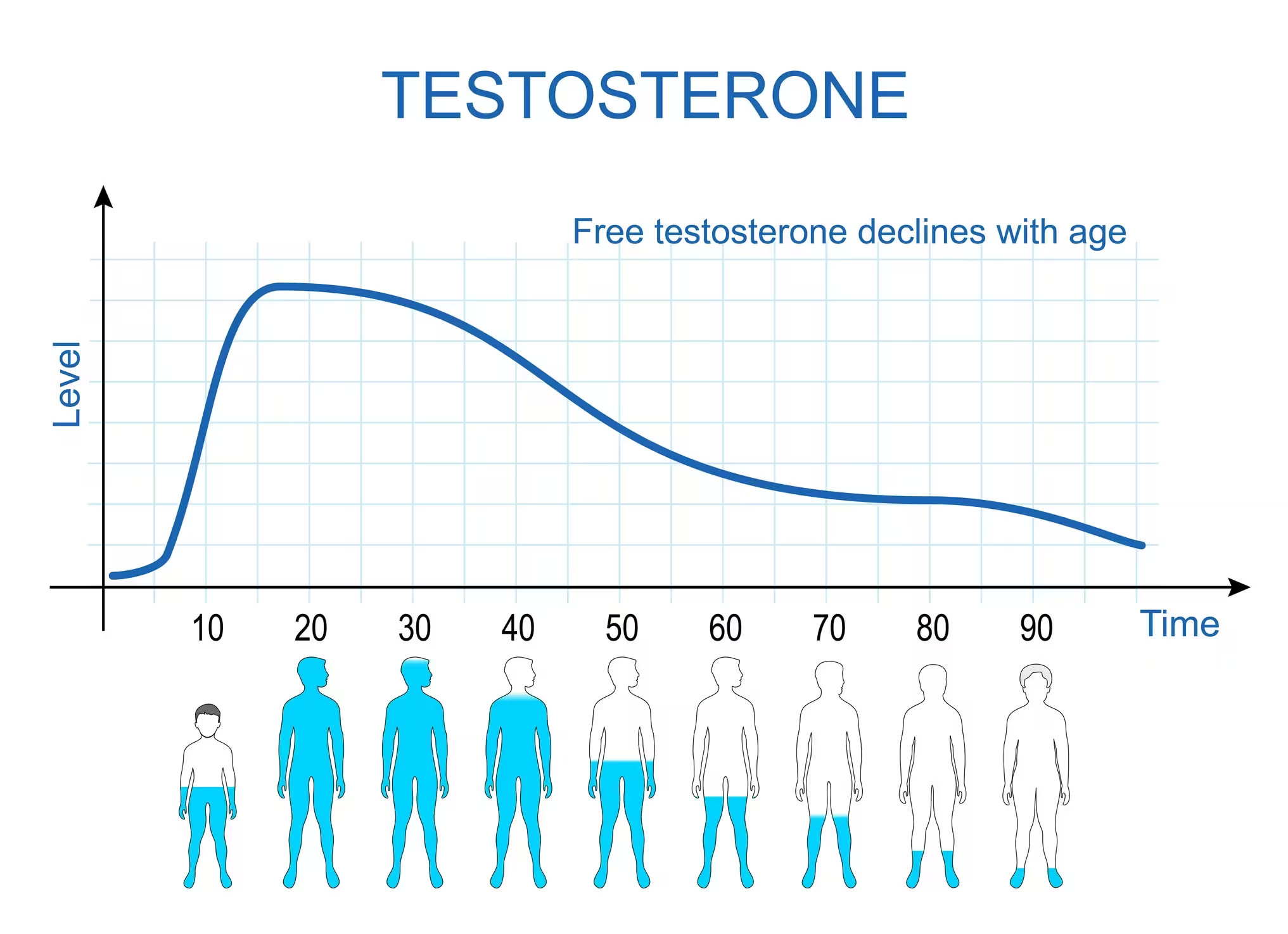
A rough indication of how testosterone levels decline with age in men.
Perhaps the most counterintuitive note: measured testosterone itself was not linked to a higher prostate cancer incidence. That fact matters because lowering testosterone is a standard prostate cancer treatment; if naturally lower testosterone increased risk, that would be paradoxical. The researchers saw no evidence of such a relationship.
So what does this mean in plain language? The team’s senior author, endocrinologist Bu Yeap, and colleagues suggest low testosterone may act more as a biomarker — a warning light — for underlying ill health, rather than a direct cause of cancer. Randomized trials add nuance: a large 2023 trial that followed more than 5,000 men found testosterone replacement therapy did not significantly change prostate cancer risk, underscoring that boosting levels is not yet proven to lower cancer deaths.
Low testosterone looks more like a red flag for poor health than a proven culprit in cancer — treating numbers is not the same as treating risk.
Clinical takeaway? If a blood test shows you have low testosterone, it is sensible to follow up. A full medical review can reveal metabolic problems, cardiovascular risk, or other conditions that might be driving hormone changes and raising long‑term risk.
This study tightens the link between hormone measurements and later cancer outcomes, but it also raises a practical question: should clinicians use hormone panels as a routine early‑warning system, or wait for trials that test whether intervening on hormone levels changes the course of disease? The next steps will determine whether these numbers become tools for prevention — or remain useful clues pointing toward other health problems.


Leave a Comment
Comments
No comments yet. Be the first.