
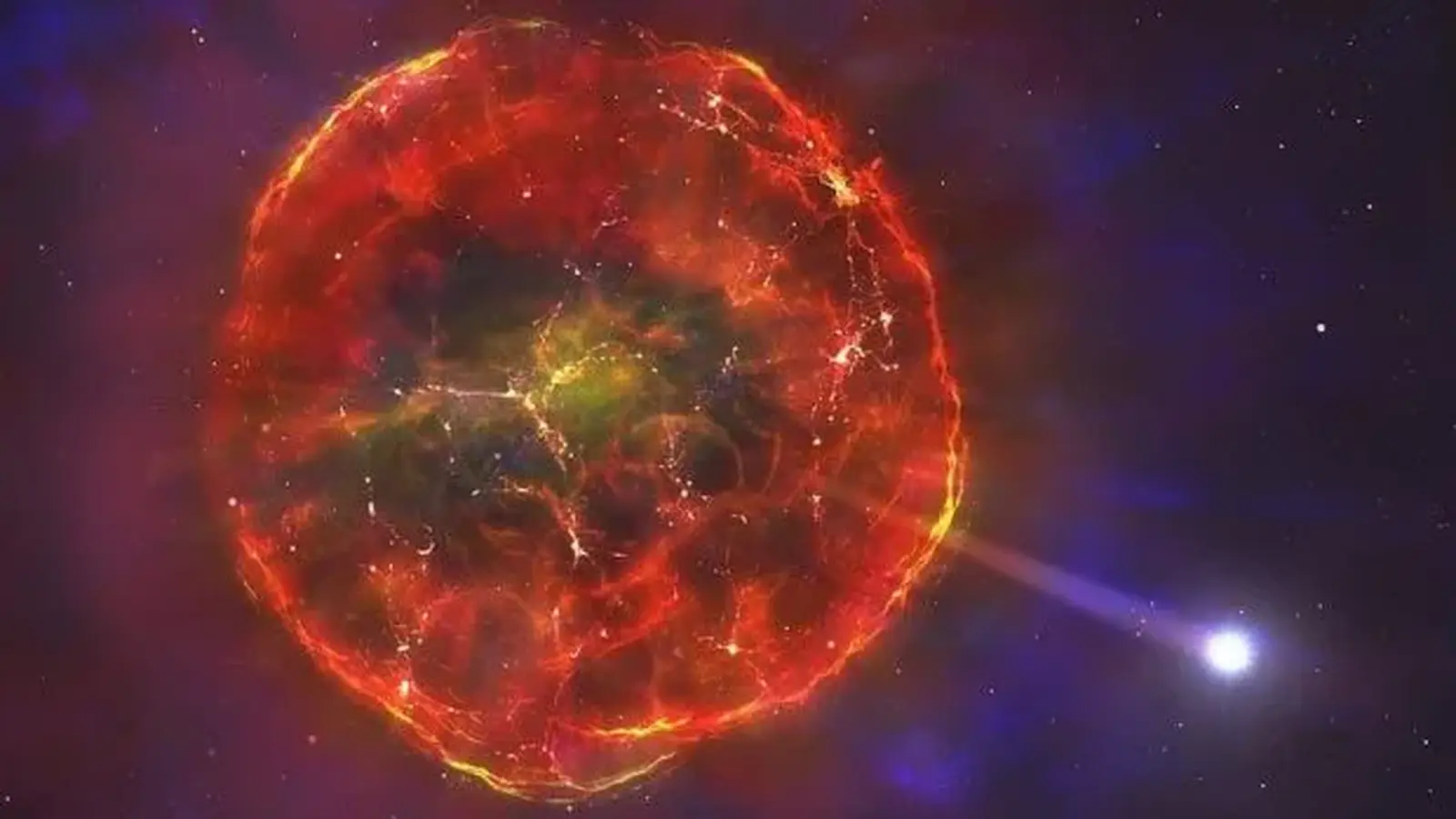
Picture this: one burst of light over the South Atlantic and, within weeks, the globe’s low-orbit communications and weather networks stutter into silence. It sounds like science fiction. It isn’t.
Researchers at the University of Wisconsin–Madison and Princeton used detailed simulations to replay a worst-case scenario: a one-megaton nuclear detonation at roughly 500 kilometers altitude above the South Atlantic Anomaly, the patch of Earth where the magnetic field is unusually weak. That weakness matters. Charged, radioactive particles produced by the blast get trapped in Earth’s magnetic field and form an artificial radiation belt—an invisible minefield that satellites must pass through repeatedly.
Why does that matter so much today? Because there are far more fragile electronics in low Earth orbit than there were in 1962 when the U.S. tested the 1.4‑megaton Starfish Prime weapon at about 400 km. Starfish Prime already damaged several satellites and helped push the U.S. and Soviet Union toward a partial test ban, but modern constellations—numbering in the tens of thousands of active and auxiliary spacecraft—are far more densely packed and more dependent on delicate microelectronics.
The new simulations tracked roughly 13,300 active low-Earth-orbit satellites. The timing is stark: about 25 percent fail within a day; by day three nearly 78 percent are out of service; a week in, 98 percent are dead; and by day 15 roughly 99.4 percent have stopped working. Even designing spacecraft with hardened shielding only blunts the curve slightly—under the same scenario, simulations still show about 99.3 percent failure within 30 days. Scale the warhead down to 100 kilotons and the timeline stretches, but does not eliminate the damage: roughly a year to produce comparable losses.

Radiation is only part of the hazard. When satellites lose power or attitude control, they become collision risks. The research team estimates on the order of 20 likely collisions in the first two years after the event. Those impacts would create thousands of new fragments; their model projects around 3,900 new pieces of orbital debris a decade after the detonation from secondary collisions alone. Each new fragment raises the odds of further impacts—a destructive cascade that can make certain orbital bands effectively unusable.
Rebuilding a shattered satellite infrastructure would not be quick nor easy. Manufacturers would be forced to launch into an environment thick with high-energy particles and orbiting shrapnel. Spare parts and replacement constellations might survive launch, but operating them safely and reliably in a freshly irradiated, debris-cluttered LEO would be a far tougher engineering challenge than erecting the satellites themselves.
Stopping the placement or use of nuclear weapons in space is therefore more than a matter of diplomacy—it is critical to preserving the global communications, navigation, and observation systems that modern society depends on.
The study is currently available as a preprint on arXiv and remains under peer review. Its message is blunt: a single high-altitude nuclear explosion could disrupt global satellite services at an almost unimaginable scale, and the downstream cascade—from radiation to collisions to long-lived debris—would complicate recovery for years to come. Policymakers and space operators would be wise to treat the weaponization of space as an urgent infrastructure risk, not an abstract security debate.


Leave a Comment
Comments
No comments yet. Be the first.