


ASTER price stabilizes after 50% crash — what happened?
ASTER has swung from a rapid bull run to a severe correction, losing roughly 50% of value from its recent peak. The token is now attempting to form a base near $1.15 after dipping to $1.10 following a decisive breakdown of a key technical level. Traders and investors are watching closely to see whether bulls can halt the decline and push ASTER back above critical resistance.
Technical backdrop: double-top and neckline break
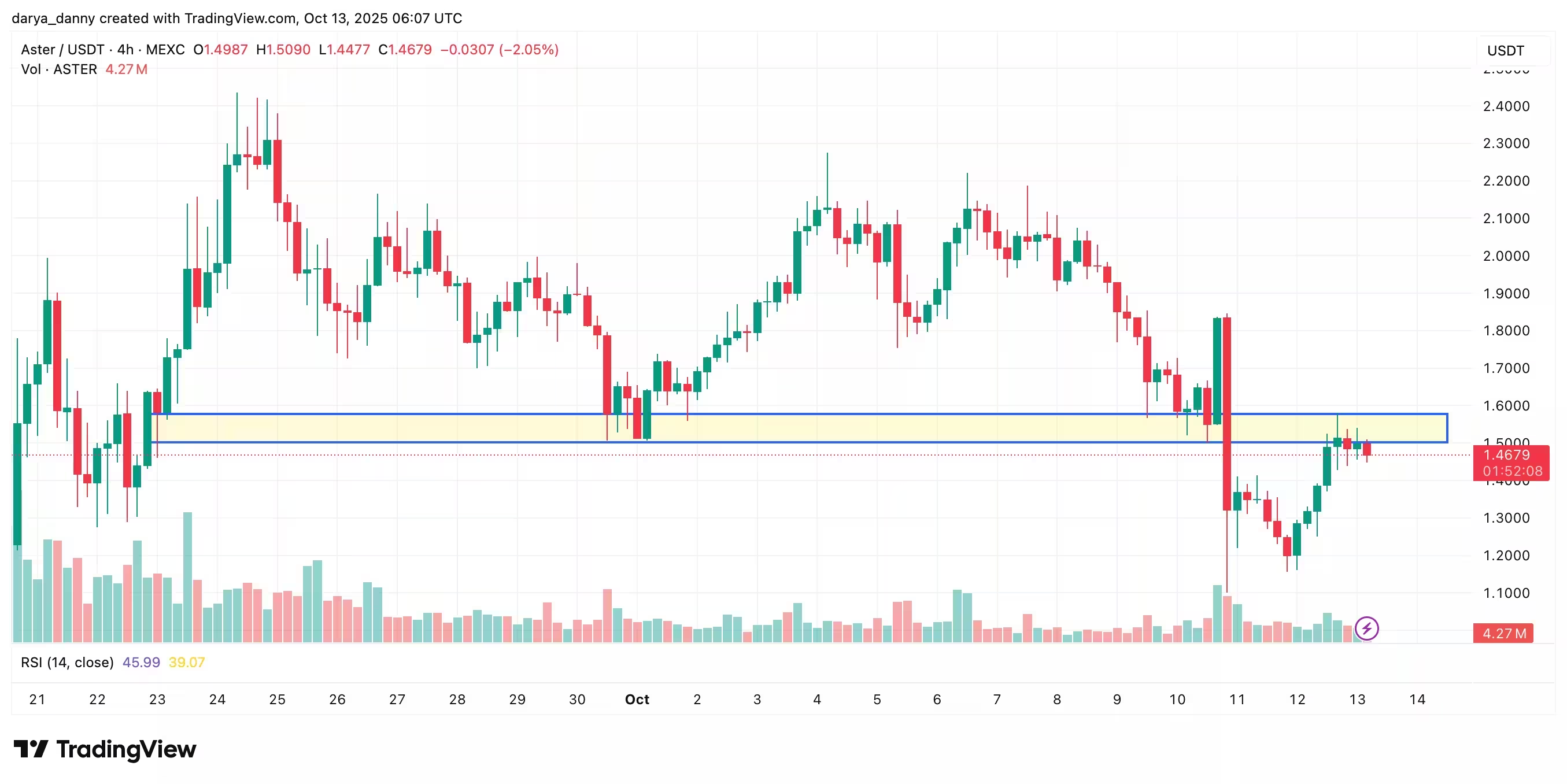
Aster (ASTER) price has recently experienced a sharp correction, plunging approximately 52% from its recent peak at $2.30. Technically, the crash was foreshadowed by the formation of a double-top pattern, as previously flagged by crypto.news.
The neckline support of the bearish pattern (around $1.50) was decisively broken on Oct. 10, triggering a wave of selling pressure that drove the token to $1.10, where buyers stepped in to scoop the dip.
Since then, Aster aster 11.26% Aster price appears to have established a new support base around $1.15 and managed to recover to $1.46 at press time, attempting to reclaim the previously broken neckline at $1.50, which now acts as the local resistance.
If bulls manage to push and close above $1.60, it could signal a potential trend reversal or at least a short-term recovery rally targeting $1.75 and $2.00. Rejection near current resistance, however, would keep bearish momentum intact and could open the door to another leg down toward $1.00–$0.70.
Key drivers behind the sell-off
The recent collapse in ASTER price was not solely technical. A cluster of fundamental and market events amplified selling pressure:

- DeFiLlama delisting: The analytics platform suspended Aster’s trading data after detecting abnormally tight volume correlations with Binance. That removal raised alarm bells about reported liquidity and trading integrity across DeFi trackers.
- Large token transfer to Binance: Over 6.1 million ASTER (roughly $12 million) moved to Binance, a transfer market participants linked to Galaxy Digital. Big transfers to centralized exchanges are often read as a prelude to selling, increasing short-term downside risk.
- Airdrop delay and data issues: Aster postponed its Phase 2 airdrop after users reported allocation inconsistencies. The team said they identified potential data problems in the allocation checker and moved the drop from Oct. 14 to Oct. 20, creating fresh uncertainty for token holders.
- Macro and geopolitical headwinds: Broader risk-off sentiment—fueled by U.S.–China tariff rhetoric and other macro shocks—pushed traders away from higher-risk crypto assets, including ASTER.
Official community update
The Aster team acknowledged allocation irregularities in a public statement:
Based on community feedback, we identified potential data inconsistencies affecting certain users' $ASTER allocation. For most users, allocations should not fall below the final snapshot RH% in each epoch.
Near-term outlook and trading plan
For traders and investors focused on ASTER and DeFi tokens, the next 48–72 hours are likely to set the short-term direction:
- Bull case: A close above $1.60 and a confirmed reclaim of $1.50 would suggest buyers are regaining control. Momentum could then target $1.75 and $2.00, supported by restoring confidence around the airdrop and data integrity.
- Bear case: Failure to reclaim the $1.50 neckline would keep the double-top pattern active, with potential support tests at $1.00 and a downside extension toward $0.70 in a prolonged sell-off.
Risk management is essential: watch on-chain signals (wallet flows, exchange deposits), DeFi analytics (volume and liquidity on DEXs), and official Aster updates about the airdrop and allocation fixes. Traders should size positions conservatively and use stop-losses given elevated volatility.
What this means for DeFi investors
ASTER’s episode highlights key vulnerabilities across DeFi tokens: reliance on third-party analytics, sensitivity to large exchange transfers, and the impact of distribution issues like delayed airdrops. For investors, diversified research—combining on-chain data, credible analytics, and community transparency—remains crucial for navigating token risk.

Overall, ASTER has formed a tentative support near $1.15. A clean break above $1.60 would be the first sign bulls are regaining control, while renewed rejection could send the token toward deeper support levels. Keep an eye on the airdrop updates, DeFiLlama listings, and exchange flows for the next directional clues.
Discussion
Leave a Comment
Comments (3)
Pretty balanced take. pattern, on-chain flows and CEX deposits all line up. Still, double top + delist = legit red flags. Watch $1.50
wow didnt expect 50% drop, brutal. If they fix the airdrop quickly maybe bounce, but man this hurts
Is this even true? Big Binance transfer plus DeFiLlama delist smells fishy... airdrop mess makes me wary, could dump more