
3 Minutes
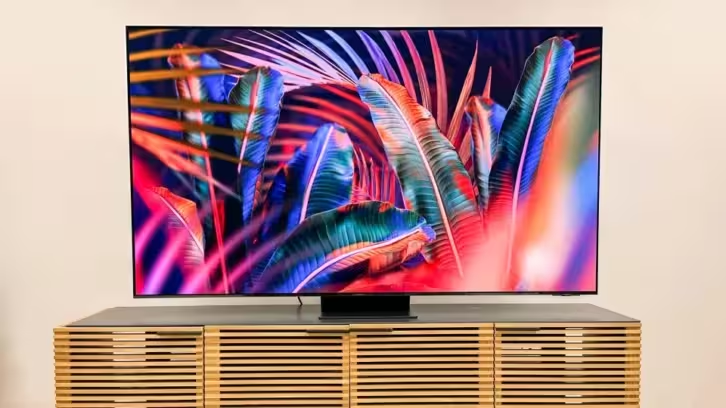
Samsung appears ready to broaden its OLED TV lineup in 2026 — not by one or two models, but by three additional SKUs. A spare-parts database lists six model codes, hinting at new sizes, mixed panel sourcing, and a wider range of price points.
Six models, not three: what the leak reveals
Since Samsung re-entered the OLED market in 2022, the range has grown slowly: one model in 2022, two in 2023, and three in both 2024 and 2025. Now the brand's internal database shows model numbers for 2026 as S82H, S83H, S85H, S90H, S95H and S99H — suggesting Samsung plans to add the S82H and S83H below the existing mid-tier and to position the S99H above the S95H as a new flagship.
Panel line-up and screen sizes: the specifics
Available details point to mixed panel sourcing. The S82H is expected to cover sizes from 48 to 77 inches, and the S83H may span 48 to 83 inches — both reportedly using LG Display's WOLED panels. The flagship S99H is listed in 55-, 65-, 77- and 83-inch variants; the 55–77-inch models are said to use Samsung Display's QD-OLED panels, while the 83-inch S99H would use LG's WOLED, similar to the S95H.
Why Samsung is mixing WOLED and QD-OLED
Combining LG's WOLED and Samsung's QD-OLED lets Samsung tailor costs and performance across the range. WOLED panels typically offer strong blacks and are cost-effective for larger inventories, while QD-OLED delivers higher peak brightness and punchier colors for enthusiasts. That split helps Samsung serve both budget-conscious buyers and those seeking top-tier picture quality.
What this means for consumers and the market
Adding entry-level and premium models expands buyer choice. A new S82H could make Samsung OLED more accessible at smaller sizes, while the S99H flagship aims at high-end buyers who prioritize peak performance. For the industry, more SKUs means stiffer competition with LG and other TV brands that supply or use OLED panels.
- More price tiers may boost OLED adoption among mainstream buyers.
- Mixed panel sourcing gives Samsung flexibility on cost and performance.
- A distinct flagship (S99H) could sharpen Samsung's claims in brightness and color against rivals.
Imagine a 48-inch Samsung OLED that pairs the company's smart TV features with more attainable pricing — that's precisely the kind of choice this expansion promises. Keep in mind these details come from a parts database leak rather than an official Samsung announcement, so specifications and model placements could still change.
Still, the early picture is clear: by expanding to six OLED models in 2026, Samsung aims to capture a broader slice of the OLED TV market with more sizes, price points, and a hybrid approach to panel technology.



.webp "Redmi 17C 5G: 6.9-inch Screen and 6,000mAh Power Lands")






Leave a Comment
Comments
No comments yet. Be the first.